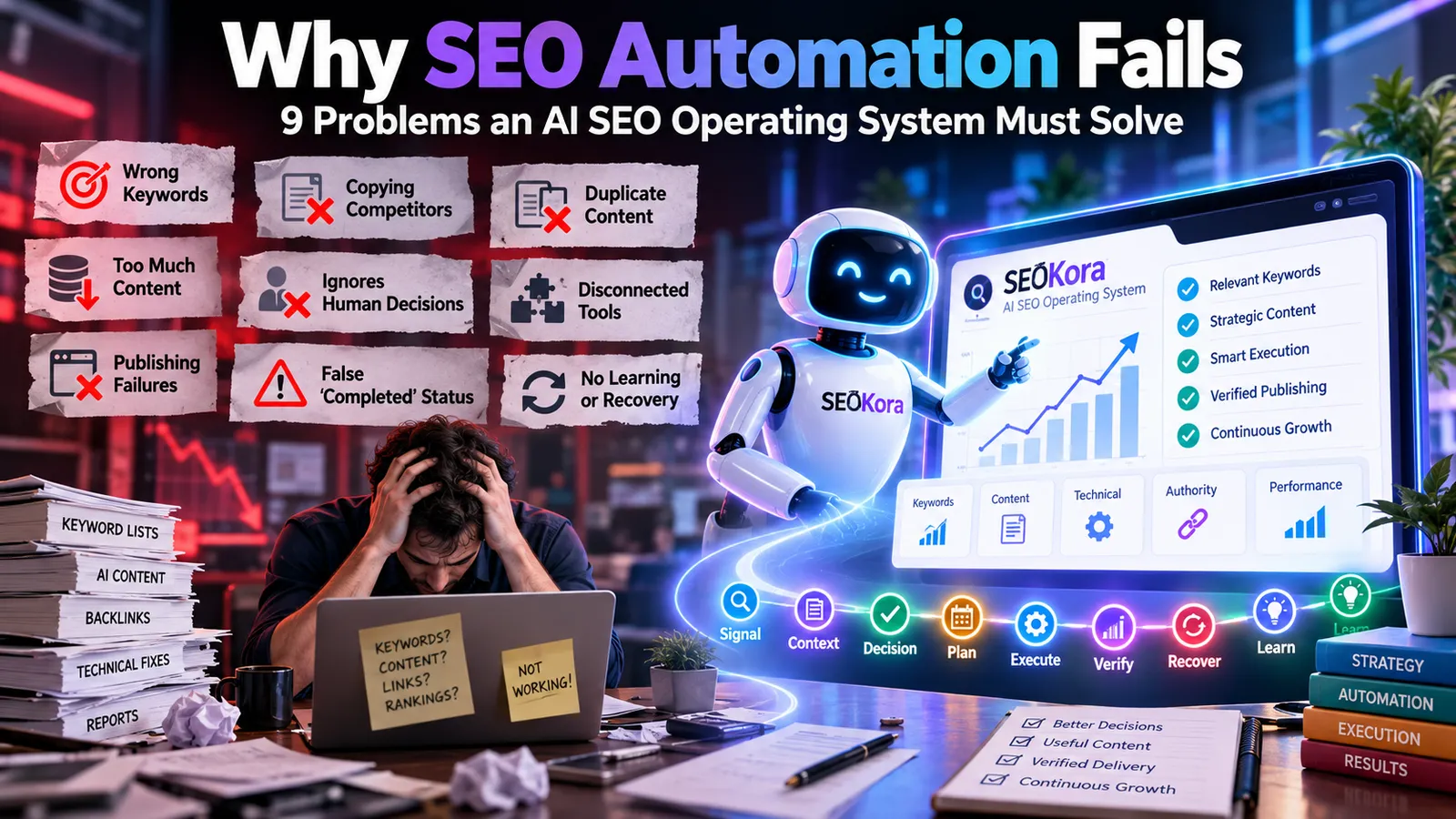
SEO Automation: What Should Be Automated, What Needs Human Review, and Why
Learn how SEO automation can handle research, monitoring, content and routine improvements while keeping human review for strategic, sensitive and high-risk decisions.

SEO has a strange problem.
There is always more work to do.
More keywords to research.
More competitors to analyze.
More pages to improve.
More technical issues to check.
More content opportunities to evaluate.
More internal links to find.
More performance data to review.
And after all of that, someone still needs to decide what actually deserves attention.
This is why SEO automation is becoming so important.
But good SEO automation does not mean giving software unlimited control of a website.
It means automating the work machines can handle reliably while keeping human judgment where context, risk, brand decisions, or uncertainty matter.
The goal is not to remove humans from SEO. The goal is to stop humans wasting time on work that software can safely handle better and faster.
What Is SEO Automation?
SEO automation means using software to perform, assist, monitor, or coordinate repetitive SEO work that would otherwise require manual effort.
That can include tasks such as:
- collecting search-performance data,
- finding keyword opportunities,
- monitoring rankings and visibility,
- analyzing competitors,
- finding content gaps,
- checking technical problems,
- identifying internal-link opportunities,
- monitoring existing pages,
- preparing content improvements,
- running quality checks,
- publishing approved work,
- and verifying whether changes actually reached the live website.
But automation should not be measured by how many tasks a system can perform.
A better question is:
Can the system perform the right work, safely, at the right time, for the right business?
The Biggest Mistake: Automating Before Understanding
Imagine giving an SEO automation system a website and telling it:
“Grow traffic.”
That sounds simple.
But the system still needs to understand:
- What does this business actually do?
- Who are its customers?
- Which countries or cities matter?
- Which languages matter?
- What products or services are most important?
- Who are the real competitors?
- What should the brand be known for?
- What type of customer action creates value?
Without that context, automation can become very efficient at doing the wrong work.
It may find keywords that have search volume but little business value.
It may create content for the wrong audience.
It may focus on competitors that do not actually matter.
Or it may improve pages that were never strategically important.
Automation should therefore begin with business understanding.
A Practical SEO Automation Framework
A responsible automation system can follow this path:
Business Context → Market Research → Opportunity Detection → Prioritization → Risk Assessment → Automation or Human Review → Execution → Quality Assurance → Live Verification → Measurement → Learning
This connects directly with our SEO Strategy FrameworkSEOKora.
Strategy decides what matters.
Automation helps make sure the work actually happens.
1. Automate Data Collection
Collecting data is one of the clearest areas for automation.
SEO teams repeatedly need information from sources such as:
- search-performance platforms,
- analytics systems,
- website crawls,
- ranking data,
- competitor research,
- content inventories,
- technical checks,
- and publishing systems.
A person should not need to manually export the same spreadsheet every morning just to discover what changed.
Software can collect, organize, compare, and prepare that information automatically.
Humans can then spend more time deciding what the information means.
2. Automate Monitoring
SEO changes constantly.
Pages gain visibility.
Pages lose visibility.
Links break.
Technical issues appear.
Competitors publish new resources.
Search demand changes.
Important pages may disappear or become inaccessible.
Monitoring these things manually is difficult.
Automation can continuously look for meaningful changes and surface the ones that deserve attention.
The important word is meaningful.
A good system should not create an emergency notification every time a metric moves slightly.
It should help separate normal variation from problems that actually require action.
3. Automate Opportunity Discovery
SEO research often involves searching through large amounts of information to find a relatively small number of useful opportunities.
Automation can help identify patterns such as:
- keywords close to stronger positions,
- topics competitors cover but the website does not,
- important pages losing visibility,
- queries landing on the wrong page,
- content that is becoming outdated,
- missing internal links,
- overlapping pages,
- technical barriers,
- authority gaps,
- and new market opportunities.
But discovery is not the same as approval.
A system may discover 500 possible keywords.
That does not mean the business needs 500 new pages.
4. Automate Research, Not Blind Decisions
Automation is excellent at expanding research.
For example, it can analyze:
- search demand,
- search intent,
- competitor coverage,
- existing site content,
- keyword relationships,
- market patterns,
- content overlap,
- and performance history.
But the result should still pass through business context.
A keyword with high search volume may still be irrelevant.
A competitor topic may not belong on your website.
A popular trend may attract the wrong audience.
Good automation reduces research work without removing strategic thinking.
5. Automate Prioritization With Clear Rules
Finding opportunities is easy compared with deciding which one should happen first.
A useful prioritization model can consider:
- business relevance,
- search demand,
- existing performance,
- customer intent,
- competitive difficulty,
- authority requirements,
- conversion potential,
- implementation effort,
- and risk.
This allows the system to move from:
“Here are 2,000 keywords.”
to:
“These are the opportunities that deserve attention first, and here is why.”
That is a much more useful form of automation.
6. Automate Content Gap Analysis Carefully
Content-gap analysis is another strong use case for automation.
A system can compare:
- existing pages,
- customer search demand,
- competitor coverage,
- search intent,
- and current performance.
It can then identify possible missing topics.
But before creating anything, it should ask:
- Does an existing page already cover this intent?
- Should that page be improved instead?
- Would a new page create cannibalization?
- Does the topic actually support the business?
- Is there enough useful information to justify a new resource?
This is why our Content Gap Analysis frameworkSEOKora uses more than keyword matching.
7. Content Creation Can Be Automated — With Quality Controls
AI can make content production much faster.
That does not mean every generated draft should be published automatically.
A strong content workflow can include:
Research → Brief → Draft → Fact & Source Checks → Brand Check → Structure Check → SEO Check → Quality Review → Publish → Verify
Automation can help at almost every stage.
But the final content still needs to be useful.
It should not:
- invent facts,
- invent statistics,
- invent customers,
- invent expertise,
- repeat generic AI language,
- copy competitors,
- or publish pages simply to satisfy a quota.
Publishing faster only helps when the content deserves to exist.
8. Automate Content Improvement, Not Just New Content
SEO automation should not become a content factory.
Many websites already have pages with:
- rankings,
- backlinks,
- history,
- traffic,
- and useful information.
Those pages may simply need improvement.
Automation can identify pages that may benefit from:
- updated information,
- better structure,
- stronger intent alignment,
- additional useful sections,
- better internal linking,
- metadata improvements,
- or clearer conversion paths.
Improving an existing asset can sometimes be more valuable than publishing another URL.
9. Automate Internal-Link Discovery
As websites grow, finding every useful internal-link opportunity manually becomes difficult.
Automation can compare page topics, entities, keywords, and website structure to identify relevant connections.
For example:
a guide about technical SEO might naturally connect to a Technical SEO AuditSEOKora.
A guide about AI search may connect to Generative Engine OptimizationSEOKora.
A local-business resource may connect to Local SEO StrategySEOKora.
But internal linking should still follow meaning.
The objective is not:
“Insert five links into every page.”
The objective is:
Connect pages when the connection genuinely helps users and search systems understand the website.
10. Technical SEO Is Well Suited to Automation
Many technical SEO checks are repetitive and measurable.
Automation can monitor:
- status codes,
- broken links,
- redirect chains,
- canonical tags,
- indexability,
- orphan pages,
- sitemaps,
- structured data,
- metadata,
- page accessibility,
- and other technical signals.
But detecting a technical problem and deciding how to fix it are different things.
A broken link may be safe to correct automatically.
Deleting hundreds of pages because software thinks they are duplicates is a very different decision.
Our Technical SEO AuditSEOKora explains why technical issues should be prioritized according to impact rather than simply counted.
11. Some Technical Fixes Can Be Automatic
Low-risk, clearly defined fixes may be suitable for automatic execution.
For example, depending on the website and its permissions, a system might safely handle certain:
- metadata corrections,
- internal-link additions,
- structured formatting improvements,
- known broken references,
- or other reversible routine changes.
But automatic execution should require:
- clear rules,
- correct permissions,
- quality checks,
- safe failure handling,
- and verification after the change.
12. High-Risk Technical Changes Need More Control
Some changes can affect large parts of a website.
Examples include:
- large redirect migrations,
- mass canonical changes,
- deleting important pages,
- changing URL structures,
- large indexation changes,
- altering major navigation systems,
- or changing critical templates.
These decisions may require human review because the cost of being wrong is much higher.
Automation should understand risk, not just capability.
13. Automate Competitor Monitoring
Competitors do not stand still.
They publish new pages.
They improve existing resources.
They gain links and mentions.
They enter new topics.
They strengthen products and offers.
Automation can monitor meaningful changes without requiring someone to manually inspect competitor websites every week.
But competitor activity should be treated as intelligence.
Not instructions.
If a competitor publishes something, that does not automatically mean you should copy it.
The question remains:
Does this matter to our customers and our strategy?
14. Automate Authority Opportunity Discovery
Authority is another area where automation can help with research.
A system can identify patterns around:
- competitor mentions,
- relevant publications,
- industry resources,
- reference-worthy topics,
- unlinked brand mentions,
- and potential authority gaps.
But authority building should not become automatic spam.
Submitting a website to hundreds of irrelevant directories or generating mass outreach is not the same as building real authority.
Our Website Authority guideSEOKora explains why relevance and genuine external validation matter more than raw volume.
15. Automate AI Visibility Monitoring Carefully
Search discovery is expanding beyond traditional search results.
Businesses increasingly want to understand how their brands, products, topics, and competitors appear across AI-powered discovery experiences.
Automation can help observe:
- brand mentions,
- entity understanding,
- topic coverage,
- competitor presence,
- source patterns,
- and changes over time.
But AI visibility should not be presented as perfectly deterministic.
Different systems can produce different responses, and results can change.
The goal is to observe patterns and improve the underlying signals the business can control.
This connects with our Generative Engine Optimization guideSEOKora.
16. Automate Publishing — But Only After the Work Is Ready
Publishing automation can save enormous amounts of time.
Once work has passed the required checks, software can potentially deliver it to the appropriate content management system.
But publication should come after validation.
A safer model is:
Research → Create → Validate → Approve Where Required → Publish → Verify Live
Not:
Generate → Publish Everything.
The difference is important.
17. Publishing Is Not the Same as Delivery
This is one of the most important ideas in SEO automation.
Imagine an internal system says:
Article published successfully.
But on the live website:
- the page does not exist,
- the HTML is broken,
- the title is missing,
- the wrong image appears,
- the page returns an error,
- or the intended update never reached production.
Was the job really completed?
No.
A stronger delivery model is:
Execute → Publish → Fetch Live → Verify → Confirm Delivery.
Automation should care about what customers actually receive, not only what an internal database says happened.
18. Automate Recovery Where It Is Safe
Automated systems sometimes fail.
An API may temporarily fail.
A website connection may time out.
A publishing request may need to be retried.
A temporary service may be unavailable.
The answer should not always be:
“Send an email to the customer.”
If the problem is safe and recoverable, the system should attempt reasonable recovery itself.
For example:
Detect → Diagnose → Retry Safely → Verify → Continue
Human attention should be reserved for situations where the system genuinely needs a decision or cannot safely continue.
19. Do Not Automate Noise
A bad automation system can create more work than it removes.
Imagine receiving notifications for:
- every keyword movement,
- every draft,
- every retry,
- every minor technical warning,
- every successful publication,
- and every small data change.
The customer eventually stops reading.
A better system handles routine activity quietly and surfaces what actually needs attention.
For example:
- a critical connection has failed,
- a high-risk action requires approval,
- important information is missing,
- or repeated automatic recovery has failed.
Good automation should reduce interruptions.
Not automate them.
20. What Should Still Involve Human Review?
Human review becomes valuable when the system encounters ambiguity, strategy, sensitivity, or meaningful risk.
Examples can include:
- major brand-positioning changes,
- uncertain market direction,
- sensitive claims,
- legal or regulated content,
- large site migrations,
- major URL changes,
- uncertain business information,
- destructive actions,
- important commercial messaging,
- or decisions where several valid strategies exist.
The human should not need to approve every routine action.
But the human should remain available when judgment genuinely adds value.
21. Human Direction Is Different From Human Micromanagement
This distinction matters.
Suppose a business owner tells the system:
“We sell primarily in Spain and the UK. Our audience is independent artists. We care about English and Spanish search demand. These are our main products. These competitors are relevant, but please also research the market independently.”
That is useful human direction.
The owner should not then need to manually approve every keyword, every internal link, every routine page improvement, and every safe publishing step.
The system should use the direction to operate intelligently within authorized boundaries.
This is the difference between:
Human-in-every-task
and:
Human-in-the-right-decisions.
22. How SEOKora Approaches SEO Automation
SEOKora is designed around a simple idea:
SEO software should not only tell you what happened. It should help move useful work forward.
Traditional SEO tools are often excellent at providing data.
They may show:
- rankings,
- keywords,
- backlinks,
- technical issues,
- competitors,
- and traffic trends.
But customers are often left with another problem:
What do I actually do with all of this?
SEOKora is built to connect intelligence with execution.
SEOKora starts by understanding the customer
Before deciding what SEO work matters, Kora needs context.
That can include:
- business type,
- products and services,
- audience,
- target markets,
- geography,
- languages,
- website structure,
- commercial priorities,
- and existing search performance.
This helps prevent a common automation failure: doing technically valid work that does not support the actual business.
SEOKora uses existing performance and independent research
Search Console and analytics can tell Kora a great deal about what is already happening.
But existing data is not the entire market.
A new website may have almost no useful search history.
An established website may be visible for the wrong topics.
A valuable opportunity may not appear in existing performance data because the website has never competed for it.
SEOKora can therefore combine existing performance with independent research into:
- search demand,
- competitors,
- market opportunities,
- content gaps,
- authority gaps,
- customer intent,
- and broader search opportunities.
This helps Kora understand both:
Where are we today?
and:
Where should we go next?
SEOKora turns research into priorities
Kora should not hand the customer an enormous list of opportunities and call the job finished.
It can evaluate opportunities using business relevance, demand, existing performance, competition, authority, intent, effort, and expected value.
The result is a prioritized direction.
Not just more data.
SEOKora can work continuously within the customer's plan
SEO is not a task that needs to be completed in one afternoon.
Work needs to happen consistently.
Depending on the customer's plan, permissions, available capacity, and configured workflows, SEOKora can coordinate ongoing work instead of trying to perform everything at once.
That may include a mix of:
- research,
- content creation,
- existing-page improvements,
- technical checks,
- internal linking,
- authority research,
- AI visibility analysis,
- and performance monitoring.
The objective is controlled progress.
Not uncontrolled volume.
SEOKora can execute authorized routine work
When a customer enables the appropriate automation and publishing permissions, routine approved work can move forward without requiring unnecessary manual intervention at every step.
That is important.
If the system already has:
- clear business direction,
- an authorized workflow,
- quality rules,
- safe execution boundaries,
- and publishing access,
then repeatedly asking the customer to approve routine low-risk work can defeat the purpose of automation.
SEOKora can instead keep humans focused on decisions where their input is genuinely needed.
SEOKora uses quality gates before delivery
Autonomy should not mean skipping quality.
Before work reaches the live website, relevant checks can validate areas such as:
- business relevance,
- content quality,
- brand correctness,
- structure,
- metadata,
- destination ownership,
- technical readiness,
- and other publication requirements.
If something does not meet the required standard, it should be corrected or stopped rather than blindly published.
SEOKora can work across supported publishing systems
Customers do not all use the same CMS.
The SEO quality standard should therefore remain consistent even when the final delivery method changes.
A useful architecture looks like:
Shared SEO Quality Rules → Publication Package → CMS Capability → CMS-Specific Delivery → Live Website → Verification
The publishing adapter may differ.
The quality expectations should not.
SEOKora verifies the result on the live website
Kora's job should not end when a publishing request receives a success response.
The stronger standard is to verify the live output.
For example:
Work Prepared → Quality Passed → Published → Live Page Checked → Delivery Verified
This helps distinguish between:
“The system attempted the job.”
and:
“The customer actually received the result.”
SEOKora tries to recover routine failures before disturbing the customer
Temporary failures are normal in connected systems.
If a safe retry can solve the problem, the system should try to solve it.
If a recoverable job can be rescheduled, it should be rescheduled.
If a connection can be rechecked automatically, it should be rechecked.
The customer should not become the error-handling system.
Only when a meaningful decision, permission, missing credential, or unresolved critical issue requires human input should the system escalate clearly.
SEOKora keeps critical human decisions visible
When human input really is required, the request should be understandable.
The customer or administrator should be able to see:
- what happened,
- why the system stopped,
- what decision is needed,
- what will happen after approval,
- and what the risk is if no action is taken.
This is much more useful than a generic:
“Need Help.”
SEOKora separates planned work from verified delivery
A future plan is not completed work.
A queued job is not completed work.
An approved draft is not completed work.
Even a publication attempt is not necessarily completed work.
SEOKora can keep these stages separate so customers can understand:
- what is planned,
- what is next,
- what is currently executing,
- what is blocked,
- and what has actually been verified on the live website.
This makes automation easier to trust because progress is based on real delivery rather than activity.
SEOKora learns from performance
Automation should not blindly repeat the same plan every month.
Once work is live, performance can feed back into the next cycle.
For example:
- Did the improved page gain visibility?
- Did the intended queries begin appearing?
- Did another page start competing with it?
- Did the content attract useful visitors?
- Did competitors change?
- Did the opportunity become more or less important?
The system can use those signals to reprioritize future work.
The loop becomes:
Understand → Research → Prioritize → Execute → Verify → Measure → Learn → Reprioritize.
23. Autopilot Should Mean Less Work for the Customer
If a customer chooses an Autopilot-style workflow, they should not need to manage an SEO team hidden inside the software.
The system should handle routine authorized work quietly.
The customer should still have visibility into what is happening.
But visibility is different from micromanagement.
A useful customer experience can show:
- what Kora is working on today,
- what is coming next,
- what has recently been delivered,
- what results are changing,
- and whether anything genuinely needs attention.
If nothing requires the customer, the system should continue working.
That is what useful automation feels like.
24. Automation Should Be Accountable
Autonomous work still needs ownership.
For every meaningful job, the system should be able to answer:
- Why was this work selected?
- Which workflow owns it?
- What stage is it in?
- Did it fail?
- Why did it fail?
- Was recovery attempted?
- What happens next?
- Was the result verified?
This creates accountability without requiring customers to understand the internal architecture.
25. SEO Automation Should Control Cost as Well as Work
Automation can use resources quickly.
AI models, crawling, research APIs, data providers, infrastructure, and publishing systems can all create costs.
A good automation platform should therefore care about efficiency.
The question is not:
“How many API calls can we make?”
The better question is:
What is the least expensive reliable path to the required result?
That can mean:
- reusing valid existing data,
- avoiding duplicate research,
- caching appropriate information,
- using lighter processes for simple tasks,
- reserving expensive analysis for work that needs it,
- and measuring cost against verified output.
Efficient automation should create more useful work from available resources, not simply consume more technology.
26. What SEO Automation Should Never Become
SEO automation should not become:
- a mass AI article generator,
- a doorway-page factory,
- a spam-link system,
- a fake-review generator,
- a keyword-stuffing engine,
- an uncontrolled website editor,
- a notification machine,
- or a dashboard full of activity that never reaches the live website.
More automation is not automatically better.
Better automation is better.
27. A Practical SEO Automation Workflow
- Understand the business. Define the customer, market, geography, languages, products, services, and goals.
- Connect reliable data. Gather existing search, analytics, website, and performance information.
- Research beyond existing data. Explore market demand, competitors, content gaps, and authority opportunities.
- Find opportunities. Detect meaningful problems and growth possibilities.
- Prioritize. Evaluate relevance, demand, business value, effort, competition, and risk.
- Classify the action. Decide whether it is safe to automate or needs human review.
- Prepare the work. Create the content, improvement, technical action, or other deliverable.
- Run quality checks. Validate the work before it reaches the website.
- Request human input only when needed. Escalate strategic, ambiguous, sensitive, or high-risk decisions.
- Execute authorized work. Deliver routine approved work through the appropriate system.
- Recover safe failures. Retry or repair temporary problems where appropriate.
- Verify live delivery. Confirm the intended result exists on the public website.
- Measure performance. Observe what changed after execution.
- Learn. Feed the evidence back into future decisions.
- Repeat. Continue the cycle according to business priorities and available resources.
SEO Automation Checklist
Frequently Asked Questions
What is SEO automation?
SEO automation uses software to perform or assist with repetitive SEO tasks such as research, monitoring, technical checks, content analysis, internal linking, publishing workflows, and performance measurement.
Can SEO be fully automated?
Many parts of SEO can be automated, but not every decision should be. Strategic, ambiguous, sensitive, destructive, or high-risk actions may still require human judgment. The strongest systems automate routine work while escalating decisions where human context genuinely matters.
Can AI automatically write and publish SEO content?
AI can assist with research and content production, and publishing can be automated where appropriate. However, content should still pass quality, factual, brand, structural, and technical checks before reaching a live website.
Should every SEO change require approval?
No. If every low-risk routine action requires manual approval, much of the benefit of automation disappears. Approval requirements should reflect permissions, uncertainty, business sensitivity, and risk.
What SEO tasks are easiest to automate?
Data collection, monitoring, reporting, opportunity discovery, website crawling, many technical checks, content analysis, and certain repeatable low-risk workflows are generally strong candidates for automation.
Which SEO tasks usually need more human judgment?
Major strategic changes, brand positioning, sensitive claims, destructive technical changes, large migrations, uncertain business decisions, and other high-risk actions often benefit from human review.
Can SEO automation damage a website?
Poorly controlled automation can create problems if it publishes low-quality content, changes important URLs, creates duplicate pages, makes incorrect technical changes, or performs actions without understanding the business. This is why permissions, quality controls, risk classification, verification, and recovery are important.
How does SEOKora automate SEO?
SEOKora connects business context, existing performance data, independent market research, competitor analysis, content opportunities, technical SEO, authority analysis, prioritization, supported execution workflows, live verification, and performance learning. The objective is to move useful SEO work from discovery toward verified delivery while keeping human input focused on decisions that genuinely require it.
What happens if an automated SEOKora task fails?
Where a failure is temporary and safe to recover, the system can attempt appropriate retry or recovery workflows. Issues that cannot be safely resolved automatically can be escalated with clearer information about what happened and what action is required.
Does SEOKora automatically publish everything it finds?
No. Discovery should not automatically equal publication. Opportunities need to pass relevance, prioritization, quality, permissions, and other applicable checks before execution.
How is SEOKora different from an SEO reporting dashboard?
A reporting dashboard primarily explains what happened. SEOKora is designed to connect that intelligence with research, prioritization, supported execution, verification, and learning so the customer can move from understanding SEO opportunities to acting on them.
Final Takeaway
SEO automation should make SEO easier to operate.
Not harder to control.
Automate the repetitive work.
Automate the monitoring.
Automate the research that machines can perform efficiently.
Automate routine execution when the rules, permissions, and quality controls are clear.
But keep humans involved where context, strategy, sensitivity, or risk demands judgment.
The goal is not:
“Automate everything.”
The better goal is:
Automate everything that can be automated responsibly — and make human attention count where it matters.
The automation cycle becomes:
Understand → Research → Prioritize → Decide → Execute → Verify → Measure → Learn → Improve.
When that cycle works, SEO stops being a collection of disconnected reports and manual tasks.
It becomes a managed growth system.
Move From SEO Reports to SEO Execution With SEOKora
Most businesses do not have a shortage of SEO data.
They have a shortage of time, prioritization, and execution.
SEOKora is designed to connect those pieces.
Kora can bring together:
- business and market context,
- search-performance data,
- independent keyword and competitor research,
- content-gap analysis,
- technical SEO,
- website authority,
- AI visibility,
- local SEO opportunities,
- conversion opportunities,
- content and page improvements,
- publishing workflows,
- live verification,
- and performance feedback.
Instead of leaving the customer with another list of recommendations, the system can help answer:
What should we work on?
Why does it matter?
Can Kora handle it safely?
Does a human need to make a decision?
Did the work actually reach the website?
Did it produce the expected improvement?
What should happen next?
For customers using supported integrations and appropriate permissions, routine authorized work can continue without turning the customer into a full-time SEO manager.
When human judgment is genuinely required, the system can surface the decision instead of hiding the problem.
And after execution, the work can be checked against the live website rather than being treated as complete simply because an internal task changed status.
Research → Prioritize → Automate Safely → Escalate When Necessary → Execute → Verify Live → Learn → Repeat
That is the purpose of SEOKora automation.
Less repetitive SEO work. Better decisions. Clearer execution. Verified delivery. Continuous learning.