AI SEO Automation for Small Business: How to Run SEO Without a Full In-House Team
Learn how small businesses can use AI SEO automation for research, content, technical SEO, execution and verification without building a full SEO team.
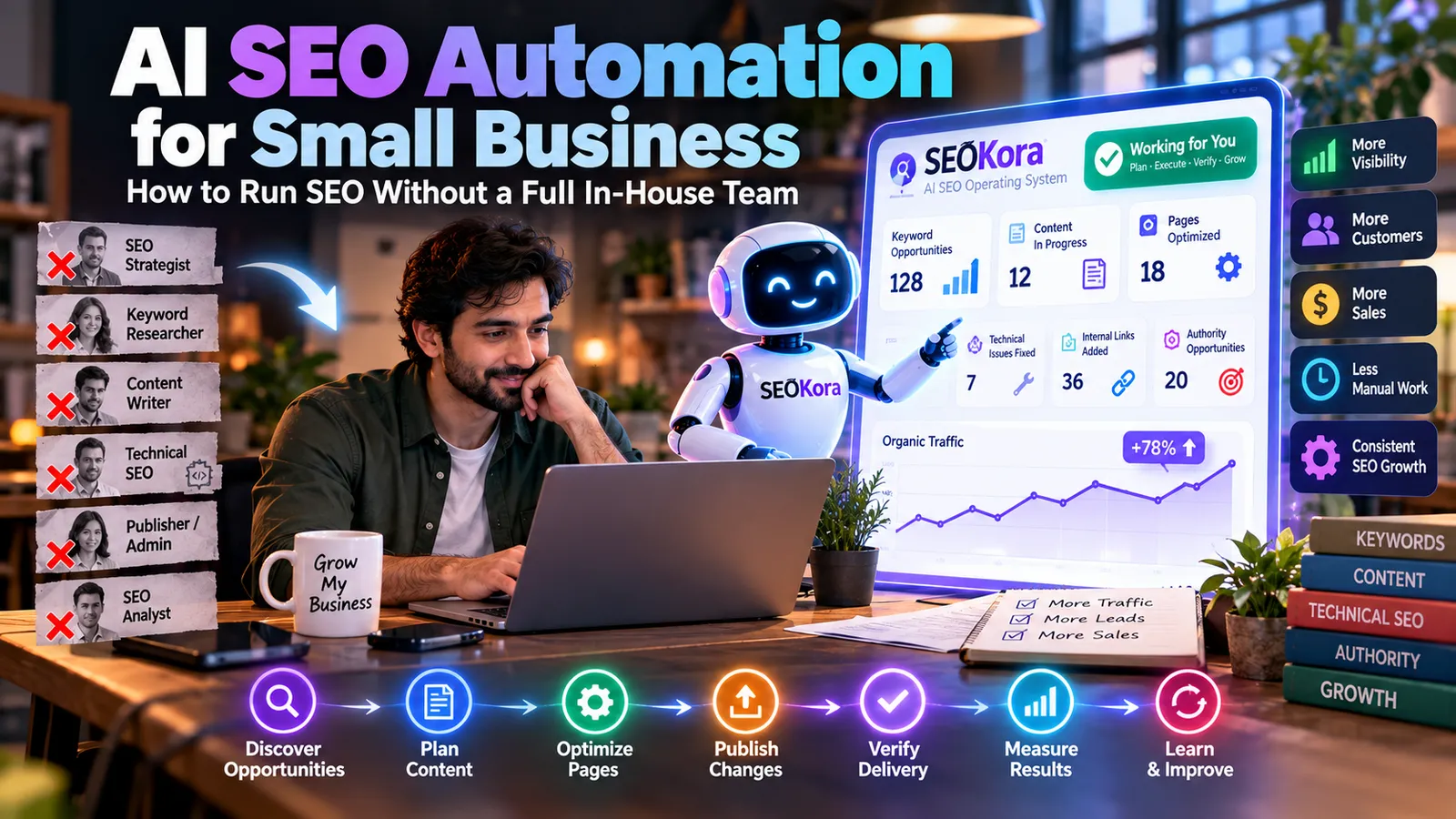
Small businesses rarely struggle with SEO because they have never heard of keywords, content, backlinks or technical optimization.
They struggle because somebody has to keep doing all of those things.
Keyword research needs interpretation. Competitors need monitoring. Existing pages need improvement. New content needs planning. Technical problems need attention. Internal links need maintenance. Publishing needs coordination. Performance needs checking.
Large companies can distribute that work across specialists.
A small business may have one owner, one marketer—or nobody dedicated to SEO at all.
This is why AI SEO automation for small business is potentially more important than simply adding another SEO dashboard.
The opportunity is not to remove humans from SEO completely.
It is to reduce the amount of repetitive research, coordination and execution that requires human attention.
But there is a catch.
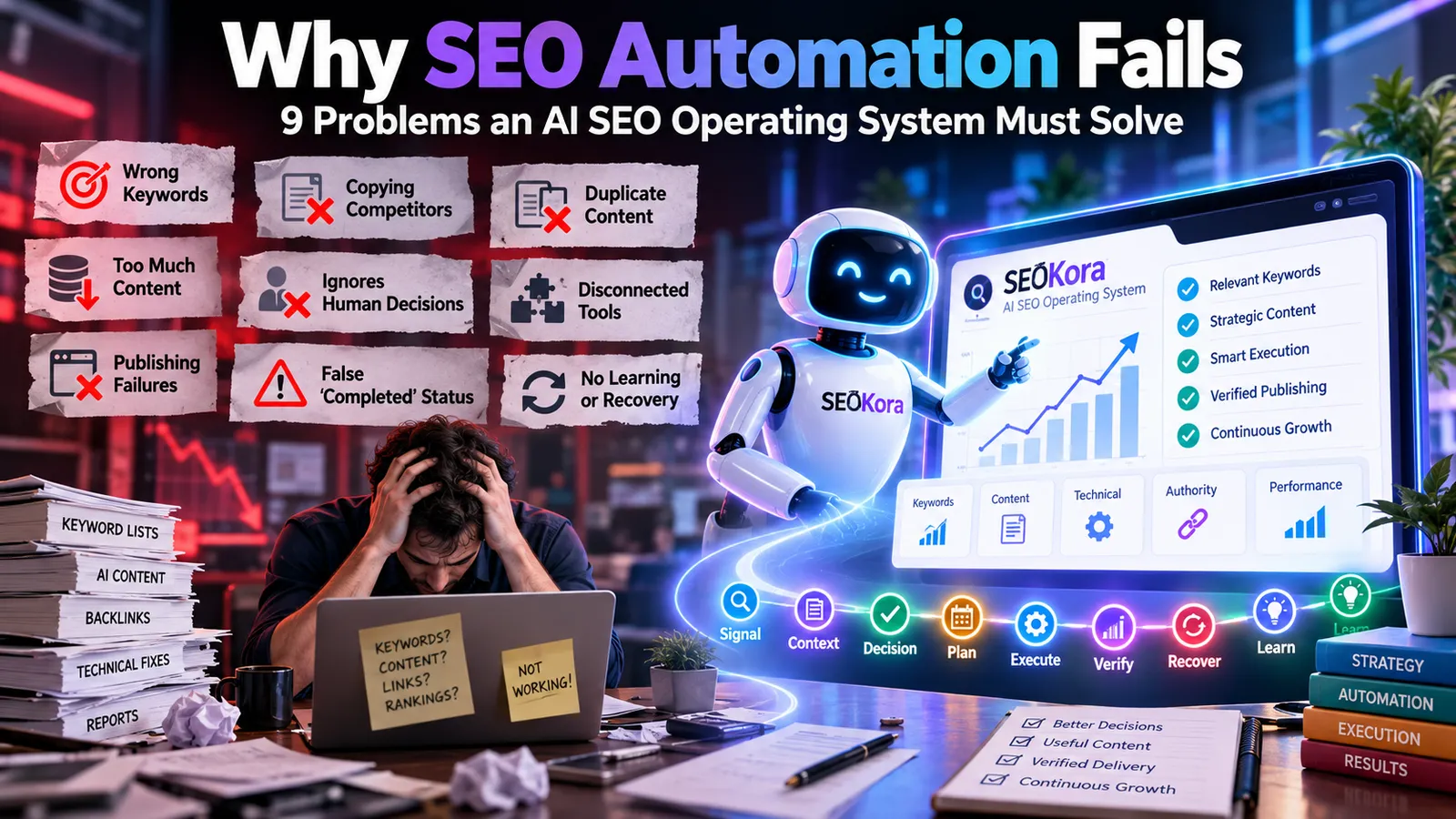
Automating SEO tasks is easy. Automating the right SEO work is much harder.
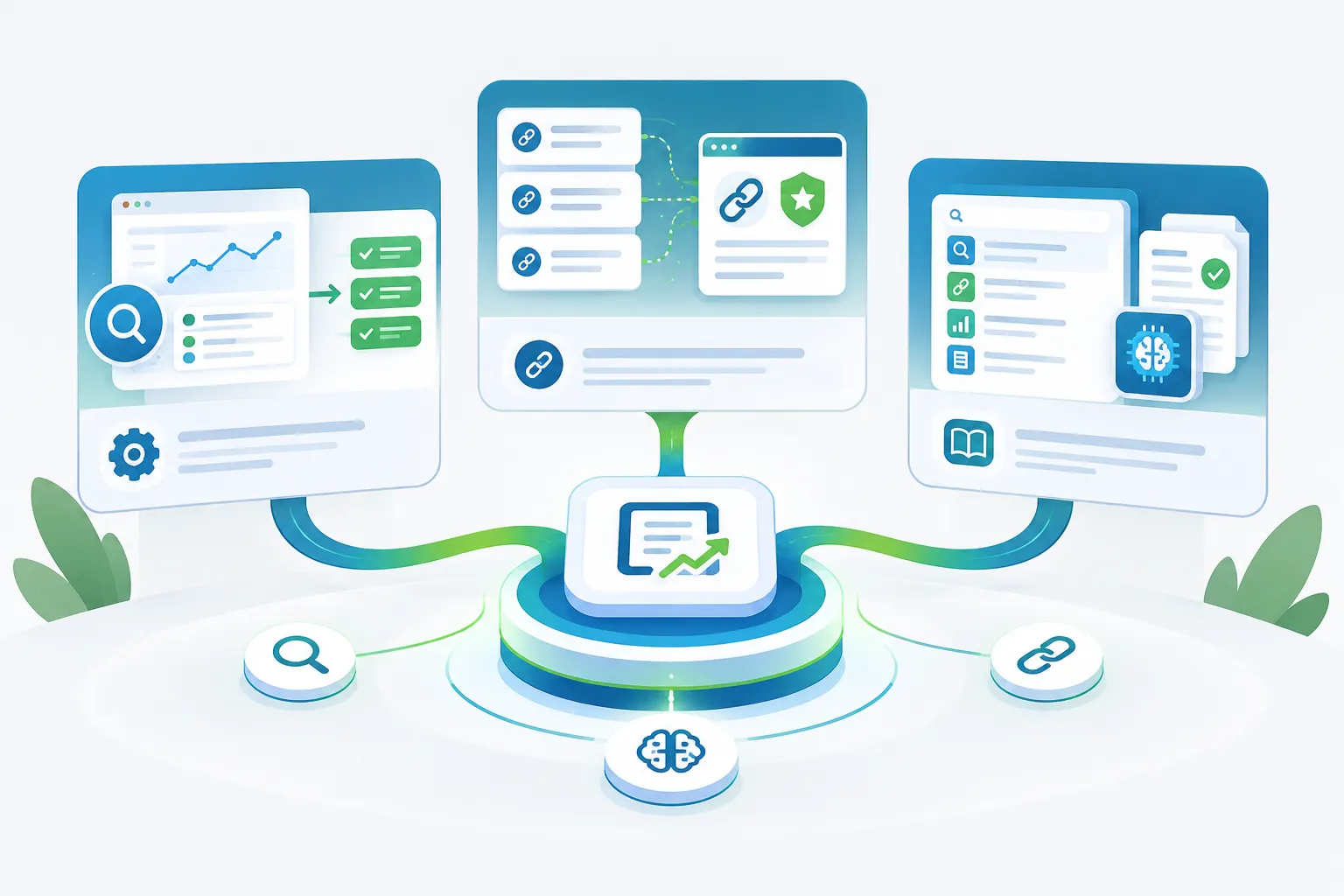
This guide explains what a small business can realistically automate, what should remain controlled, and how an AI SEO operating system can turn scattered SEO activity into a continuous workflow.
Why SEO Is Operationally Difficult for Small Businesses
Imagine a local or online business trying to manage SEO properly.
Even a relatively simple strategy can involve:
- keyword research;
- competitor research;
- Google Search Console analysis;
- content planning;
- content writing and editing;
- on-page optimization;
- internal linking;
- technical SEO;
- authority and backlink research;
- publishing;
- rank monitoring;
- and performance analysis.
None of these activities is unusual.
The difficulty comes from keeping them connected.
Finding a keyword is not useful if nobody decides what to do with it.
Writing an article is not useful if the website already has a page serving the same intent.
Finding a technical issue is not the same as fixing it.
Scheduling content is not the same as confirming it went live.
And collecting more SEO data does not automatically tell a business what deserves attention today.
The Traditional Small-Business SEO Workflow
A traditional workflow often looks something like this:
| SEO Function | Typical Responsibility |
|---|---|
| Strategy | SEO specialist or consultant |
| Keyword research | SEO specialist |
| Competitor analysis | SEO specialist |
| Content planning | Strategist/editor |
| Writing | Writer |
| On-page optimization | SEO/editor |
| Technical fixes | Developer/technical SEO |
| Publishing | Editor/site administrator |
| Performance monitoring | SEO/analyst |
A large organization can justify this specialization.
For a small business, coordinating the same workflow can become expensive and slow.
The owner may eventually become the project manager connecting all of these people and tools.
That defeats part of the purpose of outsourcing SEO in the first place.
What AI Changes
AI dramatically reduces the cost of performing many knowledge-work tasks.
It can help:
- classify keywords;
- analyze search intent;
- summarize competitor research;
- generate content briefs;
- draft content;
- suggest metadata;
- identify internal-link opportunities;
- analyze page structure;
- interpret technical issues;
- and summarize performance changes.
That is significant.
But simply putting AI into each step creates another problem.
You can end up with faster versions of the same disconnected workflow.
The keyword AI does not know what the content AI rejected.
The content generator may not understand what already exists on the website.
The technical system may prioritize issues differently from the content system.
The publishing system may know nothing about the strategic reason behind an article.
AI reduces task cost.
It does not automatically create operational coordination.
SEO Automation vs an AI SEO Operating System
This distinction is especially important for small businesses.
Traditional automation usually says:
When X happens → perform Y.
An operating system needs to ask more questions:
What happened → does it matter → what should we do → when should we do it → did it work?
A useful operating cycle can be represented as:
Discover → Understand → Prioritize → Plan → Execute → Verify → Learn
| Stage | Purpose |
|---|---|
| Discover | Find meaningful signals and opportunities |
| Understand | Add business and website context |
| Prioritize | Decide what deserves resources |
| Plan | Coordinate workload and timing |
| Execute | Perform approved actions |
| Verify | Confirm the intended result |
| Learn | Use new evidence in future decisions |
This is the basic idea behind an AI SEO operating system.
1. Automating Keyword Discovery Without Chasing Every Keyword
Small businesses do not usually suffer from a shortage of possible keywords.
Modern SEO tools can discover thousands.
The real problem is deciding which ones matter.
Suppose an automated system discovers 500 keywords.
A useful prioritization process should ask:
- Does this keyword relate to the business?
- Does it match something customers actually need?
- Does an existing page already cover the intent?
- Is there realistic business value?
- Is the website qualified to address the topic?
- Has the business rejected this topic previously?
- Is it more important than other available opportunities?
This prevents a common automation mistake:
turning keyword discovery directly into content production.
2. Turning Search Console Data Into Decisions
Google Search Console can reveal extremely useful first-party search data.
A business can observe queries, pages, impressions, clicks, click-through rates and average positions.
But dashboards still require interpretation.
Consider three situations.
| Signal | Possible Meaning | Potential Action |
|---|---|---|
| High impressions, low CTR | Search visibility exists but users rarely click | Investigate title, snippet and intent |
| Position 8–15 | Page may be close to stronger visibility | Evaluate improvement opportunity |
| Clicks declining | Page or demand may have changed | Diagnose before acting |
The word investigate matters.
A low CTR does not automatically mean “rewrite the title.”
A declining page does not automatically mean “rewrite the article.”
Search signals should trigger diagnosis before execution.
3. Automating Competitor Research Without Copying Competitors
Competitor research can reveal:
- keywords;
- successful pages;
- content gaps;
- backlinks;
- site structure;
- and emerging topics.
But competitor evidence should not become an instruction to copy.
A competitor may serve another customer segment.
They may sell different services.
They may target another country.
They may have made a bad content decision themselves.
A good automation system therefore asks:
“Is this competitor opportunity relevant to our business?”
before asking:
“Can AI create this?”
4. Improving Existing Pages Before Creating More
This may be one of the biggest opportunities for small-business SEO automation.
AI makes new content easy to produce.
That can create a bias toward publishing more.
But websites often already contain pages with:
- existing rankings;
- historical authority;
- internal links;
- backlinks;
- and established search relevance.
Improving one of those pages can sometimes make more sense than creating another URL.
Before generating content, an automated workflow should therefore check:
Does the website already have an asset capable of serving this search intent?
If yes, optimization may deserve priority.
5. Automating Content Without Building a Content Factory
A small business does not need unlimited AI articles.
It needs useful content.
Those are different objectives.
A responsible content workflow might look like:
Opportunity → Relevance → Existing Coverage → Intent → Brief → Draft → Quality Check → Approval if Needed → Publish → Verify
Notice how generation appears in the middle rather than at the beginning.
This prevents the system from optimizing for article count.
The better question is not:
“How many articles can AI produce?”
It is:
“Which content deserves to exist?”
6. Automating Internal Linking
Internal linking is important but operationally tedious.
As a website grows, someone needs to understand relationships between pages and identify useful connections.
AI can assist by analyzing:
- page topics;
- semantic relationships;
- existing links;
- orphaned content;
- anchor context;
- and site structure.
But automated internal linking should still avoid obvious mistakes.
More links are not automatically better.
The link should genuinely help users understand or navigate related information.
7. Automating Technical SEO Carefully
Technical SEO contains many tasks that are good candidates for automation.
A system can continuously monitor for:
- broken links;
- redirect problems;
- missing metadata;
- indexability changes;
- canonical issues;
- site-performance problems;
- and other crawl signals.
Detection, however, is different from remediation.
Some fixes are low risk.
Others can affect large sections of a website.
A useful automation policy therefore separates:
| Action Type | Approach |
|---|---|
| Routine and reversible | Potentially automate |
| Moderate impact | Automate with safeguards |
| High-impact structural change | Require stronger control |
| Ambiguous diagnosis | Escalate for review |
The objective is not maximum autonomy.
It is safe autonomy.
8. Planning Matters as Much as Generation
Imagine a small business wants to publish eight useful articles this month.
Generating all eight on day one does not necessarily create a better SEO operation.
A planning layer can coordinate:
- what is due;
- what is already scheduled;
- which existing pages need improvement;
- which work has higher priority;
- what requires approval;
- and what should happen next.
This turns automation from a generator into a workload manager.
For the business owner, the desired experience becomes:
“I can see what the system is doing without having to operate it every day.”
9. Human Approval Should Be the Exception, Not the Workflow
Some AI systems create so many approval requests that the user becomes the automation engine.
That is not useful for a small business.
A better model separates routine work from meaningful decisions.
| Situation | Preferred Behaviour |
|---|---|
| Routine approved workflow | Continue automatically |
| Recoverable failure | Attempt safe recovery |
| Previously rejected topic | Respect previous decision |
| Potentially destructive action | Request approval |
| Strategic uncertainty | Ask for judgment |
| Critical unresolved problem | Escalate clearly |
The business owner should not have to approve every routine operation.
But they should retain control when their judgment matters.
10. Publishing Is Not Finished Until It Is Verified
This is an important difference between content generation and operational SEO.
Suppose AI creates an excellent article.
The article passes quality checks.
The system sends it to the website.
The CMS request fails.
If the automation marks the task completed, the customer receives a false picture.
This is why:
Generated ≠ Published ≠ Verified.
| State | Meaning |
|---|---|
| Planned | Work is scheduled |
| Generated | Asset exists |
| Approved | Required quality/control gate passed |
| Published | CMS accepted publication |
| Verified | Expected live result confirmed |
| Failed | Delivery did not complete correctly |
| Recovery | System is attempting corrective action |
For a small business, this distinction is critical.
The owner should be able to judge delivery rather than internal AI activity.
11. Automation Needs Recovery
Websites are real systems.
Things fail.
Authentication expires.
APIs time out.
CMS plugins change.
Jobs become interrupted.
A resilient SEO automation platform therefore needs more than execution.
It needs recovery.
A useful model is:
Execute → Verify → Detect Failure → Recover Safely → Verify Again → Escalate if Necessary
Routine recoverable failures should not automatically become another task for the business owner.
12. The System Should Remember What the Business Told It
Imagine rejecting an irrelevant keyword today.
Tomorrow the system recommends it again.
You delete it.
Next week it returns as a critical opportunity.
That is automation without learning.
A useful system should preserve meaningful preferences and interventions.
Examples include:
- rejected keywords;
- irrelevant topics;
- unwanted competitors;
- pages that should not be duplicated;
- rejected authority prospects;
- and business-specific strategic preferences.
This produces an important principle:
Every meaningful human intervention should make future automation slightly smarter.
A Practical Small-Business Example
Imagine a small software company.
Its Search Console data shows that one existing page receives substantial impressions for a relevant query but usually appears between positions 9 and 14.
A competitor intelligence source also shows stronger competing pages.
What should happen?
A poor automation system might immediately generate another article.
A stronger workflow could do this:
| Step | Action |
|---|---|
| 1. Signal | Identify near-ranking opportunity |
| 2. Relevance | Confirm commercial/topic fit |
| 3. Mapping | Find existing ranking page |
| 4. Diagnosis | Compare page, intent and competitors |
| 5. Decision | Choose improvement rather than duplicate content |
| 6. Plan | Add optimization to workload |
| 7. Execute | Apply approved improvements |
| 8. Verify | Confirm changes are live |
| 9. Measure | Observe subsequent performance |
| 10. Learn | Feed evidence into future prioritization |
The AI did not simply write something.
It helped coordinate an SEO decision.
Where SEOKora Fits
SEOKora is being developed around this operating-system model.
The objective is not to replace every specialist SEO database or pretend that AI eliminates expertise.
The objective is to connect intelligence with ongoing execution.
That means bringing together:
- search-performance signals;
- market and competitor intelligence;
- content opportunities;
- existing site coverage;
- technical issues;
- authority opportunities;
- prioritization;
- content planning;
- execution;
- CMS delivery;
- verification;
- recovery;
- and performance feedback.
Instead of requiring the customer to repeatedly move between research, spreadsheets, AI tools, task managers and the CMS, the operating layer attempts to coordinate the lifecycle.
This is also why SEOKora should not be evaluated simply by asking:
“How many SEO tools does it contain?”
A better question is:
“How much useful SEO work can the business coordinate without becoming the full-time operator of the software?”
AI SEO Automation vs Hiring a Full SEO Team
These are not perfect substitutes.
An experienced SEO professional can provide strategic judgment, creative thinking, specialist investigation and business understanding that should not be reduced to a software feature.
Automation is strongest when handling repetitive and operational work.
| Work | Automation Potential |
|---|---|
| Routine monitoring | High |
| Opportunity detection | High with contextual filtering |
| Initial research | High |
| Content drafting | High with quality controls |
| Scheduling | High |
| Verification | High |
| Recovery workflows | Often high |
| Novel business strategy | Human judgment remains valuable |
| High-risk website changes | Human oversight may be appropriate |
The strongest small-business model may therefore be neither “hire everyone” nor “replace everyone with AI.”
It can be:
automate routine operations and use human expertise where it creates disproportionate value.
What Small Businesses Should Look for in SEO Automation Software
Before choosing an AI SEO platform, ask practical questions.
- Does it understand my existing website before recommending new content?
- Can it separate useful keywords from irrelevant ones?
- Does it prioritize or simply generate recommendations?
- Can it improve existing content instead of always creating more?
- Does it remember rejected topics?
- Can it coordinate a content schedule?
- Does it distinguish generated work from published work?
- Does it verify delivery?
- What happens when automation fails?
- Can routine work continue without asking me for constant approvals?
- Can I still intervene when an important decision requires me?
- Does performance data influence what the system does next?
Those questions reveal much more about operational value than a long list of AI features.
What AI SEO Automation Cannot Promise
There is an important boundary.
AI SEO software does not control Google or other discovery platforms.
It can improve how efficiently a business researches, prioritizes and executes SEO work.
It cannot responsibly guarantee:
- a number-one ranking;
- a specific amount of traffic;
- automatic indexing;
- a particular number of leads;
- or guaranteed revenue.
Small businesses should be cautious of any SEO product making those promises.
The measurable value of automation should instead begin with better operations:
less repetitive work, clearer priorities, more consistent execution, verified delivery and better use of performance evidence.
Frequently Asked Questions
What is AI SEO automation for small business?
AI SEO automation uses artificial intelligence and workflow automation to assist with tasks such as opportunity discovery, keyword analysis, content planning, optimization, technical monitoring, publishing and performance analysis. More advanced systems coordinate these tasks as an ongoing workflow rather than treating them as isolated features.
Can a small business automate SEO?
Many parts of SEO can be automated or heavily assisted, including monitoring, research, content workflows, technical detection, scheduling and verification. Strategic decisions and high-risk changes may still benefit from human judgment.
Can AI replace an SEO agency?
Not in every situation. Agencies and specialists can provide strategy, creative thinking, specialist research and experience. AI automation is particularly useful for reducing repetitive operational work. The appropriate model depends on the complexity of the business and its SEO requirements.
Can AI write all of my SEO content?
AI can assist heavily with content production, but generating content should not be the first decision. A useful workflow first determines whether the topic is relevant, whether existing content already serves the intent and whether a new page is genuinely necessary.
Is automated SEO safe?
It depends on what is automated and what safeguards exist. Routine and reversible actions are easier to automate safely. Structural, destructive or ambiguous changes may require stronger controls or human approval.
How does SEO automation save time?
The largest savings can come from reducing repetitive research, monitoring, coordination, scheduling, publishing checks and reporting—not simply from generating content faster.
What is the difference between an AI SEO tool and an AI SEO operating system?
An AI SEO tool usually performs one or more specific tasks. An AI SEO operating system attempts to coordinate the full lifecycle from signals and prioritization through planning, execution, verification, recovery and learning.
Does SEOKora guarantee rankings?
No. Search rankings are controlled by search-engine systems and influenced by many external factors. SEOKora's operating model is intended to improve how SEO work is selected, coordinated, delivered and measured rather than promise specific ranking positions.
Conclusion: Small Businesses Do Not Need More SEO Busywork
The biggest opportunity AI creates for small-business SEO is not unlimited content generation.
It is operational leverage.
A small company should not need a large internal team simply to keep routine SEO work moving.
At the same time, replacing every decision with an AI action creates another kind of risk.
The better model sits between those extremes.
Discover → Understand → Prioritize → Plan → Execute → Verify → Learn.
Research becomes action.
Actions become verified outcomes.
Outcomes become new evidence.
Human judgment remains available where it matters, while routine work no longer requires constant supervision.
That is the real promise of AI SEO automation for small business.
Not replacing people for the sake of automation.
Not generating activity for the sake of dashboards.
But allowing a smaller organization to operate a more disciplined SEO process than its headcount would traditionally allow.