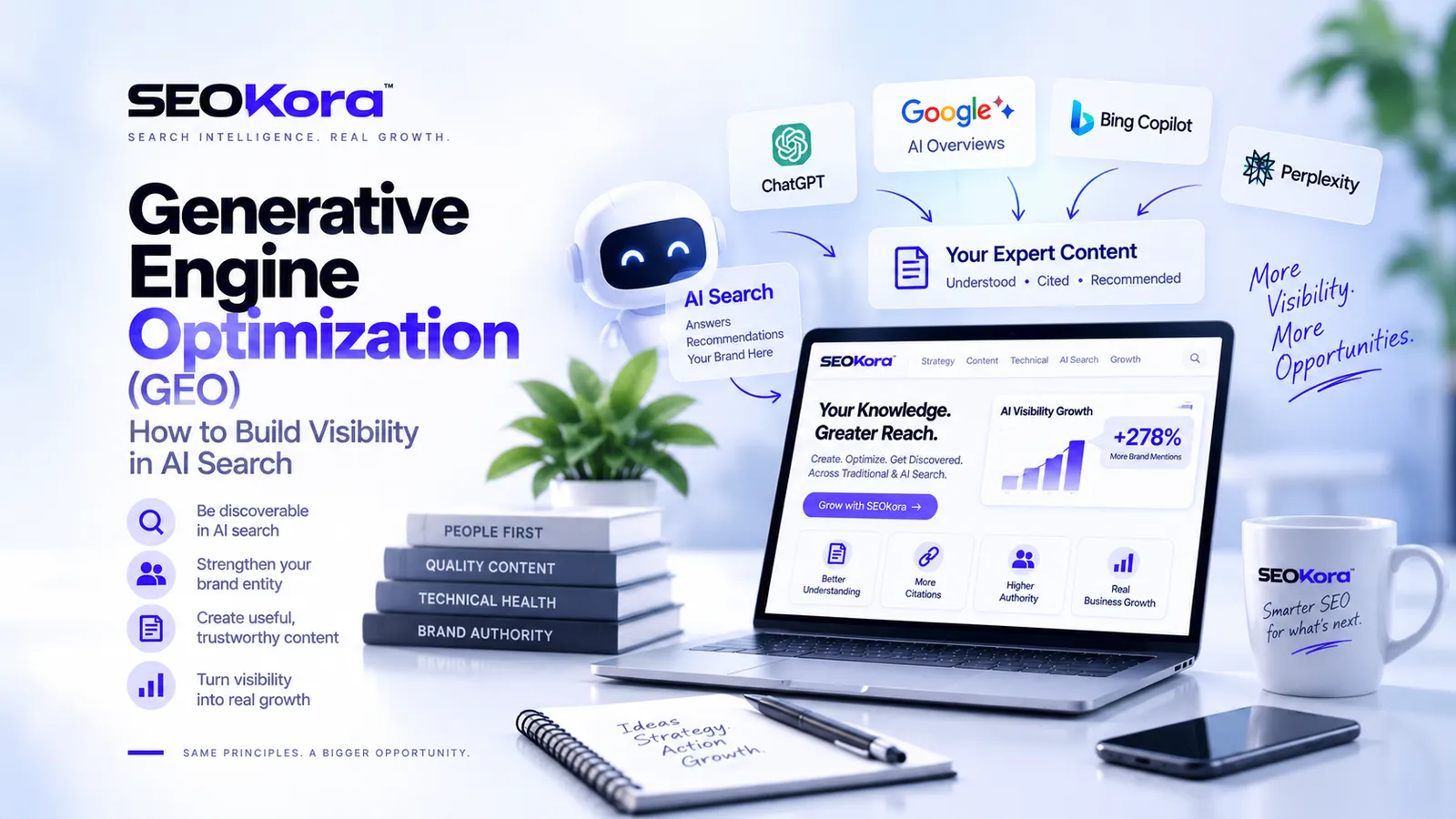
Generative Engine Optimization (GEO): How to Build Visibility in AI Search
Learn how Generative Engine Optimization helps brands build visibility across AI search through useful content, strong entities, authority, technical SEO and measurable AI presence.
Search is changing.
For years, the familiar SEO journey looked something like this:
Search query → Search results → Website click.
That journey still matters.
But it is no longer the only way people discover businesses, products, experts, publishers, and information.
Search experiences increasingly include generated answers, summaries, comparisons, recommendations, follow-up questions, and AI-assisted research.
That creates a new question for businesses:
When an AI system answers a question related to our market, does it understand who we are, what we know, and when our website is useful?
This is where Generative Engine Optimization (GEO) enters the conversation.
But GEO should not be treated as a magic replacement for SEO.
You do not need to abandon technical SEO, useful content, authority, internal linking, structured information, or traditional search visibility and start writing strange pages “for AI.”
A stronger approach is to make your business and its knowledge easier to discover, understand, trust, retrieve, and reference across both traditional and AI-assisted search environments.
What Is Generative Engine Optimization?
Generative Engine Optimization (GEO) is the practice of improving how clearly and credibly a brand, website, entity, product, service, or body of knowledge can be understood and surfaced within AI-assisted discovery experiences.
That can involve:
- clear and useful content,
- strong entity information,
- consistent brand identity,
- credible first-hand expertise,
- original information,
- logical site architecture,
- crawlable pages,
- structured data where appropriate,
- reliable external references,
- and authority beyond the website itself.
GEO is therefore bigger than trying to “rank in ChatGPT.”
Different AI and search systems work differently, change frequently, and may use different sources or retrieval mechanisms.
No legitimate GEO strategy can promise that a particular AI system will always mention or cite a particular company.
The practical objective is different:
Increase the probability that your business and content are understandable, relevant, credible, retrievable, and useful when AI-assisted systems explore your subject.
SEO and GEO Are Connected — Not Opposites
It is tempting to frame GEO as “the new SEO.”
That creates unnecessary confusion.
Many foundations that help traditional search also support AI-era discoverability:
- accessible pages,
- strong information architecture,
- clear topic coverage,
- descriptive internal links,
- credible external references,
- original information,
- consistent entities,
- structured data,
- useful images and media,
- and genuine authority.
Traditional SEO asks questions such as:
Can the page be crawled? Does it satisfy the query? Can it earn visibility?
GEO adds questions such as:
Can a machine clearly understand the answer? Is the source worth referencing? Is the entity identifiable? Does the information add something useful to the available evidence?
The two disciplines should reinforce one another.
The SEOKora AI Visibility Framework
A useful GEO workflow can be expressed as:
Business Identity → Audience Questions → Search & AI Demand → Entity Clarity → Knowledge Coverage → Information Gain → Authority → Technical Accessibility → Structured Understanding → External Validation → AI Visibility Observation → Improvement
This builds on the broader SEO Strategy FrameworkSEOKora.
It also depends on the principles discussed in our Content Gap AnalysisSEOKora and Technical SEO AuditSEOKora guides.
Why?
Because an AI visibility strategy cannot compensate for a website whose important content is inaccessible, repetitive, poorly connected, or disconnected from what its audience actually needs.
1. Start With Entity Clarity
Before thinking about AI citations, make sure the business itself is understandable.
A search or AI system may encounter your company through many places:
- your website,
- About page,
- author profiles,
- social profiles,
- business listings,
- industry directories,
- press coverage,
- interviews,
- reviews,
- partner websites,
- and third-party references.
Those signals should not tell contradictory stories.
A useful entity foundation makes questions like these easy to answer:
- What is the company called?
- What does it do?
- Who does it serve?
- Where does it operate?
- What products or services does it provide?
- Who creates its content?
- What topics does it have genuine expertise in?
- Which official profiles belong to it?
This does not mean repeating your brand name hundreds of times.
It means building a consistent identity across the places where your business appears.
2. Answer Real Questions Clearly
AI-assisted discovery often begins with natural questions.
People may ask:
- What is the best approach for this problem?
- How does this process work?
- What is the difference between these options?
- What should I choose?
- Why is this happening?
- What should I check before buying?
- What are the risks?
- How do I fix this?
Content should make useful answers easy to find.
That does not mean every paragraph must become a one-sentence FAQ.
It means using clear headings, direct explanations, useful definitions, examples, comparisons, and logical structure.
A reader should not need to decode five paragraphs of marketing language before discovering what the page is actually saying.
3. Do Not Turn GEO Into Keyword Stuffing for AI
Every new search trend eventually attracts shortcuts.
GEO is no exception.
One bad approach is to repeatedly insert phrases such as:
- “AI recommends...”
- “best company for...”
- “top solution...”
- or artificial question-and-answer variations designed purely to manipulate machine retrieval.
This usually makes content worse for humans.
A better principle is:
Write information that a knowledgeable human would find useful and structure it so machines can understand it without guessing.
Clarity helps machines because clarity helps everyone.
4. Information Gain Matters More as Generic Content Explodes
AI makes producing generic text extremely easy.
That means simply publishing another article explaining the same ten points already repeated across the web becomes less defensible.
Useful content should add something.
That “something” might be:
- original research,
- first-party data,
- first-hand experience,
- expert interpretation,
- a useful framework,
- a proprietary methodology,
- real examples,
- case studies,
- comparisons,
- new calculations,
- visual explanations,
- or a clearer synthesis of fragmented information.
For example, an SEO platform publishing another definition of “content gap analysis” adds limited value.
A platform explaining how it distinguishes:
CREATE → IMPROVE → CONSOLIDATE → LINK → DEPRIORITIZE
provides a decision framework a reader can actually use.
That is much more useful.
5. Build Topic Coverage, Not an Article Factory
AI visibility is not a reason to publish hundreds of shallow pages.
A better strategy is to understand the knowledge space around your business.
For SEOKora, for example, a useful knowledge cluster can connect:
- SEO strategy,
- content gaps,
- technical SEO,
- AI search visibility,
- programmatic SEO,
- competitive intelligence,
- authority,
- local search,
- conversion,
- and growth automation.
Each resource should own a meaningful intent while connecting naturally to related knowledge.
This creates a coherent information architecture rather than a warehouse of disconnected posts.
6. Internal Links Help Build Knowledge Relationships
Internal links are useful for traditional SEO, but their strategic value goes further.
They express relationships between information.
For example:
This GEO guide connects to technical SEOSEOKora because AI discovery still depends on accessible web content.
It connects to content gap analysisSEOKora because useful AI visibility requires identifying questions and knowledge the website does not yet cover.
And both connect to the broader SEO strategy frameworkSEOKora.
Those links are useful because the concepts genuinely relate.
The objective should never be to inject an arbitrary number of internal links into every article.
7. External Sources Strengthen Useful Content
A credible resource should not pretend the rest of the internet does not exist.
When a claim depends on an official specification, research paper, dataset, standard, or authoritative documentation, link to the relevant source.
For example, Google's current search documentation includes specific guidance for search appearance and AI-related search experiences. Readers who need implementation-level information should be able to reach that primary documentation.
The principle is straightforward:
Use external sources to strengthen the reader's understanding — not to manufacture the appearance of authority.
8. Structured Data Helps Machines Understand Explicit Information
Structured data gives machines explicit information about what a page represents.
Depending on the website and page type, that might include information about:
- an organization,
- an article,
- a product,
- a local business,
- an event,
- a person or profile,
- a video,
- or other supported entities.
For an article, structured information can help clarify elements such as the headline, author, publication date, modification date, and image.
For an organization, it can help clarify business identity, logo, URL, and other relevant organization details.
But structured data should describe reality.
It should not invent expertise, ratings, authors, reviews, or business facts that are not genuinely present.
9. Brand Authority Exists Beyond Your Own Website
Your website can say that your company is excellent.
That is expected.
Independent references carry a different kind of information.
Relevant authority can grow through:
- credible editorial mentions,
- industry publications,
- expert contributions,
- podcasts and interviews,
- research citations,
- partnerships,
- professional directories,
- community participation,
- reviews where appropriate,
- and links earned because a resource is genuinely useful.
This should not become a race to manufacture thousands of low-quality backlinks or mentions.
GEO does not make spam more intelligent.
Relevant third-party validation is valuable because it helps establish that an entity exists within a real ecosystem of people, organizations, and information.
10. Brand Consistency Matters
Imagine one website calls a product one thing.
A directory describes it differently.
Social profiles use another category.
The About page contains outdated positioning.
Author pages are missing.
And several external profiles link to old domains.
That creates unnecessary ambiguity.
A useful GEO program should periodically check consistency across important brand surfaces.
Not because every description must be identical.
But because the fundamental entity should remain recognizable.
11. AI Visibility Should Be Measured Carefully
This is one of the areas where GEO can become misleading.
A business searches its own name in an AI product once, sees a mention, and declares success.
Or it does not see a mention and declares failure.
Neither is a strong measurement system.
AI responses can vary according to:
- the exact prompt,
- follow-up context,
- location,
- language,
- system behavior,
- freshness,
- available sources,
- and changes to the underlying product.
Instead, monitor a representative set of meaningful prompts and questions over time.
Possible observations include:
- whether the brand appears,
- whether the brand is described accurately,
- whether the website is cited or linked where citations exist,
- which competitors appear,
- which external sources influence the answer,
- which topics consistently exclude the brand,
- and whether visibility changes after meaningful improvements.
The objective is trend intelligence, not a fake universal “AI ranking.”
12. GEO Is Also Competitive Intelligence
An AI response can reveal more than whether your brand appears.
It can reveal the information environment around your market.
Ask:
- Which companies are repeatedly mentioned?
- Which sources are repeatedly cited?
- Which attributes are used to compare solutions?
- Which questions produce competitor visibility?
- Which topics are dominated by publishers rather than businesses?
- What information appears to be missing?
This can inform:
- content strategy,
- authority building,
- product positioning,
- digital PR,
- entity development,
- and traditional SEO.
GEO should therefore feed the wider growth strategy rather than live inside an isolated “AI report.”
13. How SEOKora Helps With AI Search & GEO
Many GEO tools stop at monitoring.
They tell the customer:
“Your brand appeared in these prompts.”
Or:
“Competitor X appeared more often.”
That information can be useful.
But the customer still has to answer:
- Why?
- What is missing?
- Is this a content problem?
- Is this an authority problem?
- Is the entity unclear?
- Is the website technically inaccessible?
- Do competitors have stronger supporting sources?
- What should we do next?
- Who will execute it?
- And did the improvement actually happen?
SEOKora is designed to connect AI visibility intelligence with the rest of the SEO growth system.
SEOKora starts with the customer's real market
AI monitoring becomes noisy when prompts are generic.
A useful system needs context:
- business model,
- audience,
- products and services,
- geography,
- languages,
- competitors,
- and strategic market direction.
This helps focus AI visibility analysis on questions the customer's real audience might actually ask.
SEOKora separates existing search reality from independent discovery
Search Console can show valuable information about existing Google visibility.
But it cannot tell you every market your website should pursue.
SEOKora can combine existing performance signals with independent market and competitive research to identify opportunities outside the site's current visibility.
SEOKora connects AI visibility to content gaps
If meaningful prompts consistently surface competitors while the customer's site lacks useful coverage of the subject, that may indicate a content opportunity.
But SEOKora should not automatically create another article.
It first needs to determine whether the correct action is:
CREATE → IMPROVE → CONSOLIDATE → LINK → AUTHORITY BUILD → MONITOR.
SEOKora connects GEO with entity strength
If the brand is poorly understood or inconsistently represented, producing another blog post may not solve the problem.
The appropriate work may involve:
- organization information,
- author identity,
- About-page clarity,
- structured data,
- consistent brand profiles,
- or stronger external validation.
This prevents every visibility problem from being misdiagnosed as a content-volume problem.
SEOKora connects GEO with authority
Sometimes the missing ingredient is not another page.
The website may already contain a good answer but have little independent authority around the subject.
In that situation, the opportunity belongs in authority development rather than content production alone.
SEOKora connects insights to execution
Research has limited value when it permanently remains inside a dashboard.
Once an opportunity has been validated, prioritized, and authorized, it should move toward the appropriate execution path.
That might mean:
- creating content,
- improving an existing page,
- strengthening internal links,
- correcting technical problems,
- improving entity information,
- or developing authority.
SEOKora verifies what actually reached the website
A generated draft is not a published result.
An API request is not a verified live result.
And an optimization marked “complete” should not automatically be treated as delivered if the intended public change cannot be confirmed.
A stronger workflow is:
Opportunity → Decision → Execution → Delivery → Live Verification → Measurement
SEOKora creates a learning loop
The system should not forget what happened after execution.
New search visibility, AI observations, competitor changes, technical conditions, content performance, and authority signals can feed the next prioritization cycle.
Observe → Understand → Prioritize → Act → Verify → Measure → Learn → Observe Again
That is more useful than selling GEO as a one-time AI visibility score.
14. What SEOKora Should Never Promise
Responsible GEO requires boundaries.
No platform should promise:
- guaranteed inclusion in an AI-generated answer,
- a guaranteed citation from a particular AI provider,
- permanent AI visibility,
- a universal number-one AI ranking,
- or that adding schema markup automatically produces AI recommendations.
Those claims oversimplify systems that website owners do not control.
SEOKora's role should be more useful:
Find where visibility is weak, understand why, identify what can realistically be improved, execute authorized improvements, and measure what changes.
15. A Practical GEO Workflow
- Define the entity. Make the business, products, people, and expertise understandable.
- Define the market. Identify audience, geography, language, competitors, and customer problems.
- Build a prompt and question universe. Research how real customers might ask about the market.
- Observe search and AI visibility. Identify brands, sources, topics, and recurring patterns.
- Audit knowledge coverage. Determine what useful information the website already provides and what is missing.
- Check technical accessibility. Ensure important resources can actually be discovered and rendered.
- Strengthen entity signals. Improve consistent, accurate business and author information.
- Create information gain. Add original expertise, data, examples, frameworks, or evidence.
- Strengthen authority. Earn legitimate external references and participation in the relevant ecosystem.
- Connect the site internally. Build meaningful relationships between relevant resources.
- Verify execution. Confirm intended improvements actually reached the live website.
- Measure repeatedly. Observe search, AI visibility, citations, competitors, and business outcomes over time.
GEO Checklist
Frequently Asked Questions
What does GEO mean in SEO?
GEO stands for Generative Engine Optimization. It describes efforts to improve how clearly and credibly a brand, website, entity, or body of knowledge can be understood and surfaced within AI-assisted search and discovery experiences.
Is GEO replacing SEO?
No. GEO and SEO overlap heavily. Crawlability, useful content, authority, site architecture, entity clarity, structured information, and strong user experience remain important foundations. GEO expands the visibility question into AI-assisted discovery rather than replacing traditional search optimization.
Can GEO guarantee that ChatGPT or another AI platform recommends my company?
No. Website owners do not control the output of independent AI systems. GEO can improve the quality, accessibility, clarity, and authority of information available about a business, but responsible optimization should not promise guaranteed mentions or citations.
Does structured data guarantee AI visibility?
No. Structured data can provide explicit machine-readable information about a page or entity, but it does not guarantee inclusion in search features or AI-generated answers.
Do backlinks still matter for GEO?
Relevant external references remain useful signals of authority and real-world presence. The goal should be legitimate authority and useful citations, not mass-produced low-quality links.
Should I create separate pages for every AI prompt?
No. That can quickly create repetitive, low-value content and cannibalization. Group related questions by underlying intent and determine whether the right action is to create a new resource, improve an existing one, add a section, strengthen authority, or take no action.
How should AI visibility be measured?
Use a representative set of commercially and informationally meaningful prompts over time. Observe brand inclusion, accuracy, citations where available, competitor presence, recurring sources, and changes after significant improvements. Avoid treating a single prompt result as a universal ranking.
Final Takeaway
Generative Engine Optimization is not about finding a secret trick for manipulating AI.
It is about making your business and knowledge easier to understand and worth discovering.
Build a clear entity.
Understand the questions your customers actually ask.
Create information that adds something useful.
Connect related knowledge.
Keep important pages technically accessible.
Use structured information accurately.
Build legitimate authority beyond your own website.
Observe how your market appears across AI-assisted discovery.
Then turn what you learn into prioritized action.
The practical cycle is:
Understand → Create Value → Build Authority → Observe → Act → Verify → Learn.
GEO does not make good SEO obsolete.
It makes clear identity, useful information, real authority, and measurable execution even more important.
Turn AI Visibility Into Actionable Growth
SEOKora connects AI visibility, search intelligence, business context, content gaps, entity strength, technical health, competitive research, authority, execution, and live verification in one continuous growth system.
Instead of giving customers another isolated AI score, the objective is to answer the question that matters:
What is limiting our visibility, what should we do about it, and did the improvement actually happen?
Understand the market. Strengthen the entity. Build useful knowledge. Earn authority. Execute the right improvements. Verify the result. Keep learning.