
Content Gap Analysis: How to Find Topics Worth Publishing Without Keyword Cannibalization
Learn how to perform content gap analysis, discover valuable search opportunities, prevent keyword cannibalization, and prioritize content that supports real organic growth.
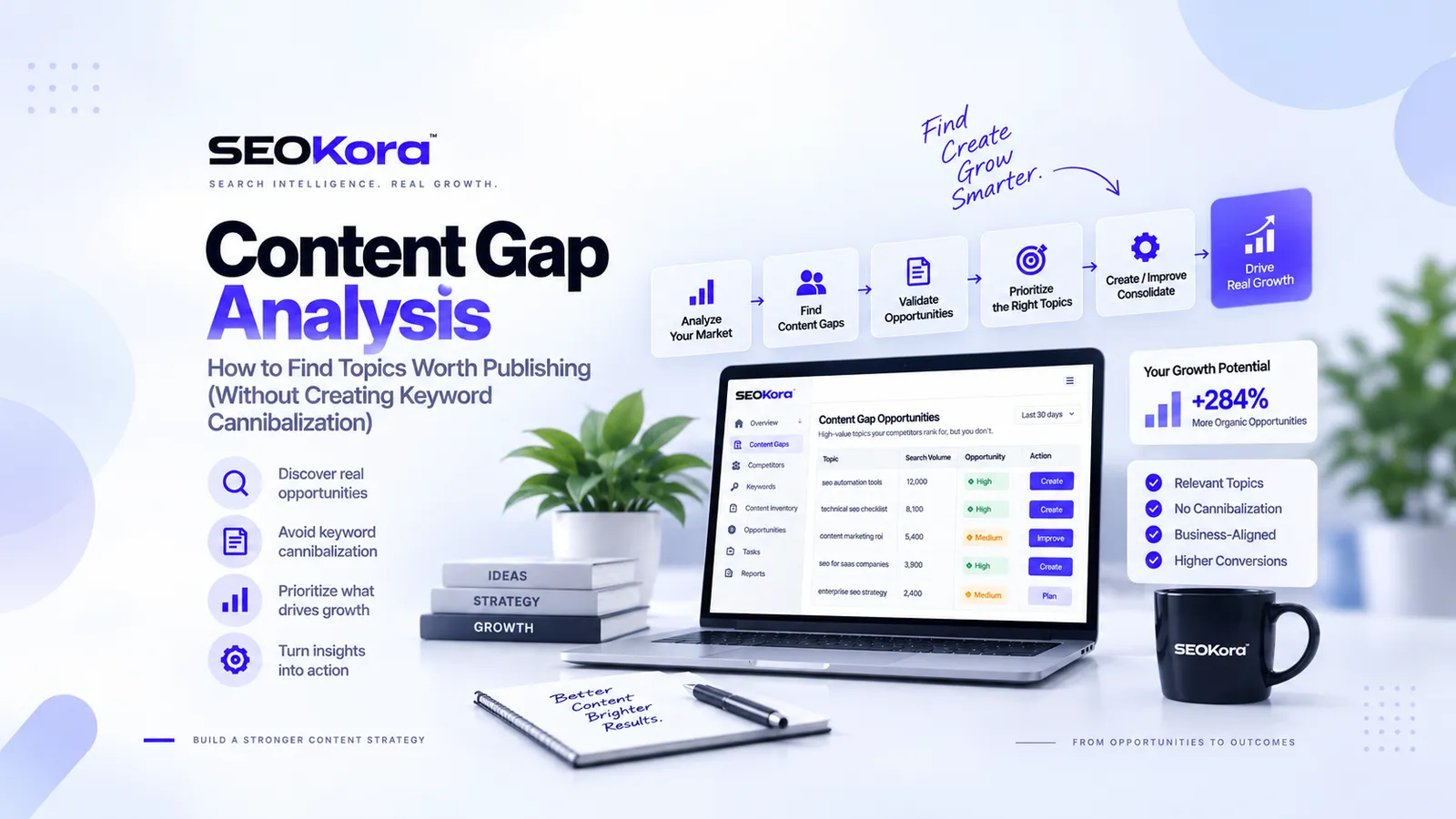
Publishing more content does not automatically create more organic growth.
Sometimes it creates the opposite.
A business identifies hundreds of keywords its competitors rank for, turns those keywords into article ideas, and begins publishing at scale. The content library grows, but several problems appear:
- multiple pages begin targeting the same search intent,
- important existing pages receive less attention,
- low-value topics consume editorial resources,
- the website becomes harder to navigate,
- and traffic grows without producing meaningful business outcomes.
The problem is not necessarily content quality.
The problem is that a keyword gap was mistaken for a content opportunity.
A useful content gap analysis must answer a more demanding question:
What useful information, search intent, or customer need is genuinely missing from this website — and does that gap deserve a new page?
This guide presents a practical framework for finding those opportunities while protecting existing content from unnecessary duplication and keyword cannibalization.
What Is Content Gap Analysis?
Content gap analysis is the process of identifying relevant customer needs, search intents, topics, questions, entities, or stages of the customer journey that a website does not adequately cover.
That definition is intentionally broader than:
“Find keywords competitors rank for that you do not.”
Competitor keyword comparison can be useful evidence, but it is only one input.
A real content gap can exist even when no direct competitor has created a strong page for it.
Likewise, a competitor can rank for thousands of keywords that your business has no strategic reason to target.
Good content gap analysis therefore connects several forms of evidence:
- business relevance,
- customer problems,
- search demand,
- existing website coverage,
- competitor coverage,
- search intent,
- commercial value,
- authority and feasibility,
- and cannibalization risk.
The objective is not to create the longest possible list of missing keywords.
The objective is to discover missing opportunities worth acting on.
Why Traditional Content Gap Analysis Often Goes Wrong
A common workflow looks like this:
- Choose several competitors.
- Export their ranking keywords.
- Remove keywords your website already ranks for.
- Sort the remaining list by search volume.
- Create articles for the largest keywords.
This approach is fast.
It is also incomplete.
It assumes that a competitor ranking for a keyword is enough evidence that your website needs a new page.
That assumption can fail for several reasons.
The competitor may serve a different audience
Two businesses can appear similar while serving different customer segments, geographies, price points, or use cases.
The keyword may not support the business
A topic can generate substantial traffic without attracting the people the company actually wants to reach.
The website may already cover the intent
The apparent “gap” may belong inside an existing page rather than requiring a new URL.
The competitor may not be a useful model
A competitor can rank with outdated, weak, or irrelevant content. Ranking is evidence of visibility, not automatic proof of editorial quality.
Search volume can distort priorities
A smaller, highly relevant commercial opportunity may be considerably more useful than a broad informational keyword with much larger volume.
For these reasons, content gap analysis should be treated as a decision process, not a keyword export.
The SEOKora Content Gap Framework
A practical content gap workflow can be organized into the following sequence:
Business Context → Existing Content Inventory → Customer Demand → Search Market → Competitor Coverage → Missing Intent → Cannibalization Check → Opportunity Validation → Prioritization → Create / Improve / Consolidate / Link / Ignore → Execute → Verify → Learn
This framework extends the broader principles described in the SEO Strategy FrameworkSEOKora.
The important idea is that discovery and publication are not the same decision.
Finding a missing keyword creates a research candidate.
It does not automatically create a publishing instruction.
1. Start With Business Context
Before comparing keywords, establish what the website is actually trying to accomplish.
Useful questions include:
- What does the business sell or provide?
- Who is the intended customer?
- Which markets and locations matter?
- Which languages matter?
- What problems does the product or service solve?
- Which customer segments are strategically important?
- What differentiates the business?
- Which actions represent business value?
This context becomes a filter for every opportunity discovered later.
Without it, content research can drift toward whatever happens to have the largest search volume.
A useful topic must be relevant not only to searchers, but also to the business publishing it.
2. Build an Inventory of Existing Content
Before asking what is missing, determine what already exists.
This sounds obvious, but it is one of the most important safeguards against unnecessary content creation.
A useful inventory should identify:
- existing URLs,
- page titles,
- primary topics,
- search intents,
- content type,
- internal links,
- current search visibility,
- traffic and engagement where available,
- conversion relevance,
- and content freshness.
Then map what each page is supposed to accomplish.
This produces something more useful than a URL list.
It creates an understanding of the website's current topic and intent coverage.
3. Discover Demand Beyond Existing Rankings
Existing search performance is valuable because it reveals what the website is already earning visibility for.
But it should not define the entire research universe.
If a website has never covered an important topic, its existing search data may contain little evidence of that opportunity.
Content gap discovery should therefore combine multiple signals, such as:
- existing query performance,
- independent keyword research,
- SERP analysis,
- competitor research,
- customer questions,
- sales and support conversations,
- industry terminology,
- related entities,
- community discussions,
- market changes,
- and product or service knowledge.
This distinction creates two useful views:
Existing visibility: What does the website already appear for?
Independent opportunity: What relevant demand exists outside the website's current visibility?
A strong content strategy needs both.
4. Identify the Right Search Competitors
Content gap analysis becomes unreliable when the wrong competitors are used.
Your commercial competitors may not be your main search competitors.
For a particular topic, search results might be dominated by:
- specialist publishers,
- software companies,
- marketplaces,
- directories,
- news organizations,
- community platforms,
- universities,
- government resources,
- or independent experts.
The correct competitor set may also change from one topic cluster to another.
Instead of asking only:
“Who competes with our business?”
also ask:
“Who repeatedly earns visibility for the searches our customers make?”
That produces a more realistic view of the search market.
5. Look for Missing Intent, Not Just Missing Keywords
This is where content gap analysis becomes much more useful.
Imagine a website already has a comprehensive guide targeting “technical SEO audit.”
Research discovers related phrases such as:
- technical SEO audit checklist,
- how to perform a technical SEO audit,
- technical website audit steps,
- SEO technical audit process,
- technical SEO audit guide.
Those may not represent five content gaps.
They may represent one underlying intent.
Creating a separate article for every keyword variation can fragment relevance and produce unnecessary overlap.
Instead, group opportunities around:
- intent,
- problem,
- audience,
- journey stage,
- entity,
- and expected content format.
The unit of strategy should be the customer need, not merely the keyword.
6. Understand Keyword Cannibalization Correctly
Keyword cannibalization is often oversimplified.
Two pages mentioning the same keyword does not automatically mean cannibalization exists.
Large websites naturally discuss related entities and terminology across many pages.
The real problem appears when multiple pages compete for substantially the same search intent without a clear reason for both to exist.
Possible symptoms can include:
- multiple URLs repeatedly switching for the same important queries,
- several weak pages covering almost identical intent,
- internal links sending conflicting relevance signals,
- similar titles and headings across multiple URLs,
- and backlinks or engagement being divided across redundant resources.
The correct question is therefore not:
“Does another page contain this keyword?”
It is:
“Does another page already satisfy substantially the same user intent?”
7. Run a Cannibalization Check Before Creating a New Page
Before approving a new content opportunity, search the existing site inventory.
Check:
- existing titles,
- headings,
- page topics,
- target intent,
- ranking queries,
- semantic similarity,
- internal-link destinations,
- and current performance.
Then ask whether the newly discovered opportunity should become:
- a new page,
- an expansion of an existing page,
- a supporting section,
- a merged resource,
- an internal-link improvement,
- or no action at all.
This decision is one of the most important differences between strategic content growth and content volume.
8. Use CREATE, IMPROVE, CONSOLIDATE, LINK, or IGNORE
Every validated content gap does not need the same treatment.
CREATE
Create a new page when the opportunity represents a distinct, valuable intent that existing content does not adequately satisfy.
IMPROVE
Improve an existing page when it already owns the relevant intent but lacks depth, freshness, clarity, evidence, or useful coverage.
CONSOLIDATE
Consolidate when multiple weak or overlapping pages would provide more value as one stronger resource.
LINK
Sometimes the content already exists, but users and search engines cannot easily discover the relationship between relevant pages.
Better contextual internal linking may be the correct action.
IGNORE OR DEPRIORITIZE
Some gaps are real but not useful.
A topic may have demand but weak relevance, poor business value, unrealistic competition, or insufficient strategic importance.
Choosing not to pursue it is a valid SEO decision.
A mature content system does not ask “Can we publish this?” It asks “Should we?”
9. Validate Information Gain
Even when a new page is justified, another question remains:
What will this page add that is genuinely useful?
If the proposed article simply summarizes what the existing search results already say, the website may be adding another interchangeable page to the web.
Useful information gain can come from:
- original data,
- first-hand experience,
- expert analysis,
- a better decision framework,
- clearer explanations,
- new comparisons,
- practical examples,
- updated evidence,
- useful templates or checklists,
- or connecting information that is normally fragmented across multiple sources.
The goal should not be to produce a longer version of whatever already ranks.
The goal should be to produce a more useful resource for the intended audience.
10. Prioritize Content Gaps by Value, Not Volume
Once opportunities survive relevance and cannibalization checks, they still need prioritization.
A practical conceptual model is:
Content Opportunity = Relevance × Demand × Business Value × Information Gain × Achievability ÷ Effort & Cannibalization Risk
This is not intended as a universal mathematical ranking formula.
It is a way to force better decisions.
Relevance
Does the subject belong naturally within the business's expertise and customer journey?
Demand
Is there evidence that the audience needs the information?
Business Value
Can the topic support a meaningful commercial or strategic objective?
Information Gain
Can the business add something genuinely useful instead of producing another generic article?
Achievability
Can the site realistically earn visibility given competition, authority, content quality, and available expertise?
Effort
How much research, writing, design, development, expertise, or maintenance will the content require?
Cannibalization Risk
Will a new page strengthen the site's architecture or compete unnecessarily with an existing resource?
11. A Practical Content Gap Example
Imagine an SEO software company already has a broad guide about SEO strategy.
Research identifies the following opportunities:
- SEO strategy framework,
- content gap analysis,
- content gap tools,
- how to find content gaps,
- keyword cannibalization,
- competitor content analysis,
- SEO prioritization.
A keyword-by-keyword publishing system might create seven separate articles.
A strategic content system asks how those intents relate.
It may determine that:
- SEO strategy framework deserves its own pillar resource,
- content gap analysis deserves a separate deep guide,
- how to find content gaps belongs within the content gap guide,
- content gap tools may become a comparison section or future dedicated page depending on intent,
- keyword cannibalization can be explained here but may justify a deeper specialist resource later,
- and SEO prioritization should connect back to the broader strategy framework.
The result is fewer pages, clearer ownership, and stronger relationships between resources.
That is the difference between publishing keywords and building topical architecture.
12. How SEOKora Turns Content Gap Analysis Into Continuous Growth
Traditional content gap analysis often ends with a spreadsheet.
Hundreds or thousands of keyword rows are exported, filtered, scored, and handed to someone else to decide what happens next.
The difficult part begins after discovery:
- Is the opportunity relevant?
- Does an existing page already cover it?
- Should a new article be created?
- Could the new page cause cannibalization?
- Is the opportunity important enough to prioritize now?
- Who executes it?
- Did it actually get published?
- Did the live page meet the intended quality and destination?
- And what happened afterward?
SEOKora is designed to connect those stages rather than treating content-gap discovery as an isolated report.
The operating model is:
Business Understanding → Human Market Direction → Existing Search Reality → Independent Research → Existing Content Inventory → Intent & Entity Gaps → Cannibalization Check → Business-Value Prioritization → Action Decision → Execution → Live Verification → Performance Feedback
SEOKora does not rely only on what a site already ranks for
Existing search data is important, but a new or underdeveloped website may have little visibility in markets it should eventually serve.
SEOKora's research model is intended to combine existing performance with independent market, topic, and competitive research so that current visibility does not become the boundary of future strategy.
SEOKora keeps customer context attached to research
A keyword does not have the same value for every customer.
Business model, audience, geography, language, product, service, and market direction affect whether an opportunity is useful.
Human direction can also matter when a business has strategic knowledge that raw search data cannot fully explain.
SEOKora checks existing content before recommending new content
The objective is not to maximize the number of articles.
When an existing URL already owns the intent, improving that page may be more appropriate than creating another one.
This helps reduce unnecessary duplication and potential cannibalization.
SEOKora can choose an action other than CREATE
A discovered opportunity can lead to different outcomes:
CREATE → IMPROVE → CONSOLIDATE → LINK → DEPRIORITIZE
This is important because efficient SEO growth requires resource allocation, not simply content production.
SEOKora connects research with execution
A valuable opportunity has limited value if it remains permanently inside a report.
Once an opportunity is validated and authorized, the system can connect it to the appropriate content or optimization workflow rather than leaving discovery disconnected from delivery.
SEOKora separates execution from verified delivery
Creating a draft is not the same as publishing it.
Sending content to a CMS is not necessarily the same as confirming the intended live result.
A stronger workflow verifies the public destination before treating delivery as complete.
SEOKora uses outcomes to improve the next cycle
Content strategy should not be static.
As new visibility, engagement, conversion, and search-performance data becomes available, that evidence can inform subsequent research and prioritization.
This creates a continuous loop:
Discover → Validate → Prioritize → Execute → Verify → Measure → Learn → Discover Again
For the customer, the benefit is straightforward: less time spent sorting through disconnected keyword exports and more focus on content opportunities that have a defensible reason to exist.
13. Content Gap Analysis in the Age of AI Search
Search discovery is expanding beyond traditional lists of blue links.
People increasingly encounter summarized answers, recommendations, comparisons, and cited resources across AI-assisted search experiences.
This makes comprehensive topic understanding more useful, but it does not justify publishing large quantities of repetitive content.
A stronger approach is to build resources with:
- clear definitions,
- direct answers,
- well-explained relationships between concepts,
- original analysis,
- credible supporting evidence,
- descriptive headings,
- useful examples,
- strong internal relationships,
- and information that adds something meaningful to the subject.
Content gap analysis therefore becomes more than identifying missing keywords.
It helps identify missing knowledge and missing explanations.
14. Measure Whether the Content Gap Was Actually Closed
Publishing a page does not automatically close a strategic gap.
After implementation, measure whether the resource actually begins performing the role it was created for.
Useful signals can include:
- indexing and crawlability,
- relevant query impressions,
- search visibility trends,
- qualified organic visits,
- internal-link engagement,
- external references,
- conversion contribution,
- and whether another URL begins competing for the same intent.
The last point is especially important.
A content strategy should continue checking whether the new resource strengthened the site's architecture or accidentally fragmented it.
Content Gap Analysis Checklist
Before creating a new page from a discovered content gap, ask:
- Does this topic fit the business?
- Does it serve the intended audience?
- Is there evidence of meaningful demand?
- Are we looking beyond existing ranking data?
- Have we identified the correct search competitors?
- Is this actually a missing intent rather than another keyword variation?
- Does an existing URL already satisfy the intent?
- Could that existing page be improved instead?
- Would a new page create unnecessary overlap?
- Can we add meaningful information gain?
- Does the opportunity have business value?
- Can the site realistically compete?
- Is CREATE really the correct action?
- How will the page connect to existing resources?
- How will publication be verified?
- How will success be measured afterward?
If those questions cannot be answered, the opportunity probably needs more research before publication.
Frequently Asked Questions
What is a content gap analysis?
Content gap analysis identifies relevant topics, questions, search intents, customer needs, or stages of the customer journey that a website does not adequately cover. A strong analysis also determines whether the gap deserves a new page or should be addressed by improving existing content.
Is content gap analysis the same as competitor keyword analysis?
No. Competitor keyword data can contribute to content gap analysis, but a complete process also considers customer needs, business relevance, existing site coverage, search intent, independent market research, feasibility, and cannibalization risk.
How do you find content gaps?
Combine existing search performance, keyword research, SERP analysis, competitor coverage, customer questions, industry knowledge, existing content inventory, related entities, and business priorities. Then group findings by intent rather than treating every keyword as a separate page opportunity.
Does every content gap need a new article?
No. A gap may be resolved by creating a page, improving an existing resource, consolidating overlapping content, adding internal links, expanding a section, or deliberately deprioritizing the opportunity.
How can content gap analysis prevent keyword cannibalization?
Before creating a new page, compare the proposed intent with existing URLs, topics, ranking queries, headings, and semantic coverage. If an existing page already satisfies substantially the same intent, improving or consolidating content may be safer than creating another competing URL.
Can a website have content gaps that competitors do not cover?
Yes. Customer questions, product knowledge, new market developments, underserved intents, original research, and emerging problems can reveal opportunities that competitors have not adequately addressed.
How often should content gap analysis be performed?
It should be revisited as the website, market, competitors, customer needs, and search behavior change. For an active growth program, content-gap discovery works best as a continuous research and learning process rather than a one-time spreadsheet exercise.
Final Takeaway
A content gap is not simply a keyword your competitor ranks for and you do not.
It is a relevant customer need or search intent that your website does not currently satisfy well enough.
That distinction changes the entire workflow.
Start with the business.
Understand the customer.
Inventory existing content.
Research the market beyond current rankings.
Find the real search competitors.
Group opportunities by intent.
Check existing pages before creating new ones.
Validate information gain.
Prioritize according to relevance, demand, business value, achievability, effort, and cannibalization risk.
Then choose the appropriate action:
CREATE → IMPROVE → CONSOLIDATE → LINK → IGNORE.
Finally, execute, verify, measure, and feed what you learn back into the next research cycle.
Because successful content growth is not about finding the largest number of missing keywords.
It is about finding the right missing opportunities — and knowing what to do with them.
Turn Content Gaps Into Verified Growth Opportunities
SEOKora connects business context, existing search performance, independent market research, competitive intelligence, content inventory, prioritization, execution, and verification into a continuous SEO growth system.
Instead of treating every missing keyword as another article request, SEOKora is designed to help determine whether an opportunity should be created, improved, consolidated, linked, or deprioritized — and then connect validated decisions to measurable execution.
Find the gap. Validate the opportunity. Protect existing content. Execute the right action. Verify the result. Learn from what happens next.