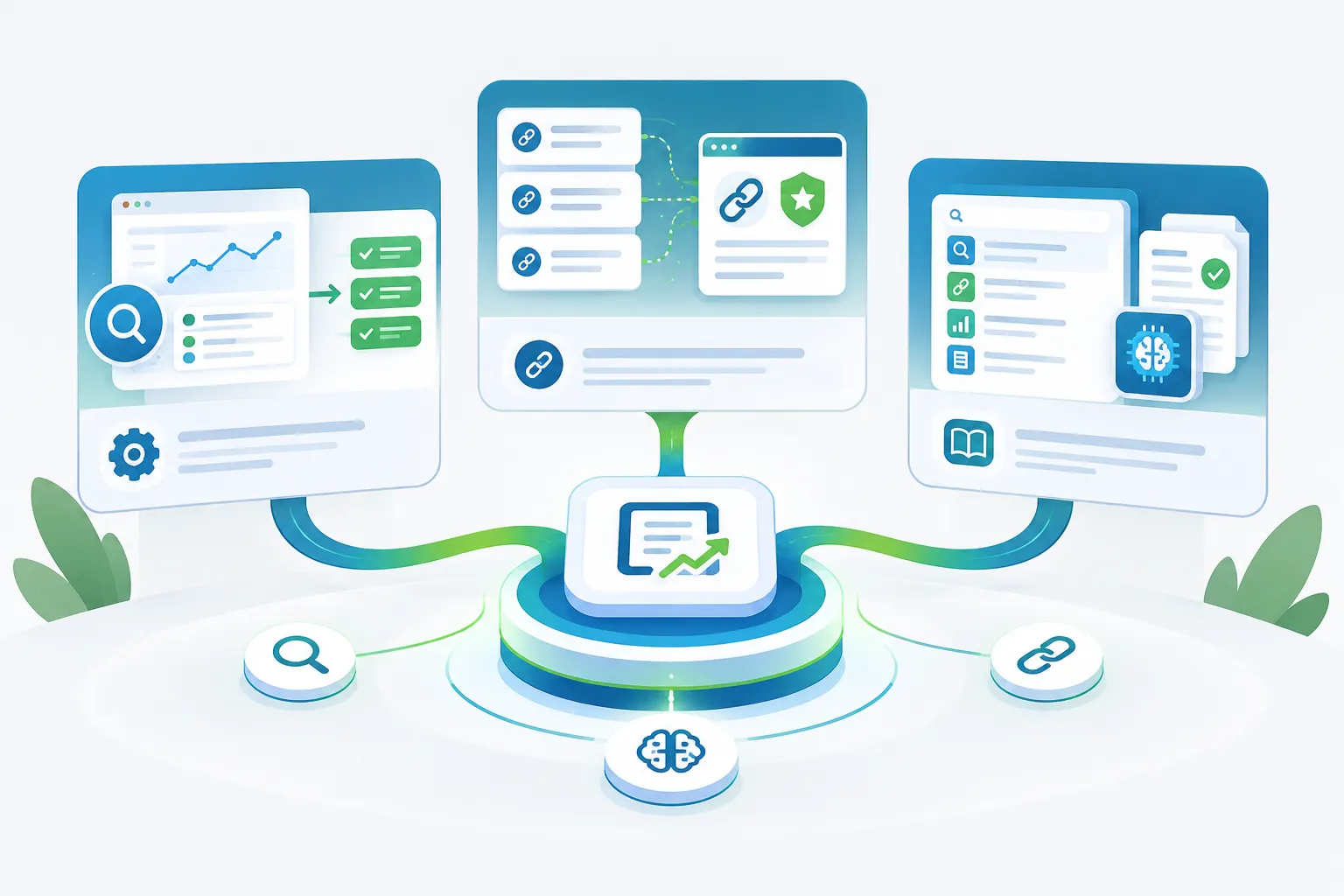
Organic Traffic Growth: How to Build Search Traffic That Actually Helps Your Business
Learn how to build sustainable organic traffic growth using search demand, content, technical SEO, authority, backlinks and continuous optimization with SEOKora.
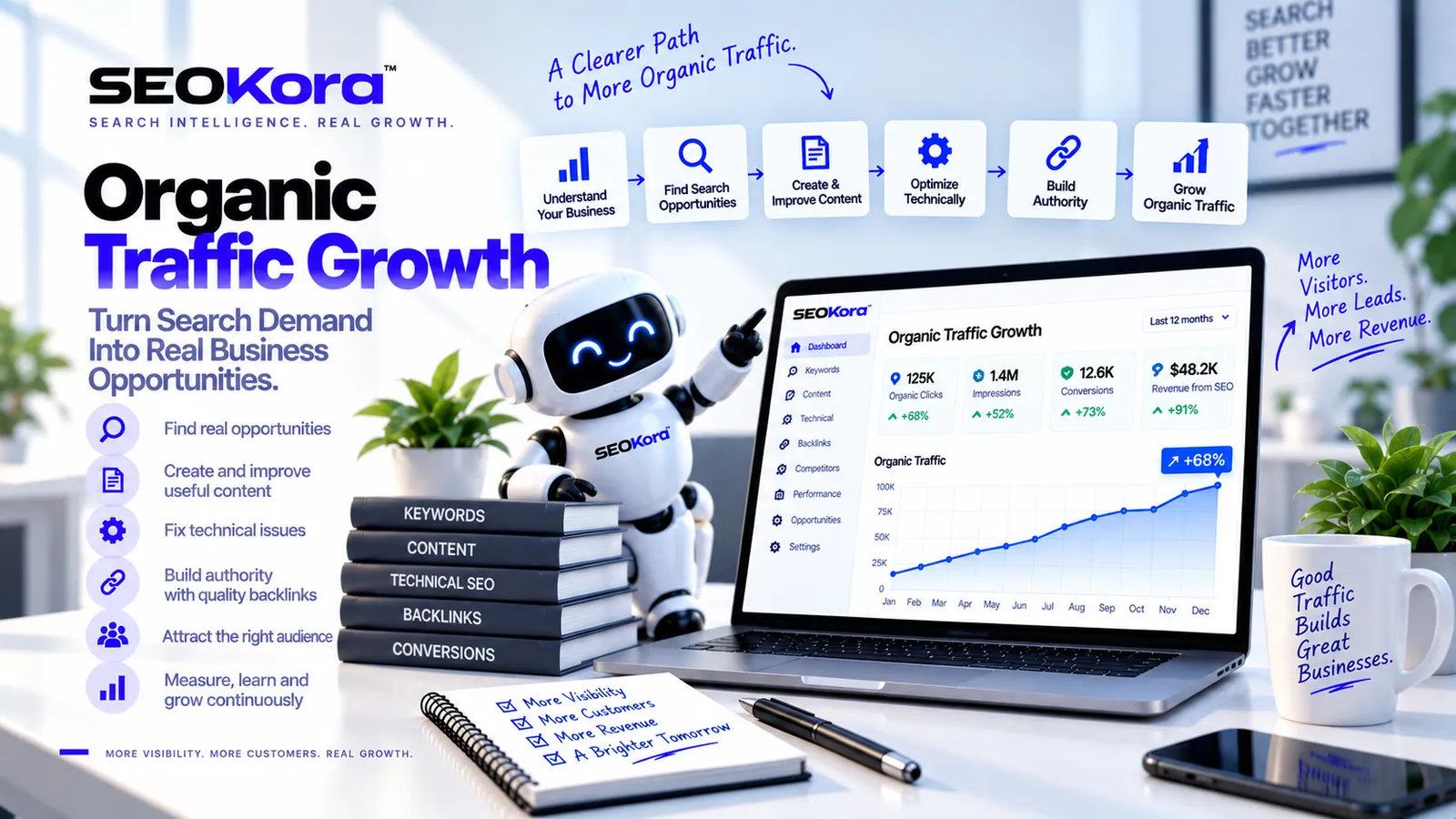
Most businesses want more website traffic.
That sounds reasonable.
More people visiting the website should mean more opportunities, right?
Sometimes.
But there is an important difference between getting more traffic and building organic traffic growth that actually helps the business.
You could attract thousands of visitors who have no interest in your products or services.
Or you could attract a much smaller group of people who are actively searching for exactly what your business provides.
Those are very different outcomes.
The goal of SEO should not simply be more traffic. It should be more of the right traffic.
That means reaching people who have a real reason to discover your website, helping them find the right information, and giving them a useful path forward.
This guide explains how organic traffic growth actually works, what usually stops websites from growing, and how SEOKora connects research, content, technical SEO, authority, backlinks, execution, and performance learning into one growth process.
What Is Organic Traffic Growth?
Organic traffic growth means increasing the number of relevant visitors who discover your website through unpaid search results over time.
These visitors may find you while searching for:
- a question,
- a problem,
- a product,
- a service,
- a comparison,
- a local business,
- a brand,
- or information that helps them make a decision.
Organic traffic growth is therefore not one SEO technique.
It is the result of several systems working together.
A useful way to think about it is:
Relevant Search Demand + Useful Content + Technical Accessibility + Website Authority + Strong Internal Structure + External Validation + Continuous Improvement = Organic Traffic Growth
Why Organic Traffic Matters
Search is different from many other marketing channels because the customer often starts the interaction.
They search because they want something.
Maybe they want to learn.
Maybe they want to compare.
Maybe they have a problem.
Maybe they are ready to buy.
Good SEO helps your business become discoverable during those moments.
That creates an important advantage:
You are not only trying to interrupt someone's attention.
You are trying to become useful when they are already looking.
But Not All Organic Traffic Is Valuable
Imagine you sell accounting software for small businesses.
Your website publishes an article about:
“The History of Calculators.”
Suppose that article somehow attracts 50,000 visitors.
The traffic graph looks fantastic.
But how many of those people are potential customers for your accounting software?
Maybe very few.
Now imagine another page attracts only 2,000 visitors from searches such as:
- accounting software for small business,
- automated bookkeeping software,
- small business accounting platform,
- accounting software pricing,
- and alternatives to manual bookkeeping.
That smaller group may be much closer to the actual market.
This is why traffic volume alone is a weak definition of SEO success.
The Right Organic Traffic Growth Framework
A practical growth system can follow this path:
Understand the Business → Understand the Audience → Research Search Demand → Find Competitors → Map Existing Visibility → Find Gaps → Prioritize Opportunities → Improve or Create → Build Authority → Verify → Measure → Learn → Repeat
This builds on the principles in our SEO Strategy FrameworkSEOKora.
The important part is that publishing does not come first.
Understanding comes first.
1. Start With the Business, Not the Keyword Tool
One of the easiest ways to build the wrong traffic is to begin SEO with a giant keyword list.
Before researching keywords, understand the business.
Ask:
- What does the company actually sell?
- Which products or services matter most?
- Who is the customer?
- Which problems does the business solve?
- Which countries, cities, or regions matter?
- Which languages matter?
- What makes a visitor commercially relevant?
- What does the business want people to do after arriving?
These answers give keyword research direction.
Without them, a system can find thousands of keywords and still fail to find the right market.
2. Understand the Customer's Language
Businesses often describe themselves differently from their customers.
An expert may use technical industry terminology.
A new customer may use a much simpler phrase.
Both can matter.
For example, an experienced marketer may search for:
“organic search visibility analysis”
while a business owner may simply search:
“how to get more traffic from Google.”
They may be looking for closely related help.
A strong SEO strategy understands both.
That is why keyword research should study customer language instead of forcing every visitor to use industry terminology.
3. Find Search Demand That Matches the Business
Search volume can be useful.
But search volume by itself does not tell you whether a keyword is valuable.
Consider these five questions:
- Is the search relevant to the business?
- Does the search represent the right audience?
- What does the person actually want?
- Can the website provide a genuinely useful answer?
- Could this visibility support a meaningful business outcome?
A keyword with 500 relevant searches can sometimes be more useful than one with 50,000 unrelated searches.
This is why good organic traffic growth begins with relevance before volume.
4. Understand Search Intent
Two keywords can look similar while representing completely different customer needs.
Consider:
“what is SEO software”
and:
“best SEO software for small business.”
The first visitor may simply be learning.
The second may be evaluating solutions.
Now consider:
“SEO software pricing.”
That person may be even closer to making a decision.
Understanding this difference helps determine:
- which page should rank,
- what information the page should contain,
- which call to action makes sense,
- and where the visitor belongs in the customer journey.
Organic traffic becomes much more useful when the page matches the reason behind the search.
5. Research the Search Market, Not Just Your Own Website
Existing website data is valuable.
It can show which queries already create impressions, clicks, and visibility.
But there is a limitation.
Your existing performance can only tell you about areas where your website already has some presence.
It cannot automatically reveal every valuable market your website has never entered.
That means organic growth research should combine:
- existing search performance,
- independent keyword research,
- competitor research,
- market research,
- customer questions,
- content-gap analysis,
- and business direction.
This helps answer two different questions:
What is already working?
and:
What are we currently missing?
6. Find the Competitors That Actually Own Search Visibility
Your biggest commercial competitor is not always your biggest SEO competitor.
Search results may contain:
- direct competitors,
- publishers,
- marketplaces,
- directories,
- review websites,
- large informational websites,
- and businesses you have never considered competitors.
If those websites repeatedly appear for searches that matter to your customers, they are part of your search landscape.
Competitor research can help reveal:
- topics you are missing,
- pages customers expect,
- authority gaps,
- backlink differences,
- content formats that work in the market,
- and opportunities competitors have overlooked.
The goal is not to copy competitors.
The goal is to understand the market you are trying to enter.
7. Find Content Gaps Before Creating Content
A content gap is not simply a keyword your website does not rank for.
A useful content gap exists when:
- customers have a real need,
- the topic is relevant to the business,
- the website does not satisfy that need well enough,
- and creating or improving content could strengthen the customer journey.
Before creating a new page, check whether an existing page already covers the intent.
The correct action might be:
CREATE → IMPROVE → CONSOLIDATE → LINK → IGNORE
Our Content Gap Analysis guideSEOKora explains this process in more detail.
8. Improve Existing Pages Before Publishing More
Many websites do not need another 100 articles.
They already have pages sitting just outside stronger search positions.
Some may have:
- good impressions but weak clicks,
- declining traffic,
- outdated information,
- weak internal links,
- poor search-intent alignment,
- missing sections,
- or stronger competitors that have simply built better resources.
Improving these pages can sometimes create growth faster than starting from zero with a new URL.
A healthy growth strategy therefore balances:
New Content + Existing Page Improvements.
9. Build Topic Depth Instead of Random Articles
Publishing random articles may generate occasional traffic.
But it does not necessarily help search systems or customers understand what the business is truly about.
A stronger approach builds connected topic coverage.
For example, an SEO platform might have resources covering:
- SEO strategy,
- keyword research,
- content gaps,
- technical SEO,
- website authority,
- backlinks,
- competitor analysis,
- local SEO,
- AI search visibility,
- conversion optimization,
- and SEO automation.
These topics support each other.
Together they make the website's subject much clearer than a collection of unrelated articles.
10. Internal Linking Turns Pages Into a Knowledge Network
A useful page should not live alone.
Internal links help people continue learning.
They also help connect related information across the website.
For example, someone reading about organic traffic may naturally need to understand:
- Technical SEO ,
- Website Authority ,
- Local SEO ,
- or SEO Conversion Optimization .
Those are useful relationships.
Internal linking should create a journey.
It should not be a mechanical exercise where software inserts the same number of links into every page.
11. Technical SEO Protects Organic Traffic Growth
Excellent content cannot perform properly if search systems struggle to access or understand it.
Technical SEO helps make sure important pages can be:
- discovered,
- crawled,
- rendered,
- indexed when appropriate,
- and connected correctly.
Problems such as broken internal links, accidental noindex directives, incorrect canonical tags, redirect problems, poor site structure, or rendering issues can limit otherwise strong content.
But technical SEO should be prioritized by impact.
Finding 5,000 technical warnings does not mean all 5,000 deserve equal attention.
12. Website Authority Affects How Far Content Can Compete
Imagine two websites publish equally useful pages.
One is already widely referenced and recognized within the topic.
The other is almost unknown.
They may not compete from the same starting point.
Authority can develop through a combination of:
- useful content,
- topic depth,
- quality backlinks,
- credible mentions,
- brand recognition,
- strong internal relationships,
- entity clarity,
- and real participation in the market.
This is why organic traffic growth and Website AuthoritySEOKora should not be treated as separate projects.
13. Backlinks Still Matter — But the Right Backlinks Matter More
A backlink is a link from another website to yours.
Backlinks can help people discover useful resources and can contribute to the wider authority and discovery of a website.
But backlink development should not become a numbers competition.
One relevant reference from a respected website in your market may be far more meaningful than a large number of unrelated links created only for SEO.
A strong backlink strategy asks:
- Is the website relevant?
- Is the page relevant?
- Would the link make sense to a real reader?
- Does the source have a legitimate audience?
- Why would this website want to reference us?
The last question is particularly important.
Instead of asking only:
“Where can we place a backlink?”
ask:
“What can we create that is genuinely worth referencing?”
14. Create Assets That Can Earn Attention
Useful backlink opportunities often begin with useful assets.
Depending on the business, these might include:
- original research,
- industry data,
- calculators,
- templates,
- free tools,
- benchmark reports,
- statistics pages,
- deep educational resources,
- visual explanations,
- or genuinely useful datasets.
These assets can support both traffic and authority.
Instead of manufacturing links, the business creates something other people have a reason to discuss or reference.
15. Do Not Ignore Search Snippets and Click-Through Rate
Ranking creates an opportunity to be seen.
It does not guarantee the click.
If a page receives many impressions but relatively few clicks, investigate what searchers are seeing.
Look at:
- the page title,
- the search intent,
- the competing results,
- the page's positioning,
- and whether the result appears to answer what the person wants.
The objective is not to create clickbait.
The search result should accurately communicate why the page is useful.
16. Traffic Growth Needs Conversion Thinking
Traffic should lead somewhere.
An informational visitor may continue to another useful resource.
A commercial visitor may view features or pricing.
A local visitor may call or book.
A product visitor may purchase.
The exact next step depends on intent.
This is why our SEO Conversion Optimization guideSEOKora treats the click as the beginning of another journey, not the end of SEO.
17. Organic Traffic Growth Is Usually Uneven
SEO growth rarely looks like a perfectly smooth line.
Some pages grow quickly.
Others take longer.
Some improve and then plateau.
Some decline because competitors improve or search demand changes.
Some topics are seasonal.
This is why short-term movement should not automatically trigger large strategic changes.
Look for meaningful patterns over appropriate periods.
18. Measure More Than Total Clicks
Total organic clicks are useful, but they are not enough to understand growth.
A stronger measurement system can examine:
- impressions,
- clicks,
- click-through rate,
- query groups,
- page performance,
- countries,
- devices,
- branded and non-branded discovery,
- topic visibility,
- important landing pages,
- conversions,
- and commercially relevant traffic.
The purpose of measurement is not to create a bigger dashboard.
It is to make the next decision better.
19. Separate Existing Performance From New Opportunity Research
This distinction is extremely important.
Existing performance tells you what Google already associates with your website.
Independent research helps you understand what the wider market contains.
If you use only existing performance data, your SEO strategy can become trapped inside what the website already does.
If you use only external keyword research, you may ignore valuable assets and momentum already present on the site.
A stronger growth system uses both:
Existing Search Reality + Independent Market Opportunity.
20. How SEOKora Approaches Organic Traffic Growth
This is where SEOKora is designed to connect the pieces.
Many SEO tools are good at answering individual questions.
One tool finds keywords.
Another crawls the website.
Another checks backlinks.
Another monitors rankings.
Another helps create content.
The business is then left trying to decide how all of those reports fit together.
SEOKora approaches the problem differently.
Kora's job is not simply to find more SEO data. It is to help turn search intelligence into prioritized, executable growth work.
SEOKora starts by understanding the business
Before deciding what traffic to pursue, Kora needs to understand what useful traffic means for that customer.
That includes context such as:
- business model,
- products and services,
- audience,
- markets,
- locations,
- languages,
- commercial priorities,
- and important customer actions.
This creates the direction for research.
SEOKora studies what is already happening
Where relevant integrations are connected, Kora can use existing performance information to understand:
- which queries already create visibility,
- which pages attract clicks,
- which pages are growing,
- which pages are declining,
- where impressions exist without enough clicks,
- and where the website may already be close to stronger visibility.
This can uncover opportunities hidden inside the website's existing performance.
SEOKora does not stop at existing search data
This is important.
If the website has never ranked for a valuable market, that opportunity may not appear clearly in its existing search-performance data.
Kora can therefore expand research beyond the website's current visibility.
That can include:
- independent keyword research,
- market research,
- competitor discovery,
- content-gap analysis,
- authority-gap research,
- customer-intent analysis,
- and relevant traffic opportunities.
The goal is to understand the market rather than simply repeat what the website already knows.
SEOKora can use human direction without depending on human micromanagement
Sometimes a business owner or SEO manager knows something the data does not.
Maybe a particular market is strategically important.
Maybe a competitor is irrelevant despite appearing similar.
Maybe the company is entering a new product category.
Maybe a certain audience or language deserves more attention.
Kora can use that human direction to improve its understanding.
But once the direction is clear, routine research and authorized execution should not require the customer to manually manage every small step.
SEOKora identifies the real search competitors
Kora can look beyond a manually supplied competitor list and examine which websites repeatedly compete for relevant search demand.
This can reveal:
- unexpected competitors,
- strong publishers,
- marketplaces,
- directories,
- specialist websites,
- and businesses owning important parts of the search journey.
This makes competitive research more useful because it is based on actual search competition.
SEOKora turns keywords into decisions
A keyword is not automatically a task.
Kora can evaluate an opportunity against:
- business relevance,
- search demand,
- intent,
- existing site coverage,
- competition,
- authority requirements,
- potential cannibalization,
- and likely business value.
Then the action can become:
CREATE → IMPROVE → CONSOLIDATE → LINK → BUILD AUTHORITY → MONITOR → DEPRIORITIZE
This prevents keyword research from becoming an endless publishing queue.
SEOKora looks for traffic growth across the whole website
Organic growth does not come only from articles.
Depending on the customer, Kora may identify opportunities involving:
- existing landing pages,
- product pages,
- service pages,
- location pages,
- resource content,
- internal linking,
- technical SEO,
- website authority,
- backlinks and mentions,
- AI search visibility,
- and conversion paths.
The correct growth action depends on the problem.
SEOKora can identify pages worth improving
One of the most valuable opportunities may already exist.
Kora can look for signals such as:
- high impressions with weaker clicks,
- valuable queries sitting outside stronger positions,
- declining pages,
- outdated resources,
- weak internal relationships,
- content overlap,
- and pages that no longer satisfy the market as well as competing results.
Instead of automatically publishing something new, Kora can prioritize improving what already has value.
SEOKora connects traffic growth with authority
Some opportunities cannot be solved with another article.
The website may have enough content but lack authority.
Kora can use competitor and market research to identify potential authority gaps and backlink opportunities.
This might point toward:
- reference-worthy content,
- relevant publications,
- industry resources,
- legitimate directories,
- partnership opportunities,
- unlinked mentions,
- or other relevant sources of external validation.
The objective is not to manufacture the largest number of links.
It is to strengthen authority where it can support meaningful search competition.
SEOKora connects research with execution
Finding an opportunity is only useful if something eventually happens.
Depending on the customer's plan, permissions, integrations, and configured automation, Kora can help move validated work through the appropriate workflow.
That can include supported tasks around:
- content creation,
- existing-page improvements,
- internal linking,
- technical improvements,
- metadata,
- content consolidation,
- and other SEO work.
The operating loop becomes:
Research → Prioritize → Prepare → Quality Check → Execute → Publish → Verify → Measure
SEOKora verifies what actually reaches the website
A completed internal job is not enough.
If Kora is expected to deliver a page or improvement, the stronger standard is to verify that the intended result actually exists on the live website.
This separates:
Activity
from:
Verified delivery.
That distinction matters when measuring whether an SEO growth system is actually doing useful work.
SEOKora learns from performance
Once work is live, the next question is:
What happened?
Kora can use new performance evidence to understand whether:
- visibility improved,
- new queries appeared,
- clicks increased,
- a page moved closer to stronger positions,
- another page began competing with it,
- the opportunity needs more authority,
- or the original priority should change.
That information feeds the next cycle.
Understand → Research → Prioritize → Execute → Verify → Measure → Learn → Reprioritize.
21. What SEOKora Should Not Do for Traffic Growth
Traffic growth becomes dangerous when volume becomes the only goal.
A responsible system should not:
- publish unrelated trending topics just to attract clicks,
- create thousands of low-value pages,
- stuff keywords unnaturally into content,
- copy competitor articles,
- create fake locations,
- generate doorway pages,
- buy spammy backlinks,
- manufacture reviews or mentions,
- create content only to satisfy publishing quotas,
- or report traffic growth as business success without understanding its relevance.
More traffic is not automatically better SEO.
More useful visibility is the goal.
22. A Practical Organic Traffic Growth Workflow
- Understand the business. Define products, services, audience, market, language, geography, and business goals.
- Establish the baseline. Understand current impressions, clicks, queries, pages, and organic performance.
- Research the wider market. Find relevant demand beyond what the website already ranks for.
- Identify real search competitors. Learn who owns visibility across important topics.
- Map customer intent. Understand what people actually want from each important search.
- Audit existing coverage. Determine which needs the website already satisfies.
- Find content and authority gaps. Identify what is genuinely missing.
- Prioritize opportunities. Balance relevance, demand, business value, competition, authority, effort, and risk.
- Improve existing assets. Strengthen valuable pages before automatically creating new ones.
- Create missing resources. Publish useful content where a real gap exists.
- Strengthen internal linking. Connect related pages into a useful knowledge structure.
- Protect technical accessibility. Make sure important pages can be discovered and understood.
- Build relevant authority. Develop legitimate backlinks, mentions, references, and market recognition.
- Connect traffic with conversion. Give relevant visitors a useful next step.
- Verify delivery. Confirm that intended work actually reached the live website.
- Measure the right signals. Track visibility, traffic quality, page performance, and meaningful outcomes.
- Learn and repeat. Use new evidence to decide what deserves attention next.
Organic Traffic Growth Checklist
Frequently Asked Questions
What is organic traffic?
Organic traffic generally refers to visitors who reach a website through unpaid search results rather than paid advertising. For SEO, the most useful organic traffic is traffic from people whose searches are relevant to the business and its content.
How can I increase organic traffic?
Start by understanding your audience and search market. Research relevant demand, identify content and competitor gaps, improve existing pages, create genuinely useful missing content, strengthen internal linking, fix important technical problems, build authority, and measure what happens over time.
How long does organic traffic growth take?
There is no universal timeline. Growth depends on the website's current condition, competition, market demand, authority, technical health, content quality, resources, and the opportunities being targeted. Some improvements can appear relatively quickly while others require sustained work.
Does publishing more articles increase organic traffic?
Not automatically. New content can help when it satisfies real search demand that the website does not already cover. Publishing repetitive, irrelevant, or low-value articles simply increases the number of pages, not necessarily useful search visibility.
Should I target high-volume keywords?
High search volume can be attractive, but relevance and intent matter just as much. A lower-volume query closely connected to your product or service can be more valuable than a much larger unrelated topic.
Are backlinks important for organic traffic growth?
Relevant backlinks and external references can support discovery and website authority, but backlink quality and context matter. A sustainable strategy focuses on earning legitimate references and creating resources that are genuinely worth linking to rather than generating large numbers of unrelated links.
Should I focus on new content or existing pages?
Usually both. Existing pages with impressions, rankings, links, or traffic may offer strong improvement opportunities, while genuine content gaps may justify new pages. The right balance depends on the website.
How do I know whether organic traffic is good traffic?
Look beyond total sessions or clicks. Consider which queries created the visits, which pages people reached, whether those searches match the target audience, and whether visitors take meaningful next steps connected to the business.
Can SEOKora help grow organic traffic?
SEOKora is designed to connect business context with search-performance data, independent market research, competitor analysis, content opportunities, technical SEO, authority research, prioritization, supported execution, live verification, and performance learning. This helps turn traffic growth from a collection of disconnected SEO tasks into a continuous process.
Does SEOKora guarantee traffic or rankings?
No responsible SEO platform can guarantee specific rankings or traffic levels. SEOKora focuses on improving the work a business can control: research, prioritization, content quality, technical health, authority development, execution, verification, and learning from real performance.
Final Takeaway
Organic traffic growth is not about getting everyone to visit your website.
It is about becoming visible to the people who have a genuine reason to find you.
That requires more than keywords.
You need to understand the business.
Understand the customer.
Understand the market.
Find the right search demand.
Create and improve useful pages.
Build authority.
Strengthen internal connections.
Protect technical accessibility.
And learn from what actually happens after the work goes live.
The growth loop becomes:
Understand → Discover → Prioritize → Improve → Build Authority → Execute → Verify → Measure → Learn → Grow.
Because the goal is not simply:
“Get more traffic.”
The better goal is:
Build search visibility that brings the right people closer to your business.
Build Organic Growth With SEOKora
SEO becomes difficult when research, content, technical work, authority, backlinks, publishing, and measurement all live in separate places.
SEOKora is designed to connect those pieces into one growth system.
Kora can help businesses move from questions such as:
“Why isn't our traffic growing?”
to more useful questions:
Which market opportunities are we missing?
Which searches actually matter to our customers?
Which competitors are taking that visibility?
Which existing pages are closest to growth?
Where do we need new content?
Where do we need stronger authority or backlinks instead?
What should Kora work on next?
Did the work actually reach the live website?
And what did the results teach us?
Depending on the customer's plan, connected systems, permissions, and supported workflows, SEOKora can help move validated opportunities from research into execution while keeping quality controls, live verification, and performance feedback connected.
That creates a continuous operating model:
Business Understanding → Search Intelligence → Market Research → Prioritization → Content & Page Improvements → Technical SEO → Authority Development → Execution → Live Verification → Performance Learning
Instead of chasing traffic for the sake of a bigger graph, Kora helps keep the focus on traffic that makes sense for the business.
Find the right opportunities. Do the work that matters. Verify what was delivered. Learn from real performance. Keep growing.