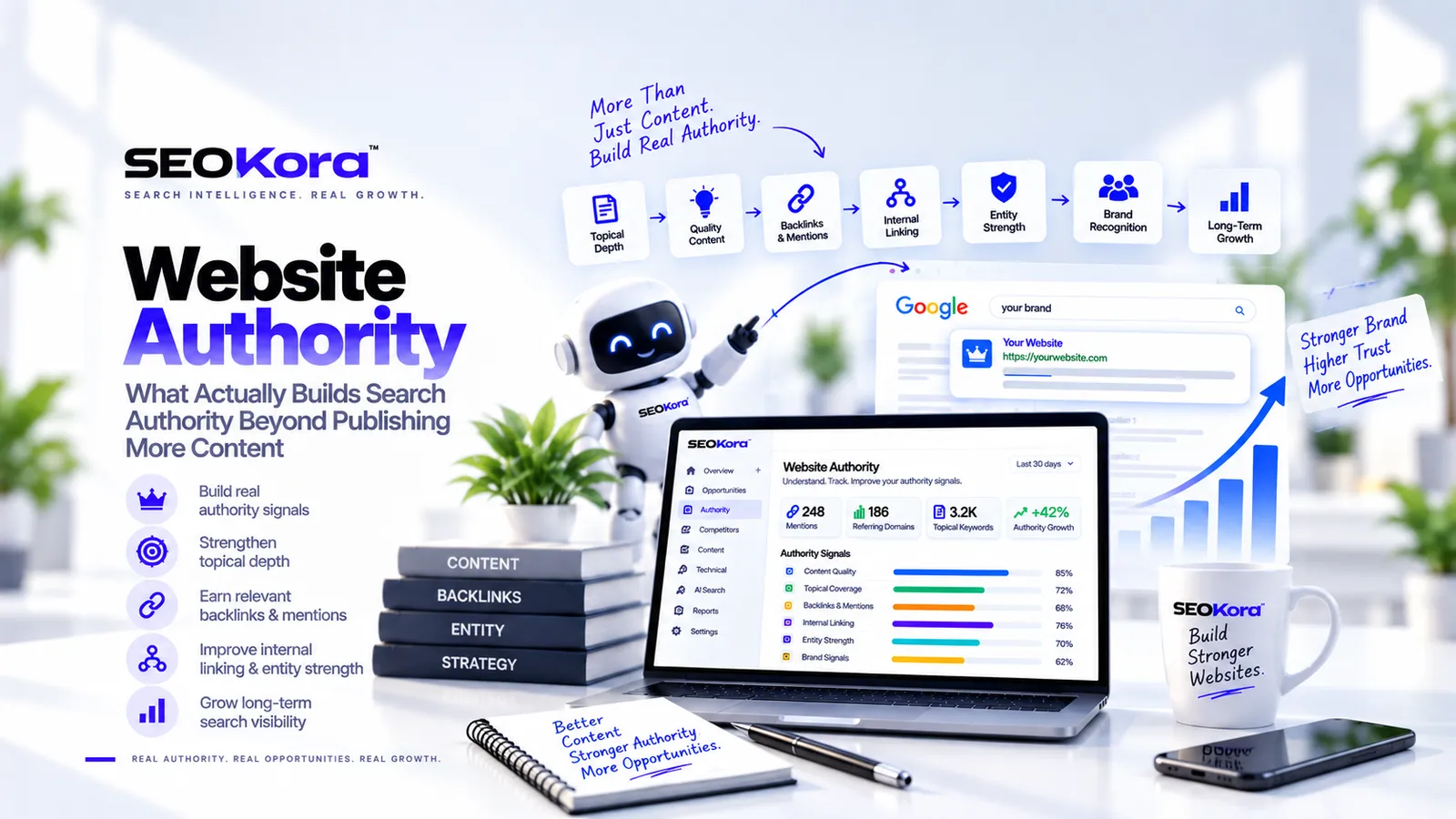
Website Authority: What Actually Builds Search Authority Beyond Publishing More Content
Learn what actually builds website authority through useful content, backlinks, entity strength, internal linking, trust signals and a measurable SEO strategy.
Publishing more content can grow a website.
But publishing more content does not automatically make a website authoritative.
A business can publish hundreds of articles and still struggle to compete with websites that have fewer pages, stronger reputations, better references, clearer expertise, stronger external validation, and more useful information.
This is where many SEO strategies become too simple.
The strategy becomes:
More keywords → more articles → more traffic.
But sustainable search growth usually requires something broader:
Useful Knowledge + Topical Depth + Entity Clarity + Internal Connections + External Validation + Brand Trust + Technical Accessibility + Real Market Value = Stronger Website Authority
Authority is not created by one metric.
It is built from a collection of signals that help users, search systems, publishers, journalists, industry participants, and increasingly AI-driven discovery systems understand one thing:
This website is a credible and useful source within this subject area.
This guide explains what website authority actually means, what contributes to it, what does not, and how businesses can build it without turning SEO into a race for more articles or more backlinks.
What Is Website Authority?
Website authority is the strength, credibility, relevance, recognition, and usefulness a website develops within its market and subject areas.
It is important to separate this idea from third-party SEO metrics.
SEO tools may provide proprietary scores designed to estimate aspects of a domain's link strength or competitive position.
Those scores can be useful for comparison and research.
But they are not the same thing as search engines assigning your website a universal authority score.
Real authority is more complex.
It can involve:
- the quality and usefulness of your content,
- how thoroughly you cover relevant subjects,
- who references or links to your website,
- how clearly your brand and entities are understood,
- how your pages connect internally,
- whether your information is original or differentiated,
- how consistently your business appears across the web,
- whether people actually seek out or recognize your brand,
- and whether your website demonstrates genuine knowledge within its market.
This is why authority should be treated as a system rather than a number.
Why Publishing More Content Is Not Enough
Imagine two websites competing in the same market.
Website A publishes 500 articles.
Website B publishes 120.
Website A has produced far more content.
But Website B may still be stronger if its pages:
- answer important customer questions better,
- contain original research or experience,
- earn references from respected websites,
- connect logically through strong internal linking,
- support clearly defined topic clusters,
- demonstrate recognizable expertise,
- and build a stronger relationship between the brand and the subject.
Content volume and authority are not the same thing.
Publishing can contribute to authority.
But only when the content strengthens the website's knowledge, usefulness, reputation, and market position.
The Website Authority Framework
A practical authority-building framework can be organized as:
Business Identity → Market Relevance → Topical Coverage → Information Quality → Internal Knowledge Structure → External Validation → Entity Strength → Brand Recognition → Technical Trust → Measurement → Continuous Improvement
This framework should connect directly with the wider SEO Strategy FrameworkSEOKora.
Authority should not be treated as a separate campaign running independently from content, technical SEO, competitors, or customer demand.
It should support the areas where the business actually needs to become more competitive.
1. Authority Starts With Relevance
A website does not need to become authoritative about everything.
It needs authority in the areas that matter to its customers and business.
This sounds obvious, but many websites accidentally build content libraries that become broader and broader simply because keyword tools continue discovering new topics.
A SaaS company may begin writing about its software category.
Then it publishes general marketing advice.
Then entrepreneurship.
Then productivity.
Then artificial intelligence.
Eventually the website contains hundreds of articles but has no obvious center of expertise.
A stronger approach begins with:
- What does the business actually do?
- Who does it serve?
- Which problems does it solve?
- Which topics directly influence those problems?
- Which adjacent topics genuinely support customer decisions?
- Where does the business have knowledge or data worth contributing?
Authority begins with a clear relationship between the business and the knowledge it publishes.
2. Build Topical Depth, Not Random Content Volume
One strong article rarely establishes meaningful topical coverage.
Search markets contain layers of questions.
For example, a website focused on SEO software might need useful resources around:
- SEO strategy,
- keyword and market research,
- content gaps,
- technical SEO,
- internal linking,
- competitor analysis,
- website authority,
- AI search visibility,
- programmatic SEO,
- content performance,
- and conversion from organic traffic.
Those subjects reinforce one another.
This is different from publishing disconnected articles simply because each keyword has search volume.
The goal is to create a useful knowledge system around the problems your market actually needs solved.
Our Content Gap Analysis guideSEOKora explains how to discover missing topics without automatically turning every keyword into another article.
3. Depth Must Exist Inside the Content Too
Topical authority is not created merely by having a page for every keyword.
The pages themselves need substance.
A useful resource should help the reader understand the problem better than they did before arriving.
Depending on the subject, that can mean providing:
- clear explanations,
- practical frameworks,
- examples,
- decision criteria,
- original observations,
- first-party data,
- real workflows,
- comparisons,
- limitations,
- and useful next actions.
Ten shallow pages do not necessarily create more authority than one exceptional resource.
The correct question is not:
How much content did we publish?
It is:
How much useful knowledge did we add?
4. Information Gain Matters
If every website targeting a topic repeats the same information, publishing another version adds limited value.
Strong authority-building content should look for opportunities to contribute something additional.
That might include:
- original data,
- real examples,
- internal research,
- industry observations,
- expert commentary,
- unique frameworks,
- first-hand experience,
- case studies,
- calculations,
- visual explanations,
- or a better synthesis of complicated information.
Not every article needs original research.
But a website that consistently contributes useful information has a stronger foundation than one that simply rewrites existing search results.
5. Internal Linking Turns Pages Into a Knowledge Network
A website can have excellent pages that remain strategically disconnected.
Internal linking helps transform individual documents into a structured knowledge system.
For example, this article naturally connects with:
- SEO Strategy Framework ,
- Content Gap Analysis ,
- Technical SEO Audit ,
- Generative Engine Optimization ,
- Programmatic SEO ,
- and the SEO competitor analysis framework.
Those relationships are useful because the subjects genuinely support one another.
Internal linking should help users move through related knowledge and help search systems understand:
- which pages are important,
- which topics belong together,
- which page owns a particular intent,
- and how information across the website is related.
Randomly inserting internal links simply to reach a target number is not the same thing.
6. External Links Can Strengthen Credibility
Authority does not require pretending your website is the only source of information on the internet.
Useful external references can make content more trustworthy.
If an article discusses search-engine requirements, linking to official search documentation may help the reader verify the information.
If an article references a study, linking to the original research is usually more useful than citing a website that summarized the study.
External references are especially valuable for:
- official documentation,
- statistics,
- research,
- standards,
- regulations,
- technical specifications,
- and factual claims that readers may want to verify.
The purpose is not to add external links for SEO decoration.
The purpose is to improve the resource.
7. Backlinks Still Matter — But Quality Matters More Than Counting
Links from other websites remain an important part of how information and reputation move across the web.
But treating every backlink as equally valuable creates bad incentives.
A relevant editorial reference from a respected industry source is fundamentally different from hundreds of automated links placed on unrelated websites.
A stronger authority strategy asks:
- Is the linking website relevant?
- Is the linking page itself useful?
- Is the link editorially meaningful?
- Would this reference make sense if search engines did not exist?
- Could the mention introduce the business to a relevant audience?
- Does it reinforce the brand's relationship with the topic?
This moves backlink strategy away from raw quantity and toward genuine external validation.
8. Link-Worthy Assets Are Better Than Constant Link Requests
One of the strongest ways to earn authority is to create things people actually want to reference.
Examples can include:
- original research,
- industry statistics,
- benchmark reports,
- free tools,
- calculators,
- templates,
- datasets,
- interactive resources,
- visual explanations,
- definitive guides,
- and genuinely useful proprietary insights.
These assets can support SEO, PR, partnerships, community discussions, social distribution, and AI-era discovery simultaneously.
That is much stronger than treating link acquisition as a repetitive task of asking strangers to link to ordinary articles.
9. Competitor Authority Gaps Reveal What Your Site Is Missing
Authority should not be analyzed in isolation.
Your real search competitors can reveal important gaps.
But first you need the right competitors.
A business competitor and a search competitor are not always the same company.
A search competitor may be:
- a publisher,
- a marketplace,
- a directory,
- a specialist blog,
- a software platform,
- a large brand,
- or another website repeatedly appearing for the searches that matter to your audience.
Once those competitors are identified, authority analysis can examine:
- which topics they dominate,
- which websites reference them,
- what kinds of assets earn links,
- where their brand is mentioned,
- which entities they are associated with,
- how their internal knowledge is structured,
- and which authority advantages your website does not yet have.
This is why authority building naturally follows a strong SEO competitor analysis.
10. Entity Strength Is Becoming Increasingly Important
A brand is more than a domain name.
Search and discovery systems need to understand what an organization, person, product, service, or other entity actually represents.
Entity clarity can be strengthened through consistent information about:
- brand name,
- business purpose,
- products and services,
- authors or experts,
- locations,
- relationships between entities,
- official profiles,
- structured data where appropriate,
- and external references.
If the website describes the business one way, external profiles describe it another way, and third-party mentions associate it with completely different subjects, the entity picture becomes weaker.
Consistency helps systems understand who the business is and where it belongs.
11. Authority Extends Beyond Traditional Google Search
Search discovery is expanding.
Users can discover brands through traditional search results, AI-generated search experiences, answer engines, social platforms, communities, industry websites, directories, videos, and other information systems.
This means authority increasingly has a broader footprint.
A brand that is:
- clearly described on its own website,
- referenced by credible external sources,
- associated consistently with relevant topics,
- supported by strong original resources,
- and recognized across multiple useful sources
creates a stronger information ecosystem around itself.
This connects directly with our Generative Engine Optimization guideSEOKora.
GEO should not be treated as a trick for forcing AI systems to mention a brand.
It is partly about creating information that is easier to discover, understand, evaluate, and reference.
12. Brand Signals and Search Authority Reinforce Each Other
SEO and branding are often treated as separate disciplines.
In reality, they increasingly reinforce each other.
As a brand becomes better known, more people may:
- search for it directly,
- mention it,
- reference its resources,
- link to it,
- discuss its products,
- compare it with alternatives,
- and return to its website.
At the same time, strong search visibility introduces the brand to more people.
The relationship can become:
Visibility → Discovery → Useful Experience → Recognition → Mentions → References → Stronger Authority → More Discovery
This is one reason sustainable SEO should not be reduced to keyword positions alone.
13. Technical SEO Protects Authority
A website can build excellent content and external recognition while technical problems weaken its ability to benefit from them.
Examples include:
- important pages blocked from crawling,
- incorrect canonical tags,
- broken internal links,
- redirect chains,
- duplicate URLs,
- orphaned authority pages,
- broken structured data,
- poor rendering,
- and important content that search systems cannot reliably access.
Authority building therefore depends on technical foundations.
The Technical SEO Audit frameworkSEOKora explains how to prioritize technical problems according to their actual search impact rather than simply chasing every warning produced by an audit tool.
14. Programmatic Scale Needs Authority Controls Too
Programmatic SEO can dramatically increase the number of pages on a website.
That makes authority management even more important.
If a website adds thousands of low-value pages, the result is not automatically thousands of new authority assets.
Before scaling, programmatic systems should determine:
- whether the page family satisfies real demand,
- whether each page provides distinct value,
- how pages connect to the wider topic architecture,
- whether they strengthen or dilute existing coverage,
- and whether the website has enough information to justify the page set.
Our Programmatic SEO guideSEOKora explains why scalable publishing should begin with validated patterns rather than URL volume.
15. Authority Should Be Built Where It Can Change Outcomes
Authority building requires resources.
Creating original research takes time.
Developing useful tools takes time.
Building relationships takes time.
Improving topic coverage takes time.
Digital PR takes effort.
This means prioritization matters.
Do not attempt to become equally authoritative across every subject connected to your industry.
Instead, identify where additional authority could realistically improve:
- competitive search visibility,
- customer trust,
- brand recognition,
- conversion,
- external references,
- AI discovery,
- and long-term market position.
Authority should support business strategy.
16. Measure Authority With Multiple Signals
No single metric can fully measure website authority.
A useful measurement model should combine multiple indicators.
Depending on the business, these may include:
- growth in relevant non-branded search visibility,
- growth in branded search demand,
- quality referring domains,
- relevant editorial mentions,
- links earned by important resources,
- topic-level visibility,
- performance against actual search competitors,
- engagement with authority assets,
- citations or mentions in relevant discovery environments,
- and business outcomes influenced by organic discovery.
Third-party authority metrics can be included as directional indicators.
But they should not become the objective themselves.
The goal is not to increase a proprietary score.
The goal is to strengthen the website's real competitive position.
17. How SEOKora Approaches Website Authority
Authority is where SEO systems can easily become misleading.
A dashboard can show a score.
A backlink tool can show millions of links.
A content system can show hundreds of published pages.
But none of those numbers alone answer the important question:
Is this website becoming a stronger, more credible and more competitive source in the markets that matter?
SEOKora approaches authority as part of a wider search-growth system rather than an isolated metric.
SEOKora starts with the business and market
Authority opportunities should be evaluated in the context of:
- what the customer does,
- who the customer serves,
- where they compete,
- which languages and markets matter,
- which products or services create value,
- and which topics are strategically relevant.
This prevents authority work from drifting into unrelated high-volume topics.
SEOKora identifies the competitors that actually matter
Competitor analysis should not stop with the companies a customer already knows.
The system can examine the websites repeatedly competing for relevant search demand and distinguish different competitive relationships.
This provides a better foundation for authority-gap analysis.
SEOKora separates content gaps from authority gaps
Sometimes a competitor performs better because it has content you do not have.
Sometimes you already have equivalent content, but the competitor has stronger external validation.
Sometimes the difference is technical.
Sometimes the competitor has better internal architecture.
Sometimes its brand is simply more established within the market.
Those are different problems and should produce different actions.
SEOKora looks for authority opportunities, not just backlink counts
A useful authority opportunity may be:
- a missing reference-worthy resource,
- an original research opportunity,
- a relevant industry directory,
- a legitimate editorial mention opportunity,
- a partnership,
- a topic cluster that needs strengthening,
- an entity consistency problem,
- an internal linking weakness,
- or a valuable page that deserves stronger promotion.
This creates a broader and more useful authority model.
SEOKora connects authority with content decisions
Content should not be produced in isolation from authority strategy.
Research can help identify which resources have the potential to become:
- reference assets,
- topic hubs,
- link-worthy research,
- competitive differentiators,
- or important commercial support pages.
That allows the content system to prioritize not only search demand but strategic value.
SEOKora connects authority with internal linking
When important resources are created, they should not remain isolated.
The system can identify relevant relationships between:
- existing articles,
- new resources,
- commercial pages,
- topic hubs,
- and supporting content.
The objective is to create a useful knowledge structure rather than simply add more links.
SEOKora connects authority with AI visibility
AI visibility and authority should not operate as separate systems.
If market research shows that a brand lacks clear external references, entity consistency, or strong source material, those weaknesses can also affect how easily the brand can be understood across emerging discovery environments.
The system can therefore connect:
SEO Research → Content Authority → Entity Strength → External Validation → AI Visibility Observation
without promising that any particular AI platform will cite or recommend the brand.
SEOKora measures progress instead of promising authority
No responsible SEO platform can guarantee that a website will become an “authority” simply by completing a checklist.
Authority develops through accumulated evidence.
A better system measures whether the underlying signals are improving:
- topic coverage,
- relevant visibility,
- external references,
- competitive gaps,
- entity clarity,
- content performance,
- and business outcomes.
18. What SEOKora Should Not Do
Authority automation needs strong boundaries.
A responsible system should not:
- promise guaranteed authority scores,
- sell backlink quantity as authority,
- create spam links,
- automatically submit customers to irrelevant directories,
- publish hundreds of unrelated articles simply to create topical volume,
- invent authors or expertise,
- fabricate statistics,
- manufacture fake mentions,
- or claim that more pages automatically create stronger authority.
Authority should be earned through useful information, legitimate relationships, clear expertise, and consistent market presence.
19. A Practical Website Authority Workflow
- Define the authority territory. Identify the topics and markets where the business genuinely needs recognition.
- Map existing coverage. Understand what the website already explains well.
- Identify real search competitors. Find the domains actually competing for relevant demand.
- Analyze the authority gap. Separate content, links, brand, entity, technical, and structural differences.
- Prioritize important gaps. Focus resources where stronger authority could change meaningful outcomes.
- Improve weak existing resources. Do not create new pages when a strong existing page can be upgraded.
- Create missing knowledge. Add genuinely useful coverage where important information is absent.
- Create reference-worthy assets. Develop research, tools, data, guides, or resources people may genuinely want to cite.
- Strengthen internal relationships. Connect relevant knowledge and important commercial pages logically.
- Build legitimate external validation. Pursue relevant mentions, references, partnerships, and editorial opportunities.
- Strengthen entity consistency. Make the brand and its relationships easier to understand.
- Verify technical accessibility. Ensure important authority assets can actually be discovered and accessed.
- Measure competitive change. Monitor whether the site's position is improving in the topics and markets that matter.
- Learn and repeat. Expand the approaches that produce meaningful results.
Website Authority Checklist
Frequently Asked Questions
What is website authority in SEO?
Website authority describes the broader credibility, relevance, recognition, usefulness, and competitive strength a website develops around particular subjects and markets. It can be influenced by content quality, topical depth, external references, entity clarity, internal architecture, brand recognition, technical accessibility, and other factors.
Is website authority the same as Domain Authority?
No. Domain Authority and similar metrics are proprietary measurements created by third-party SEO platforms. They can be useful research indicators, but they are not universal search-engine authority scores and should not be treated as the objective of SEO.
Does publishing more articles increase website authority?
It can help when the new content fills meaningful knowledge gaps and provides useful information. Publishing large amounts of repetitive, irrelevant, or low-value content does not automatically create stronger authority.
Do backlinks still matter?
Relevant external references remain valuable, but link quality, context, relevance, and legitimacy matter more strategically than simply accumulating the largest possible number of backlinks.
How do you build backlinks naturally?
Create things worth referencing and actively make relevant audiences aware of them. Original research, useful tools, datasets, statistics, expert resources, visual explanations, and strong guides can provide better reasons for legitimate websites to mention or link to your work.
How important is internal linking for authority?
Internal linking helps connect related knowledge, establish page relationships, guide users, and prevent important resources from becoming isolated. It is an important part of building a coherent website rather than a collection of disconnected pages.
Can AI-generated content build authority?
AI can assist research and production workflows, but automatically generated text does not create authority by itself. The underlying information still needs to be useful, accurate, differentiated, relevant, and appropriately reviewed.
Does website authority help AI search visibility?
Strong entity clarity, useful information, external validation, and consistent brand references can create a stronger information environment around a business. However, no authority strategy can guarantee that a particular AI system will mention, cite, or recommend a brand.
How long does it take to build website authority?
There is no universal timeline. It depends on the market, competition, starting position, resources, quality of execution, brand recognition, and the type of authority gaps being addressed. Authority is generally accumulated rather than switched on.
How should website authority be measured?
Use a combination of relevant search visibility, topic performance, quality referring domains, editorial mentions, branded demand, competitive position, engagement with important resources, entity consistency, and business outcomes. Third-party authority metrics can provide additional context but should not be the sole measure.
Final Takeaway
Website authority is not built by pressing publish more often than your competitors.
And it is not created by chasing a single SEO score.
Real authority grows when a website consistently becomes more useful, more credible, more connected, and more recognizable within the subjects that matter to its market.
Build relevant topical depth.
Add information worth reading.
Create resources worth referencing.
Connect your knowledge properly.
Earn legitimate external validation.
Strengthen your entities and brand.
Protect everything with strong technical foundations.
Then measure whether your competitive position is actually improving.
The authority cycle becomes:
Understand → Build Knowledge → Add Unique Value → Connect → Earn Validation → Strengthen the Entity → Measure → Learn → Improve.
Because the goal is not to make a website look authoritative to an SEO tool.
The goal is to become a source that customers, search systems, publishers, industry participants, and other discovery environments have genuine reasons to trust and reference.
Build Authority Where It Actually Matters
SEOKora connects business context, competitive intelligence, content-gap research, technical SEO, internal linking, entity analysis, authority opportunities, AI visibility, execution, and performance learning into one search-growth system.
Instead of asking only:
“How many articles should we publish?”
or:
“How many backlinks do we need?”
the better questions are:
Where are we weaker than the competitors that actually matter?
What kind of authority are we missing?
Which actions can strengthen our position?
And is that position improving after we act?
Understand the gap. Build real value. Earn validation. Measure the change. Strengthen what works.