
Why SEO Automation Fails: 9 Problems an AI SEO Operating System Must Solve
Discover why SEO automation fails—from irrelevant keywords and duplicate content to publishing errors—and how an AI SEO operating system can respond.
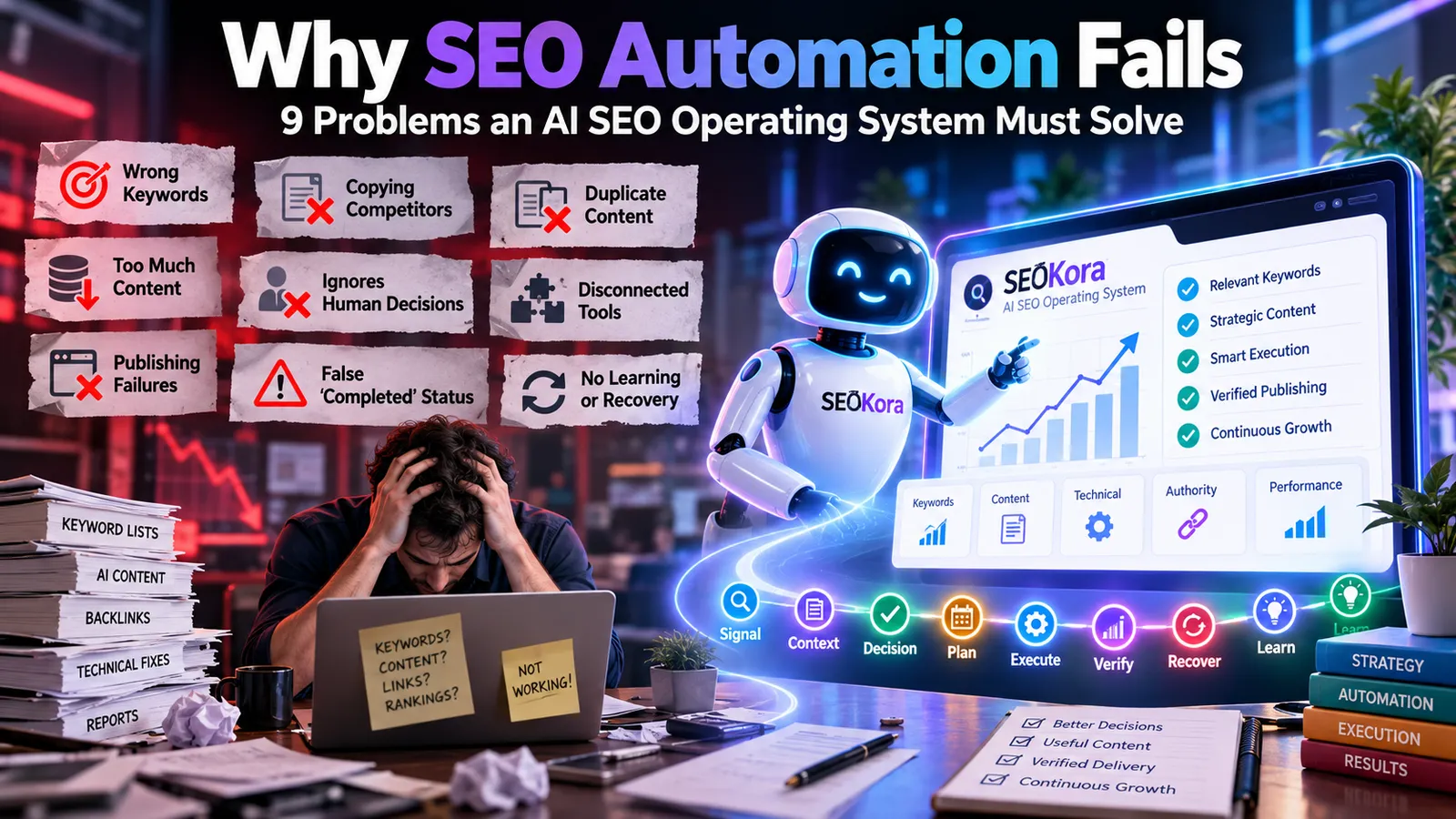
SEO automation sounds simple in theory.
Connect the data. Find keywords. Generate content. Fix technical issues. Build links. Publish changes. Track rankings. Repeat.
If every step can be automated, why should search engine optimization still require so much human coordination?
Because the difficult part of SEO is rarely performing an isolated task.
The difficult part is deciding which task deserves to happen, when it should happen, what evidence justifies it, whether it conflicts with previous work, and whether the intended result actually reached the website.
That is where many SEO automation systems break down.
They automate actions without adequately coordinating the decisions around those actions.
An AI system can generate ten articles in minutes. That does not prove the website needed those ten articles.
A crawler can identify hundreds of issues. That does not mean all of them deserve immediate engineering work.
A competitor tool can discover thousands of keywords. That does not mean those keywords belong in your strategy.
The real challenge is therefore not simply:
How much SEO can we automate?
It is:
How can we automate SEO without automating bad decisions?
This article examines nine problems that an effective SEO automation system needs to solve—and the operating principles SEOKora is being built around to address them.
The Difference Between SEO Automation and an SEO Operating System
Before examining the failures, it helps to separate two ideas.
SEO automation usually means automating individual tasks.
Examples include:
- running scheduled site crawls;
- generating keyword ideas;
- creating content briefs;
- drafting articles;
- monitoring rankings;
- finding internal-link opportunities;
- detecting technical problems;
- and producing reports.
These automations can save substantial time.
But an AI SEO operating system needs another layer.
It must coordinate those tasks around a persistent understanding of the website and its priorities.
A simplified operating cycle looks like this:
Signal → Context → Decision → Plan → Execute → Verify → Recover → Learn
| Stage | Core Question |
|---|---|
| Signal | What changed or what opportunity appeared? |
| Context | What does it mean for this particular website? |
| Decision | Does anything actually need to happen? |
| Plan | What should happen, and when? |
| Execute | Can the approved action be completed safely? |
| Verify | Did the intended result really go live? |
| Recover | If something failed, what happens next? |
| Learn | What should this evidence change about future decisions? |
The difference is important.
Automation performs tasks.
An operating system must coordinate consequences.
Problem #1: Automating the Wrong Keywords
Keyword discovery has become incredibly efficient.
Modern SEO platforms can surface thousands of terms from competitor rankings, Search Console data, keyword databases, content gaps and AI-assisted research.
That abundance creates a new problem.
Not every keyword that exists deserves to be targeted.
Imagine a website discovers these four opportunities:
| Keyword | Surface Signal | Question Automation Must Ask |
|---|---|---|
| Keyword A | High search volume | Is it relevant to the business? |
| Keyword B | Competitor ranks | Do we actually serve the same intent? |
| Keyword C | Position 12 | Would improving the existing page be better? |
| Keyword D | No current ranking | Is a new page justified? |
A simplistic system sees opportunities.
A context-aware system sees decisions.
Search volume, ranking difficulty and competitor coverage are useful evidence, but they do not understand the business by themselves.
A strong SEO automation system therefore needs filters for:
- business relevance;
- search intent;
- existing coverage;
- commercial relevance;
- topical fit;
- previous human decisions;
- and current priorities.
The objective should not be to target the maximum number of keywords.
It should be to select the smallest useful set of opportunities capable of moving the website forward.
Problem #2: Treating Every Competitor Gap as Your Gap
Competitor analysis is one of SEO's most useful research methods.
It is also one of the easiest to automate badly.
Suppose three competing websites publish articles about a particular subject and receive organic traffic from them.
Your website does not cover that subject.
A content-gap system may correctly identify the difference.
But a dangerous automation rule would be:
Competitor has content + we do not = create content.
Your competitor's strategy is not automatically your strategy.
Their topic may:
- serve a different audience;
- support a different product;
- target another geography;
- have weak commercial relevance;
- sit outside your expertise;
- duplicate something you already cover;
- or simply be a bad decision they made first.
Competitor intelligence should therefore become an input, not an automatic instruction.
This is particularly important when combining an operating layer such as SEOKora with specialist intelligence platforms.
As discussed in our SEOKora vs Ahrefs comparison, deep competitive intelligence becomes most useful when relevant findings can be filtered through business context before becoming work.
Problem #3: Creating New Content When the Website Needs Improvement Instead
AI makes creating a new article extraordinarily easy.
That convenience can produce a dangerous bias:
New keyword → new article.
But many SEO opportunities do not require another URL.
Imagine a website already has a page ranking between positions 8 and 15 for several useful queries.
Instead of improving that page, an automated content engine creates another article targeting almost the same intent.
The website may now have:
- two overlapping pages;
- split internal links;
- duplicated information;
- unclear search intent;
- and possible cannibalization.
The automation technically completed its job.
Strategically, it may have made the website worse.
A better decision tree is:
| Question | Possible Action |
|---|---|
| Does a relevant page already exist? | Evaluate that page first |
| Does it satisfy the same search intent? | Improve rather than duplicate |
| Is the existing page structurally unsuitable? | Consider a dedicated asset |
| Would another URL compete with it? | Avoid unnecessary creation |
| Is there a genuinely distinct intent? | A new page may be justified |
Content automation becomes much more useful when it knows when not to generate content.
Problem #4: Confusing More Content With More SEO
Once content generation becomes cheap, production volume becomes an attractive metric.
“We generated 100 articles this month” sounds impressive.
But article count is an operational output, not an SEO outcome.
A website does not necessarily benefit from publishing more URLs.
Every new page creates responsibilities:
- quality control;
- internal linking;
- crawl management;
- future updating;
- content differentiation;
- performance monitoring;
- and potential consolidation later.
The wrong automation model optimizes for production.
The better model optimizes for usefulness.
The objective of SEO automation should not be maximum activity. It should be maximum useful progress with minimum unnecessary work.
Sometimes that means publishing.
Sometimes it means improving.
Sometimes it means fixing.
Sometimes it means waiting for more evidence.
Problem #5: Forgetting Human Decisions
This is one of the most frustrating failures in supposedly intelligent software.
Imagine an SEO system recommends a keyword.
A human reviews it and rejects it because it is irrelevant.
Three days later the system recommends the same keyword.
The human deletes it again.
A week later it appears as a “critical content opportunity.”
The system has data.
It has automation.
But it has no useful memory of the decision.
Human intervention should not disappear after the click.
Meaningful decisions can become persistent context.
| Human Decision | What the System Should Learn |
|---|---|
| Reject irrelevant keyword | Suppress or heavily down-rank similar recommendations |
| Delete unwanted topic | Do not continuously recreate it |
| Prefer existing page | Avoid unnecessary new URL |
| Reject prospect | Prevent repeated outreach attempts |
| Approve recurring low-risk work | Reduce unnecessary future interruption |
This creates an important principle for SEOKora:
Human judgment today should reduce unnecessary human intervention tomorrow.
Problem #6: Connecting Tools Without Connecting Decisions
Many SEO automation stacks are assembled from multiple services.
For example:
Search data → spreadsheet → AI model → project manager → CMS → analytics dashboard.
Technically, everything may be connected.
Operationally, the workflow may still be fragmented.
The keyword tool does not necessarily know what the content system rejected.
The content generator may not know what already exists on the site.
The publishing system may not understand the strategic reason behind the article.
The reporting dashboard may show performance without knowing which intervention caused the change.
APIs solve data movement.
They do not automatically solve decision continuity.
This is one reason the idea of an AI SEO operating system matters.
The operating layer needs to preserve the relationship between:
Why → What → When → Action → Result.
Problem #7: Assuming a Successful API Call Means Successful Publishing
This is where automation collides with the real world.
Imagine the system:
- finds an opportunity;
- creates an article;
- passes quality checks;
- sends it to the CMS;
- records the publication job;
- and moves on.
But the CMS rejects the request.
Or authentication expires.
Or a network request times out.
Or the scheduled job never runs.
Or the page publishes without the expected metadata.
If the system reports “completed,” the dashboard is measuring internal activity rather than customer delivery.
This leads to one of the most important principles in SEO automation:
Generated ≠ Published ≠ Verified.
| Status | What It Actually Means |
|---|---|
| Generated | The asset exists |
| Approved | Required control gate passed |
| Scheduled | A delivery attempt has been planned |
| Published | The CMS accepted publication |
| Verified | The expected live result was confirmed |
| Failed | The intended result was not delivered |
For customers, verified delivery is a much more meaningful metric than AI activity.
Problem #8: Automation That Cannot Recover
Failures are inevitable in automated systems.
The important question is what happens afterward.
A brittle workflow looks like this:
Execute → Fail → Stop.
A resilient workflow looks more like:
Execute → Verify → Detect Failure → Diagnose → Safely Retry or Escalate.
Not every failure should wake up the customer.
If a temporary CMS problem can be safely retried, the system should be able to recover.
If a job becomes stuck, it should not remain invisible forever.
If repeated retries would create duplicate publication, retry logic must understand idempotency.
If recovery requires a strategic decision, then human intervention becomes appropriate.
| Failure Type | Preferred Response |
|---|---|
| Temporary network failure | Safe retry |
| Expired authentication | Recover if possible or request reconnection |
| Duplicate-risk publication | Verify existing state before retry |
| Quality failure | Repair or return to review |
| Strategic ambiguity | Escalate to human |
| Persistent critical failure | Notify clearly with required action |
Automation should therefore be judged not only by how often it succeeds.
It should also be judged by how intelligently it behaves when something goes wrong.
Problem #9: Automation That Never Learns From Results
The final failure is perhaps the biggest.
Many automated systems are actually repeating systems.
They perform the same workflow again and again without meaningfully changing their behavior based on what happened previously.
True continuous optimization requires a feedback loop.
Suppose a page is improved because it ranks near page one for a commercially relevant query.
The work is published and verified.
Over the following weeks, new evidence appears.
Possible outcomes include:
- visibility improves;
- click-through rate improves;
- rankings remain unchanged;
- another query begins emerging;
- performance declines;
- or the page becomes less strategically important.
The system should not treat the original intervention as the end of the story.
The result becomes new evidence.
That evidence should influence future prioritization.
This creates the complete operating loop:
Discover → Understand → Prioritize → Plan → Execute → Verify → Measure → Learn → Reprioritize.
What Good SEO Automation Should Actually Automate
After examining these failures, the answer is not to avoid automation.
It is to automate at the correct level.
| Weak Automation Goal | Stronger Operating Goal |
|---|---|
| Generate more keywords | Identify relevant opportunities |
| Generate more articles | Create content only when justified |
| Copy competitor topics | Use competitor evidence selectively |
| Fix every detected issue | Prioritize meaningful issues |
| Send more outreach | Pursue credible authority opportunities |
| Reduce all human involvement | Reserve humans for meaningful decisions |
| Mark jobs completed | Verify customer-visible outcomes |
| Repeat workflows | Learn from outcomes and interventions |
The Role of the Human Changes—It Does Not Disappear
AI automation is sometimes presented as replacing the SEO professional or removing the business owner from SEO entirely.
That is not necessarily the most useful objective.
A better goal is to change where humans spend their attention.
Humans are expensive when used for repetitive coordination.
They are valuable when used for judgment.
Routine work can often proceed automatically.
Unusual, destructive, ambiguous or strategically important decisions may deserve human attention.
The ideal operating model is therefore not:
Human does everything.
Nor is it:
AI does everything.
It is:
Automation handles routine operations; humans intervene where judgment materially improves the decision.
Why This Matters More for Small Businesses
Large organizations can distribute SEO work across specialists.
They may have:
- SEO strategists;
- content writers;
- editors;
- developers;
- digital PR teams;
- analysts;
- and project managers.
A small business may have one owner and a freelancer.
For that business, the problem is not necessarily access to SEO software.
There are already excellent tools available.
The problem is operating everything consistently.
Someone still needs to interpret the dashboard, decide what matters, organize the work, publish it, detect failures and come back later to measure what happened.
This is why operational automation can matter as much as research automation.
How SEOKora Fits Into This Model
SEOKora is being developed around the idea that SEO should function as an ongoing operating cycle rather than a collection of disconnected AI tasks.
The objective is not to remove research.
Research remains essential.
The objective is to connect useful evidence with controlled execution.
That means coordinating:
- search and website signals;
- competitor intelligence;
- keyword relevance;
- existing content;
- technical opportunities;
- authority opportunities;
- planning and quotas;
- quality controls;
- CMS delivery;
- verification;
- recovery;
- and subsequent performance evidence.
This is the distinction explored in our earlier guide to the AI SEO operating system and our comparison of SEO data versus continuous execution.
The system should not merely ask:
“What can AI do?”
It should continuously ask:
“What useful SEO work should happen next, and can we prove that it happened?”
What SEO Automation Should Never Promise
Automation can make SEO operations faster and more consistent.
It cannot control search engines.
No third-party SEO platform has access to Google's internal ranking systems in a way that allows it to guarantee specific organic positions.
A responsible SEO automation product should therefore avoid promises such as:
- guaranteed number-one rankings;
- guaranteed traffic increases;
- guaranteed indexing;
- or guaranteed revenue from a particular optimization.
The appropriate promise is operational rather than magical:
better evidence, better prioritization, more consistent execution, clearer verification and a stronger feedback loop.
A Better Test for AI SEO Software
When evaluating SEO automation software, ask more than whether it contains AI.
Ask:
- How does it decide which opportunities are relevant?
- Does it understand existing website content before creating more?
- Can it remember rejected recommendations?
- How does it prioritize competing tasks?
- Can humans intervene without becoming full-time operators?
- What happens when publication fails?
- How does it prevent duplicate actions?
- Does it distinguish generated work from verified delivery?
- Does performance evidence influence future decisions?
Those questions reveal far more about an automation platform than the number of AI buttons on its dashboard.
Frequently Asked Questions
What is SEO automation?
SEO automation is the use of software to perform or coordinate repetitive search optimization tasks such as keyword analysis, technical auditing, content workflows, rank monitoring, internal linking and reporting. More advanced systems can also prioritize, execute and verify selected actions.
Why does SEO automation fail?
SEO automation often fails when task execution is separated from business context. Common problems include irrelevant keyword targeting, unnecessary content generation, repeated recommendations, fragmented tools, failed publishing and a lack of feedback from previous outcomes.
Can AI fully automate SEO?
AI can automate substantial parts of research, analysis, production and workflow coordination, but strategic ambiguity, business context and high-risk decisions can still require human judgment. The useful objective is not necessarily zero human involvement but far less unnecessary human operation.
Can automated SEO create duplicate content?
Yes. A poorly designed system may create new pages for keywords already covered by existing URLs. Effective automation should map opportunities against current content and search intent before deciding whether a new page is justified.
Should every competitor content gap become an article?
No. Competitor gaps are research signals. A topic should also be evaluated for audience relevance, business fit, existing coverage, search intent and strategic value before becoming content.
What is verified SEO delivery?
Verified delivery means confirming that the intended action actually reached its expected live state. For example, generating an article is not the same as publishing it, and an attempted CMS publication is not the same as confirming that the correct page is live.
What happens when automated SEO publishing fails?
A resilient system should detect the failure, preserve the relevant state, safely retry recoverable problems and escalate only when human action is genuinely required. It should also prevent retries from creating duplicate publications.
Does SEO automation guarantee rankings?
No. Search engines control their ranking systems. Automation can improve the consistency and efficiency of SEO work, but it cannot guarantee a particular ranking, traffic level or business result.
What makes an AI SEO operating system different?
An AI SEO operating system goes beyond automating isolated tasks. It attempts to coordinate signals, business context, prioritization, planning, execution, verification, recovery and learning as one continuous operating cycle.
Conclusion: Automate the Process, Not the Mistakes
The future of SEO is likely to contain far more automation than the past.
Keyword discovery will become faster.
Content production will become easier.
Technical analysis will become more automated.
Competitive intelligence will become richer.
AI visibility will add another layer of evidence.
But none of those advances remove the fundamental requirement for good decisions.
In fact, as execution becomes cheaper, decision quality becomes more important.
A system capable of generating 100 bad actions is not more intelligent than a human capable of making one good decision.
The stronger model is a controlled loop:
Signal → Context → Decision → Plan → Execute → Verify → Recover → Learn.
That is the operating philosophy behind SEOKora.
Not automation for the sake of activity.
Not AI for the sake of AI.
But an attempt to make SEO work continuously while preserving context, accountability and human judgment where they matter.
Because the real objective is not to automate more SEO.
It is to automate the right SEO work—and know whether it actually happened.