SEO Conversion Optimization: How to Turn Organic Traffic Into Leads, Customers, and Revenue
Learn how SEO conversion optimization turns organic traffic into leads and customers by matching search intent, improving landing pages, building trust and removing conversion barriers.
Getting more traffic from Google feels good.
Rankings improve. Impressions go up. More people visit the website.
But then comes the question that actually matters:
What happens after those visitors arrive?
If 10,000 people visit your website but almost nobody books, buys, calls, signs up, requests a quote, or takes another useful action, more traffic alone may not solve the problem.
This is where SEO conversion optimization becomes important.
SEO should not stop when someone clicks a search result.
The full journey looks more like this:
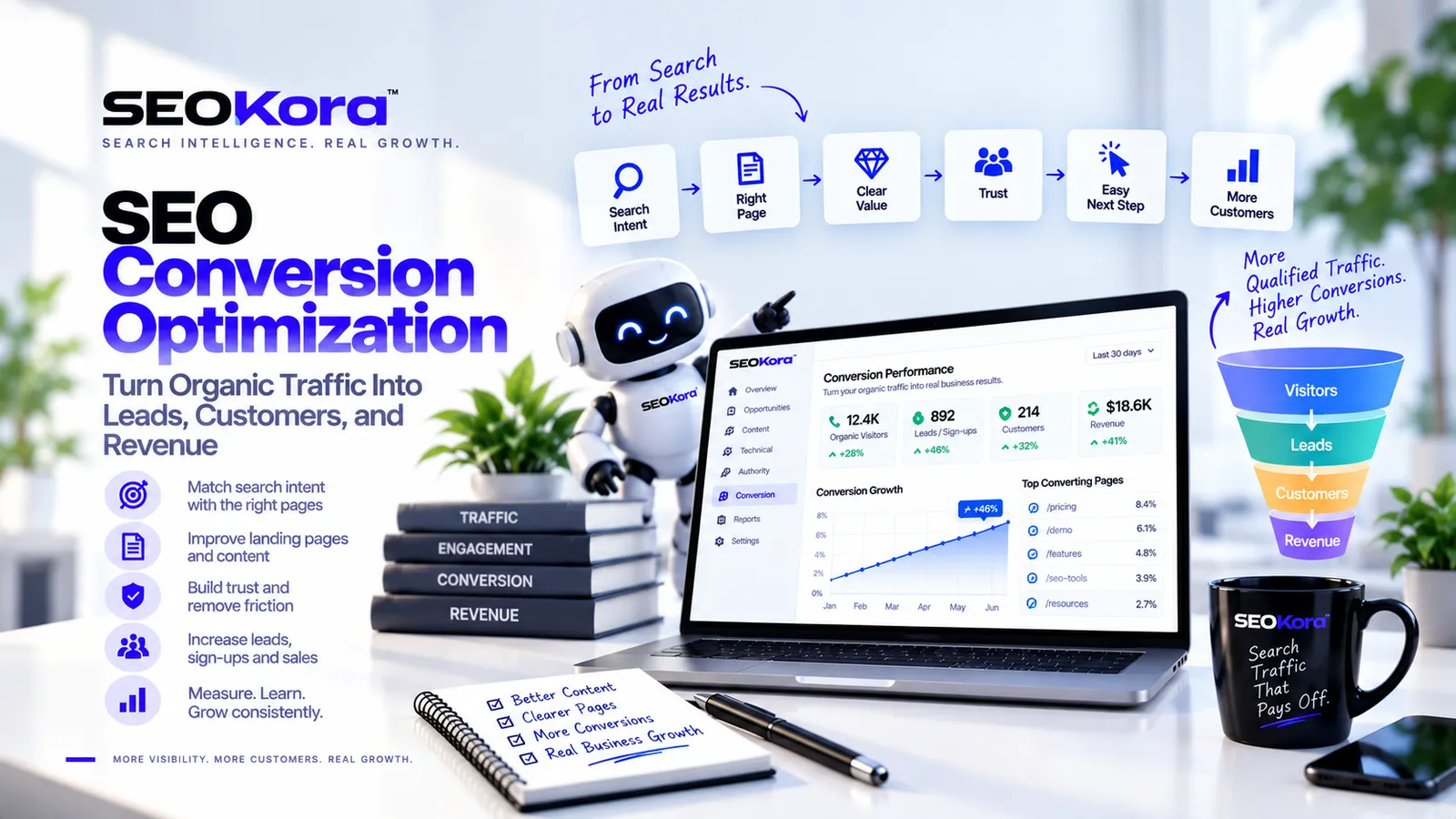
Search → Click → Understand → Trust → Take Action → Become a Lead or Customer
Every step matters.
This guide explains how businesses can connect organic visibility with conversion without turning every page into an aggressive sales pitch.
What Is SEO Conversion Optimization?
SEO conversion optimization is the process of improving the journey between organic search traffic and meaningful business outcomes.
A conversion does not always mean an immediate sale.
Depending on the business, a useful conversion might be:
- buying a product,
- booking an appointment,
- requesting a quote,
- calling the business,
- starting a free trial,
- creating an account,
- submitting a lead form,
- joining a waiting list,
- downloading something useful,
- or moving to the next important stage of the customer journey.
The goal is simple:
Bring the right person to the right page, give them what they expected, build enough confidence, and make the next useful action easy.
Traffic Is Not the Same as Growth
This is one of the easiest SEO mistakes to make.
Imagine two websites.
Website A receives 100,000 organic visits every month.
Website B receives 20,000.
Which business has the better SEO?
There is not enough information to answer.
If Website A attracts mostly irrelevant visitors while Website B attracts people actively looking for its products and services, Website B may create far more business value.
This is why SEO performance should not be judged only by:
- traffic,
- impressions,
- keyword counts,
- or rankings.
Those metrics are useful.
But they describe visibility.
They do not automatically describe business impact.
A Practical SEO Conversion Framework
A useful SEO conversion process can follow this path:
Search Demand → Search Intent → Right Page → Clear Value → Useful Content → Trust → Easy Next Step → Conversion → Measurement → Learning → Improvement
This builds on the wider SEO Strategy FrameworkSEOKora.
Before trying to improve conversion, you need to understand why the visitor arrived in the first place.
1. Start With Search Intent
Search intent simply means:
What is this person actually trying to do?
Consider these searches:
“what is technical SEO”
“best SEO software for small business”
“SEO software pricing”
“buy SEO software”
They are all related to SEO.
But the person behind each search may be at a different stage.
Someone asking what technical SEO is may primarily want to learn.
Someone comparing software may be evaluating options.
Someone searching pricing may be much closer to making a decision.
If you treat all four visitors exactly the same, the experience can feel wrong.
2. Match the Visitor With the Right Page
A common SEO problem is sending every type of search traffic to whichever page currently ranks.
That page may not be the best destination.
For example:
- an informational search may need a useful guide,
- a comparison search may need a comparison or solution page,
- a local search may need a location or service page,
- a pricing search may need clear commercial information,
- and a product search may need the relevant product page.
Good SEO conversion starts before the visitor lands on the website.
It begins by deciding which page should own which intent.
This is also why Content Gap AnalysisSEOKora matters.
Sometimes the conversion problem exists because the correct page does not exist yet.
3. Make the Page Purpose Obvious
When someone opens a page, they should not need thirty seconds to understand what they are looking at.
The top of the page should make the basics clear:
- what this page is about,
- who it is for,
- what problem it helps solve,
- and what the visitor can do next.
This does not require a huge headline full of marketing language.
Usually, clarity works better.
For example:
“We help businesses grow.”
sounds positive, but it tells the visitor very little.
A more useful message might explain:
“SEO software that finds search opportunities, prioritizes the work, helps execute improvements, and tracks what actually reached your website.”
Now the visitor understands much more quickly what the product is designed to do.
4. Answer the Question Before Pushing the Sale
Not every organic visitor is ready to buy.
This is especially important for articles and educational resources.
If someone searches:
“how to perform a technical SEO audit”
they probably want help with a technical SEO audit.
If the page immediately becomes:
BUY OUR SOFTWARE. START NOW. BOOK A DEMO.
the visitor may leave before understanding whether the company can actually help.
A stronger approach is:
Help first. Demonstrate expertise. Then show the relevant next step.
This is exactly why useful resource content can support both Website AuthoritySEOKora and conversion.
5. Make the Value Easy to Understand
Customers do not buy feature lists.
They buy outcomes.
Suppose an SEO platform says:
“Includes automated opportunity clustering.”
That describes a feature.
But the customer may still ask:
Why should I care?
A clearer explanation might be:
“SEOKora groups related search opportunities so you can focus on the pages and topics that matter instead of working through thousands of disconnected keywords.”
Now the feature is connected to a problem the customer understands.
Good conversion copy repeatedly answers:
- What is this?
- Why does it matter?
- How does it help me?
- What happens next?
6. Trust Is Part of Conversion
A visitor may understand your offer perfectly and still not take action.
Why?
Because understanding and trust are different things.
Trust can be strengthened through genuine signals such as:
- clear company information,
- transparent pricing where appropriate,
- real customer reviews,
- case studies,
- real product screenshots,
- accurate contact information,
- clear policies,
- useful educational content,
- credible external references,
- and realistic claims.
One of the fastest ways to damage trust is to promise things nobody can responsibly guarantee.
Claims such as:
“Guaranteed #1 ranking.”
or:
“Guaranteed AI recommendation.”
may sound powerful, but they can make a serious customer more skeptical.
Strong marketing does not need fake certainty.
7. Calls to Action Should Match the Visitor
A call to action, or CTA, is simply the next action you want the visitor to consider.
Examples include:
- Start Free Trial
- View Pricing
- Book a Consultation
- Request a Quote
- Check Availability
- Create Account
- Compare Plans
- Learn More
The strongest CTA depends on the page.
A person reading an educational article may not be ready to buy immediately.
But they may be ready to:
- see how the product solves the problem,
- view a relevant feature,
- compare plans,
- or continue to another useful resource.
The CTA should feel like a natural next step.
Not an interruption.
8. Remove Unnecessary Friction
Sometimes conversion problems have nothing to do with SEO copy.
The website simply makes things difficult.
Common examples include:
- forms asking for too much information,
- important buttons hidden on mobile,
- confusing navigation,
- unclear pricing,
- broken checkout flows,
- slow pages,
- poor mobile layouts,
- buttons that do not work,
- and unclear next steps.
Each additional barrier gives the visitor another reason to leave.
Conversion optimization often means removing unnecessary work.
9. Mobile Conversion Deserves Special Attention
A page can look excellent on a desktop and become frustrating on a phone.
On mobile, check whether:
- the main message is visible,
- text is readable,
- buttons are easy to tap,
- forms are practical,
- menus work properly,
- important information is not buried,
- and the page loads reliably.
This becomes especially important for Local SEOSEOKora, where people may be searching on a phone because they want to call, book, get directions, or visit a business soon.
10. Internal Linking Can Move Visitors Through the Journey
Internal links are usually discussed as an SEO technique.
They also affect conversion.
Imagine someone arrives on a guide about competitor analysis.
They may naturally want to understand:
- how authority gaps are identified,
- how content opportunities are prioritized,
- how SEOKora performs competitive research,
- or which product features can help them act on the findings.
Relevant internal links can guide them there.
This creates a journey instead of a dead end.
The key word is relevant.
Internal linking should help the visitor continue logically.
11. Commercial Pages Need Different Information From Articles
An article and a product page have different jobs.
A useful article might explain:
- what a problem is,
- why it happens,
- how to think about it,
- and how to solve it.
A commercial page may need to explain:
- what the product does,
- who it is for,
- which problems it solves,
- how it works,
- what is included,
- how much it costs,
- why it is different,
- and what the customer should do next.
Trying to make every page do everything usually creates confusing pages.
12. High Traffic Pages Are Not Always the Highest Priority
Suppose one article gets 30,000 visits per month but almost everyone is looking for free information unrelated to your product.
Another page receives only 2,000 visits but those visitors are actively comparing solutions like yours.
The smaller page may deserve more conversion attention.
This is why prioritization should consider:
Traffic × Intent × Business Relevance × Conversion Potential
rather than traffic alone.
This connects directly with the prioritization principles in our SEO Strategy FrameworkSEOKora.
13. Look for Pages With Visibility but Weak Outcomes
Some of the best conversion opportunities already have traffic.
Look for pages that:
- receive meaningful organic visits,
- rank for commercially relevant searches,
- attract the right audience,
- but generate fewer useful actions than expected.
Then investigate why.
The problem could be:
- intent mismatch,
- unclear messaging,
- weak trust,
- poor CTA placement,
- missing product information,
- mobile problems,
- slow performance,
- or a difficult conversion path.
Sometimes improving an existing page is more valuable than publishing another article.
14. Search Queries Can Reveal Conversion Problems
The queries bringing visitors to a page provide useful clues.
Imagine a page was written for people ready to compare SEO software.
But most of its traffic comes from searches asking:
“What is SEO?”
The page may be attracting the wrong stage of the customer journey.
Or imagine an educational guide begins ranking for:
“SEO software pricing.”
That may reveal a missing or weak commercial page.
Search data is therefore useful not only for finding keywords.
It can help diagnose whether the website's page structure matches real customer intent.
15. Conversion Problems Can Reveal Content Gaps
Sometimes a visitor cannot convert because an important question has not been answered.
For example:
- How much does it cost?
- Does it work with my CMS?
- Is it suitable for my business size?
- Can I cancel?
- How does onboarding work?
- What happens after I connect my website?
- Which features are included in my plan?
- How is my data handled?
If customers repeatedly need information that the website does not provide clearly, that is a content gap.
Content-gap research should therefore include the customer journey, not only search volume.
16. Measure the Right Conversions
Not every button click deserves to be treated as a business success.
Before reporting conversion performance, define which actions actually matter.
For example:
A SaaS company may track:
- account creation,
- trial activation,
- plan selection,
- paid subscription,
- demo requests,
- and qualified leads.
A local business may care more about:
- calls,
- appointments,
- direction requests,
- quote requests,
- and completed bookings.
An ecommerce business may focus on:
- product views,
- add-to-cart actions,
- checkout starts,
- completed purchases,
- and revenue.
Measurement should reflect the business model.
17. Revenue Is Important — But Attribution Is Not Perfect
Customers do not always follow a simple journey.
Someone may:
discover your brand through Google,
read an article,
leave,
see the brand again later,
search the brand directly,
and finally buy.
If you look only at the final click, the original SEO discovery may disappear from the story.
This means attribution should be used carefully.
Use the available data to make better decisions, but avoid pretending every customer journey can be measured perfectly.
18. Test Meaningful Changes
Conversion optimization does not mean changing button colors every week.
Start with meaningful questions.
For example:
- Do visitors understand the product?
- Is pricing confusing?
- Does the page answer the main objection?
- Is the CTA appropriate for the visitor's intent?
- Is important proof missing?
- Is the form too difficult?
- Does the mobile experience work?
Then make a change based on evidence.
Measure what happens.
Keep what helps.
Reconsider what does not.
19. SEO and Conversion Optimization Should Work Together
SEO teams often focus on getting visitors to the page.
Conversion teams focus on what happens afterward.
That separation can create problems.
An SEO change might increase traffic while reducing conversion quality.
A conversion change might remove useful content that helped the page satisfy search intent.
A better system considers both.
The objective becomes:
Improve search visibility without losing user value, and improve conversion without damaging search relevance.
20. How SEOKora Connects SEO With Conversion
This is where SEOKora's approach goes beyond simply showing more keyword charts.
A business does not need another dashboard telling it:
“Traffic increased by 14%.”
That information is useful.
But the next question should be:
Did the traffic help the business?
SEOKora is designed to connect search intelligence with action.
SEOKora first understands what the business is trying to achieve
Conversion means different things for different customers.
For one business, success may be a subscription.
For another, it may be an appointment.
For another, a qualified lead.
For another, a purchase.
That means the system needs business context before interpreting SEO performance.
SEOKora can use information about:
- the business model,
- products and services,
- target audience,
- markets,
- locations,
- languages,
- commercial priorities,
- and important customer actions.
This gives SEO work a direction beyond “get more traffic.”
SEOKora finds opportunities beyond existing Google Search Console data
Existing search data is extremely useful.
It tells us what is already happening.
But it cannot show every opportunity the website has never reached.
SEOKora can combine existing performance with independent research into:
- search demand,
- competitors,
- content gaps,
- market opportunities,
- authority gaps,
- and customer intent.
This helps separate:
What the website already gets traffic for
from:
What the business should be competing for next.
SEOKora can identify high-value pages that deserve attention
Not every page should receive the same amount of work.
SEOKora can help identify situations such as:
- a page with strong impressions but weak clicks,
- a page receiving relevant traffic but weak business actions,
- a commercial page that is losing visibility,
- an informational page attracting valuable prospects but offering no useful next step,
- a high-value query landing on the wrong page,
- or an existing page that could perform better with an improvement rather than a replacement.
This creates a more useful priority list than simply sorting pages by traffic.
SEOKora connects intent with the correct destination
If a query has commercial intent but lands on an informational article, the system can identify the mismatch.
The right action might be:
- improve the existing page,
- create a better destination,
- strengthen internal linking,
- clarify the CTA,
- consolidate overlapping pages,
- or leave the page alone if it already serves the intent well.
The goal is not to create more pages by default.
The goal is to create a better search-to-customer journey.
SEOKora can connect content work with commercial goals
Content planning should not exist in a separate world from the business.
If SEOKora identifies a topic opportunity, the next questions can include:
- Which customer problem does this solve?
- Where does it fit in the buying journey?
- Which product or service does it naturally support?
- What should the visitor understand next?
- Which internal pages should connect to it?
This allows educational content to remain genuinely useful while still supporting growth.
SEOKora can improve existing pages instead of endlessly publishing new ones
Sometimes the best SEO action is not another article.
A page may already have authority, impressions, traffic, and useful rankings.
But it may need:
- clearer positioning,
- better structure,
- updated information,
- stronger internal links,
- better answers to customer questions,
- a clearer next step,
- or improved technical performance.
SEOKora can identify these improvement opportunities alongside new-content opportunities.
This helps protect existing assets instead of constantly replacing them with new URLs.
SEOKora connects technical SEO with conversion
Technical problems are not only search problems.
A broken button, missing image, slow page, failed form, incorrect mobile layout, or inaccessible page can also become a conversion problem.
SEOKora's technical workflows can help surface issues affecting important pages and connect them to their potential business impact.
This follows the same impact-first approach explained in our Technical SEO AuditSEOKora.
SEOKora connects authority and trust with the customer journey
A visitor is more likely to consider a business when the website gives them legitimate reasons to trust it.
Authority analysis can reveal opportunities around:
- useful supporting resources,
- external references,
- brand consistency,
- entity strength,
- relevant mentions,
- and stronger topic coverage.
These improvements can support both visibility and customer confidence.
SEOKora turns findings into work
Finding an opportunity is not the same as completing it.
A useful growth system needs a path from research to execution.
Depending on the customer's setup and authorization, SEOKora can connect validated opportunities with workflows for:
- content creation,
- page improvements,
- internal linking,
- technical fixes,
- metadata improvements,
- content consolidation,
- and other supported SEO actions.
The process becomes:
Discover → Understand → Prioritize → Execute → Verify → Measure → Learn
SEOKora verifies the live result
This matters.
A task saying “completed” does not necessarily mean the customer received the intended change.
If an article or page improvement is supposed to reach a website, SEOKora's delivery model can verify the live result after publication.
The stronger standard is:
Planned → Executed → Published → Verified Live → Measured
That prevents internal job status from being confused with actual customer delivery.
SEOKora learns from what happens next
SEO should not be a fixed plan created once and followed forever.
Markets change.
Competitors change.
Search behavior changes.
Pages gain and lose visibility.
Customer priorities change.
SEOKora can use performance feedback to decide what deserves attention next.
That creates a continuous loop:
Research → Act → Verify → Measure → Learn → Reprioritize → Improve.
This is the difference between SEO reporting and an SEO growth system.
21. What SEOKora Should Not Do
Conversion optimization becomes dangerous when automation starts making business decisions without enough context.
A responsible system should not:
- turn every article into an aggressive sales page,
- remove useful content simply to make room for CTAs,
- create fake reviews or testimonials,
- invent conversion data,
- claim revenue that cannot reasonably be attributed,
- promise guaranteed conversion increases,
- publish misleading urgency,
- create fake scarcity,
- or make major high-risk commercial changes without the appropriate controls.
Automation should help customers make better decisions.
It should not manipulate visitors or manufacture success.
22. A Practical SEO Conversion Optimization Workflow
- Define the business outcome. Decide which customer actions actually matter.
- Understand search intent. Learn why people are reaching each important page.
- Check the destination. Confirm that the right query is reaching the right page.
- Prioritize valuable pages. Focus on pages where visibility, intent, and business value overlap.
- Review the first impression. Make sure visitors quickly understand the page and its value.
- Check content quality. Answer the questions that brought the visitor there.
- Strengthen trust. Add legitimate evidence, clarity, and business information where needed.
- Improve the next step. Make the CTA useful and appropriate for the visitor's stage.
- Remove friction. Fix unnecessary form fields, confusing navigation, broken journeys, and mobile problems.
- Strengthen internal journeys. Connect visitors with the next relevant page.
- Check technical health. Make sure important conversion paths actually work.
- Measure meaningful actions. Track outcomes connected to the business.
- Verify changes live. Confirm that intended improvements reached the public website.
- Compare before and after. Look for meaningful changes rather than isolated vanity metrics.
- Learn and repeat. Use results to decide the next improvement.
SEO Conversion Optimization Checklist
Frequently Asked Questions
What is SEO conversion optimization?
SEO conversion optimization improves the journey between organic search traffic and meaningful customer actions. It combines search intent, landing-page quality, messaging, trust, user experience, calls to action, measurement, and ongoing improvement.
Is more organic traffic always better?
No. More relevant traffic is usually more useful than simply more traffic. A smaller audience actively interested in your product or service may create more business value than a much larger audience with little connection to what you sell.
What is a good SEO conversion rate?
There is no universal conversion rate that every website should target. Conversion depends on the industry, product, price, traffic intent, customer journey, conversion definition, device, market, and many other factors. Comparing relevant segments and your own historical performance is usually more useful than chasing a generic benchmark.
Should every SEO article have a sales CTA?
Not necessarily. Every page should have a useful purpose. An educational article may naturally lead to another resource, a relevant feature, a product explanation, or a commercial page. The next step should match the visitor's intent rather than forcing a sale.
Can SEO improve sales?
SEO can help businesses reach people who are searching for relevant information, products, or services. Whether that visibility becomes sales depends on the quality of the offer, website experience, customer intent, trust, pricing, competition, and conversion journey.
Should I create a new landing page for every keyword?
No. Keywords with the same underlying intent can often be served by one strong page. Creating unnecessary pages can create overlap and cannibalization. First determine whether the search represents a genuinely different customer need.
How can I find organic pages that need conversion improvement?
Look for pages with useful search visibility and relevant traffic but weaker-than-expected customer actions. Then review search intent, page messaging, trust, calls to action, mobile usability, technical health, and the next step in the journey.
Can AI optimize website conversions automatically?
AI can assist with analysis, research, copy suggestions, page comparisons, and identifying possible problems. But major decisions should still be based on real business context, customer behavior, reliable data, and appropriate controls.
How does SEOKora help with conversion optimization?
SEOKora connects business context with search intelligence, competitor research, content opportunities, technical SEO, authority, page improvements, execution, live verification, and performance feedback. This helps customers move from simply measuring traffic to identifying and acting on the SEO opportunities most likely to support meaningful business growth.
Does SEOKora guarantee more leads or revenue?
No responsible SEO system can guarantee a specific number of leads, sales, rankings, or revenue. SEOKora helps improve the factors a business can control: research quality, prioritization, content, technical health, website structure, execution, verification, and learning from performance.
Final Takeaway
SEO does not finish when someone clicks your result.
That click is the beginning of another journey.
The visitor still needs to understand you.
They need to find what they came for.
They need a reason to trust you.
And when they are ready, they need a clear and easy next step.
So do not ask only:
“How much organic traffic did we get?”
Also ask:
Did we attract the right people?
Did they land on the right page?
Did the page help them?
Did we make the next step obvious?
And did any of this create value for the business?
The SEO conversion cycle becomes:
Attract → Match → Help → Build Trust → Guide → Convert → Measure → Learn → Improve.
Because the goal is not simply to generate more clicks.
The goal is to turn useful search visibility into useful business growth.
Turn Search Visibility Into Real Business Growth With SEOKora
SEOKora is built to connect the parts of SEO that are often managed separately.
It combines business context, search intelligence, independent market research, competitor analysis, content gaps, technical SEO, website authority, AI visibility, page improvements, publishing workflows, live verification, and performance learning.
That means the process does not stop at:
“We found a keyword.”
or:
“Traffic went up.”
SEOKora helps move the process forward:
What opportunity did we find?
Why does it matter to this business?
Which page should own it?
Should we create something new or improve what already exists?
What work should happen next?
Did that work actually reach the live website?
And what did the results teach us?
For customers using supported automation and publishing workflows, SEOKora can help move validated SEO opportunities from research into execution while keeping quality, authorization, verification, and performance feedback connected.
The result is a simpler growth loop:
Understand the Business → Find the Opportunity → Prioritize What Matters → Execute the Work → Verify It Live → Measure the Result → Learn → Improve Again
That is the difference between collecting SEO data and actually using it.
SEOKora helps turn search intelligence into action — and action into measurable learning for the next stage of growth.