
Local SEO Strategy: How Businesses Build Visibility Across Google Search and Local Results
Learn how to build a practical local SEO strategy using local search demand, Google Business Profile, location pages, reviews, authority and measurable growth.
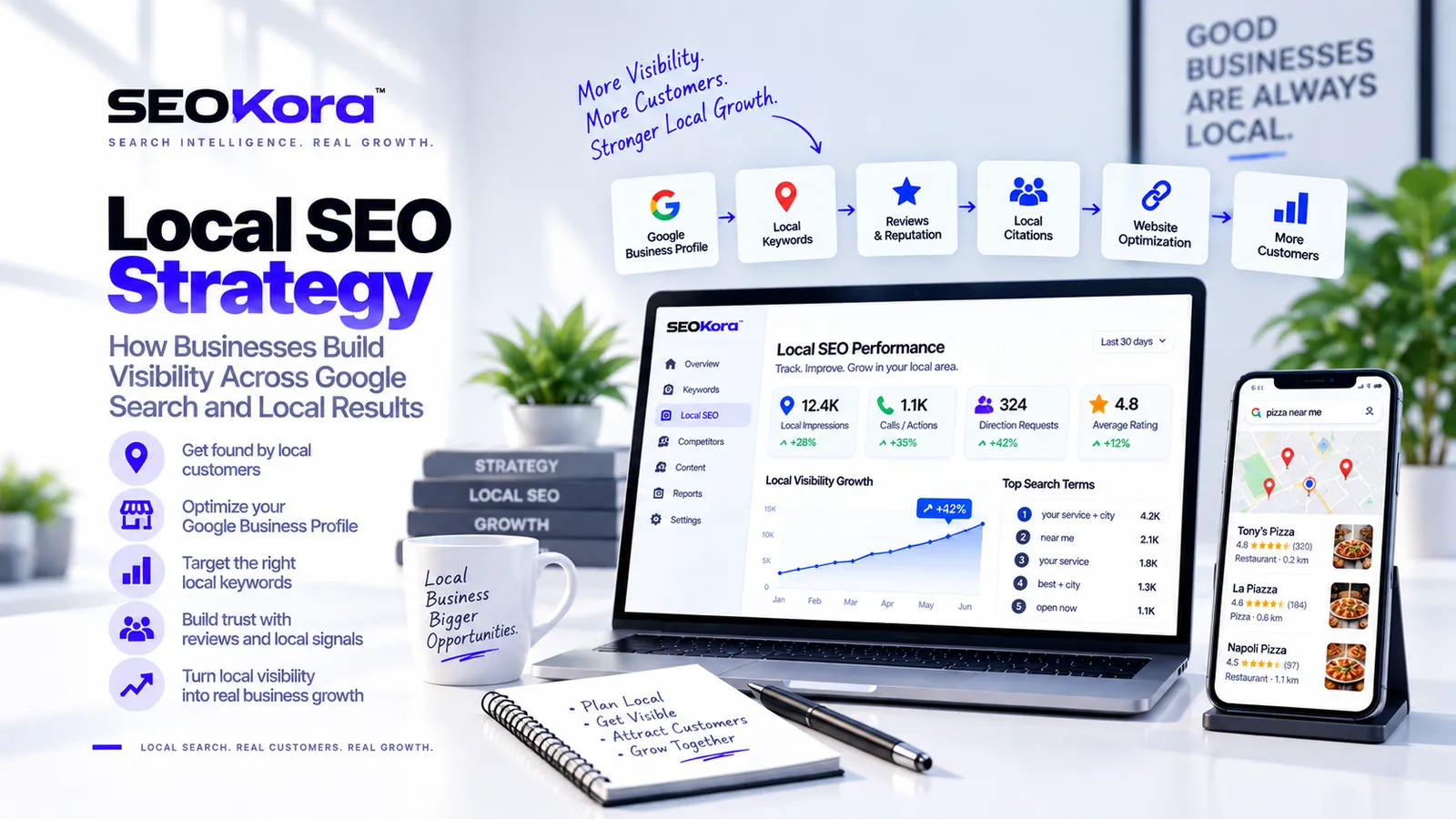
When someone searches for a service near them, they usually want an answer quickly.
They may search for a dentist nearby, an accountant in their city, a restaurant for tonight, a plumber who can visit their area, or a shop that sells a particular product.
For a local business, appearing at the right moment can be extremely valuable.
That is what local SEO is really about.
It is not simply about adding a city name to a page.
And it is not just about creating a Google Business Profile and waiting for customers to arrive.
A strong local SEO strategy connects several things:
The right business information + the right location + the right customer need + a useful website + a trustworthy local presence.
When those pieces work together, a business becomes easier to discover when people in its target area are actively looking for what it offers.
This guide explains how to build that system in a practical way.
What Is Local SEO?
Local SEO is the process of improving a business's visibility for searches connected to a specific location or service area.
For example:
- dentist in Madrid,
- Italian restaurant near me,
- plumber in Manchester,
- accountant in Barcelona,
- car repair near me,
- family lawyer in Chicago,
- hair salon in Valencia.
Sometimes the person includes the location directly.
Sometimes they simply search for something like:
“coffee near me”
or:
“best dentist nearby.”
In these cases, location becomes part of the search even when the city name is not typed.
A good local SEO strategy helps search engines understand:
- what the business does,
- where it is located,
- which areas it genuinely serves,
- how relevant it is to the search,
- and whether customers have reasons to trust it.
Local SEO Is More Than Google Maps
Many businesses think local SEO means only Google Maps.
Maps are important, but local visibility is broader than that.
A potential customer may discover a business through:
- Google Search,
- local map results,
- Google Business Profile,
- the business website,
- local directories,
- review platforms,
- industry websites,
- local publications,
- or other search and discovery experiences.
That means the business needs a consistent local presence, not one isolated profile.
A Practical Local SEO Framework
A useful local SEO strategy can follow this path:
Business Context → Service Area → Local Search Demand → Local Competitors → Google Business Profile → Website → Location & Service Pages → Reviews → Citations & Mentions → Local Authority → Conversion → Measurement → Improvement
The important part is the order.
Before creating pages, listings, or campaigns, understand the business.
Where does it actually operate?
What does it actually sell?
Who are the customers?
Which locations matter?
And what are people in those locations actually searching for?
1. Start With the Real Business Location and Service Area
Local SEO should begin with reality.
Imagine a business based in Madrid that serves customers across Madrid but does not operate in Barcelona.
Creating pages that make the company appear to have an office in Barcelona would not be a good local strategy.
Instead, define:
- the real business location,
- real branches or offices,
- cities genuinely served,
- neighborhoods that matter,
- delivery or service areas,
- and any geographic limitations.
This becomes the geographic foundation of the strategy.
It also prevents one of the most common local SEO mistakes: creating pages for places where the business has no meaningful presence or service.
2. Understand How Local Customers Actually Search
Business owners often describe their services differently from customers.
A company may use an industry-specific term while customers use something much simpler.
Local keyword research should therefore look at combinations of:
- service,
- problem,
- product,
- location,
- customer intent,
- and language.
For example, a customer may search:
emergency plumber Madrid
while another searches:
plumber near me open now
and another:
fix leaking pipe Madrid
These searches are related, but they reveal different needs.
The goal is not to create a separate page for every keyword variation.
The goal is to understand the customer behind the searches.
3. Language Matters in Local Search
Local markets are not always single-language markets.
A city may contain customers searching in several languages.
Businesses serving international residents, tourists, immigrant communities, or multilingual regions should consider how those audiences actually search.
But multilingual SEO should not mean automatically translating every page into every possible language.
Ask:
- Is there meaningful demand in this language?
- Can the business actually serve customers in that language?
- Does the translated page help the customer?
- Can the business maintain the information accurately?
Language strategy should follow the market, not simply create more URLs.
4. Find the Local Competitors That Actually Matter
The shop across the street is not automatically your biggest search competitor.
And the largest company in your industry may not be your main local competitor either.
Your real local search competitors are the businesses and websites repeatedly appearing for the searches your customers make.
That might include:
- another local business,
- a regional chain,
- a national company with strong local pages,
- a marketplace,
- a directory,
- or a specialist platform.
This is why competitor research should come from actual search behavior rather than assumptions.
Our SEO competitor analysis framework explains the wider principle: find the competitors that matter in search before deciding what gaps you need to close.
5. Build a Complete Google Business Profile
For many local businesses, Google Business Profile is one of the most important parts of local visibility.
The profile should accurately represent the real business.
Important information can include:
- business name,
- primary category,
- relevant additional categories,
- address where applicable,
- service area where applicable,
- phone number,
- website,
- opening hours,
- business description,
- services,
- photos,
- and other relevant profile information.
The objective is completeness and accuracy.
Do not add keywords to the business name simply to try to improve rankings.
Do not create fake locations.
Do not select irrelevant categories because they appear popular.
The profile should represent the business customers will actually find.
6. Your Website Still Matters
A Google Business Profile is powerful, but it does not replace the website.
The website provides space to explain:
- what the business offers,
- who it serves,
- where it operates,
- why customers should choose it,
- how services work,
- what customers can expect,
- and how to contact or buy from the business.
Search engines can also use the website to understand the relationship between the business, its services, and its locations.
A strong local strategy therefore connects the business profile and the website rather than treating them as separate projects.
7. Create Location Pages Only When They Are Useful
Location pages can be valuable.
They can also become one of the easiest ways to create low-value SEO content.
Imagine a company creates these pages:
- Plumber Madrid
- Plumber Barcelona
- Plumber Valencia
- Plumber Seville
- Plumber Malaga
If every page contains exactly the same text and only the city name changes, customers gain very little.
A useful location page should have a genuine reason to exist.
Depending on the business, that could include:
- services available in that location,
- real branch information,
- local contact details,
- service coverage,
- local pricing where relevant,
- location-specific customer questions,
- real photos,
- local testimonials,
- directions or accessibility information,
- and useful information specific to customers in that area.
The page should help someone in that location.
It should not exist only because the city has search volume.
8. Avoid Doorway-Style Location Pages
Creating hundreds of nearly identical city pages can look attractive because the keyword pattern is easy to scale.
But scale does not create value by itself.
This is particularly important when using automation.
A system should not take:
[Service] + [City]
and automatically create every possible combination.
Before creating a local page, ask:
- Does the business really serve this location?
- Is there meaningful demand?
- Does this location require its own information?
- Can the page provide unique value?
- Is another existing page already sufficient?
This connects directly with the principles in our Programmatic SEO guideSEOKora.
Automation should scale valid opportunities, not multiply thin pages.
9. Service Pages and Location Pages Are Different
This distinction can make local websites much easier to understand.
A service page explains what the business does.
A location page explains the business's relationship with a particular location.
Sometimes a combined service-location page is justified.
Sometimes it is not.
For example, a law firm may have:
- a main family law service page,
- a Madrid office page,
- and potentially a specific Madrid family law page if there is enough distinct demand and useful information to justify it.
The website should not automatically create every mathematical combination of services and locations.
That can quickly turn a useful website into hundreds of overlapping pages.
10. Reviews Are Part of Local Trust
Before contacting a local business, many customers want to know what previous customers experienced.
Reviews therefore play an important role beyond SEO.
They influence trust and conversion.
A healthy review process should make it easy for genuine customers to leave honest feedback.
Businesses can:
- ask customers for reviews at appropriate moments,
- provide a simple review link,
- respond professionally,
- learn from recurring complaints,
- and monitor important review platforms.
The goal should be genuine customer feedback.
Not fake reviews.
Not purchased reviews.
And not pressuring customers to provide only positive feedback.
11. Respond to Reviews Like a Human Business
A review response does not need to sound like an SEO paragraph.
If someone leaves a positive review, thank them naturally.
If someone leaves a negative review, understand the issue and respond professionally.
Customers reading the response are often just as important as the person who wrote the original review.
Good review management demonstrates that a real business is listening.
12. Keep Business Information Consistent
Local businesses often appear across multiple websites.
These can include:
- business directories,
- industry associations,
- local chambers,
- review platforms,
- maps,
- partner websites,
- social profiles,
- and local publications.
Important business information should be reasonably consistent.
For example:
- business name,
- address,
- phone number,
- website,
- and basic business details.
This does not mean the business needs to appear in every directory on the internet.
A smaller number of accurate, relevant listings is more useful than hundreds of low-quality submissions.
13. Local Citations Should Be Relevant
A citation is generally an online reference to a business and its identifying information.
Businesses sometimes treat citation building as a numbers game.
That can lead to mass submissions to websites that have no connection to the business or its customers.
A better approach asks:
- Is this directory relevant to the location?
- Is it relevant to the industry?
- Do real customers use it?
- Is the listing accurate?
- Does this platform add genuine visibility or trust?
If not, the listing may not deserve attention.
14. Build Local Authority Beyond Directories
Local authority can come from real participation in the market.
Depending on the business, opportunities may include:
- local publications,
- industry organizations,
- business associations,
- community partnerships,
- local events,
- suppliers,
- universities,
- charities,
- professional organizations,
- and relevant local websites.
The goal is not simply to obtain another backlink.
The stronger question is:
Where would it genuinely make sense for this business to be mentioned?
This connects with the wider authority principles in our Website Authority guideSEOKora.
15. Create Content That Helps Local Customers
Local content should not become a collection of city-name articles.
Think about questions people in the market genuinely need answered.
For example, a property business might create useful information about:
- buying property in a particular area,
- local market trends,
- neighborhood comparisons,
- transport connections,
- common buying costs,
- and local regulations.
A dental clinic might explain:
- which treatments it offers,
- what appointments involve,
- pricing considerations,
- emergency treatment options,
- and questions patients commonly ask.
The content should come from the customer's world.
Not from a desire to insert more location keywords.
16. Internal Linking Helps Local Pages Make Sense
A local website should have a logical structure.
For example:
Homepage → Services → Locations → Relevant Local Services → Helpful Resources
The exact structure depends on the business.
But users should be able to understand:
- what the company does,
- where it operates,
- which service is available where,
- and where to go next.
Internal links can reinforce these relationships.
They should be added because the destination helps the user, not because an SEO checklist says every page needs a certain number of links.
17. Technical SEO Still Matters Locally
A great local strategy can still struggle if the website has technical problems.
Important local pages need to be:
- accessible,
- crawlable,
- indexable when appropriate,
- mobile-friendly,
- fast enough for practical use,
- properly linked,
- and technically stable.
Common problems can include:
- duplicate location pages,
- incorrect canonical tags,
- broken links,
- orphan pages,
- redirect problems,
- poor mobile experiences,
- and important information hidden from search systems.
Our Technical SEO Audit guideSEOKora explains how to prioritize technical issues according to their real impact.
18. Structured Data Can Clarify Business Information
Appropriate structured data can help machines understand information about a business and its pages.
Depending on the website, this may include information about:
- the organization,
- local business,
- address,
- contact information,
- opening hours,
- services,
- breadcrumbs,
- and other supported information.
Structured data should match the visible page.
It should not be used to invent information that customers cannot see.
And adding markup does not guarantee a particular search appearance or ranking.
19. Local SEO Should Lead Somewhere
Visibility is useful.
But most businesses do not want visibility for its own sake.
They want customers.
That means local pages should make the next action easy.
Depending on the business, that might mean:
- calling,
- booking,
- requesting a quote,
- getting directions,
- sending a message,
- checking availability,
- or visiting the location.
A page can rank well and still perform poorly for the business if customers cannot easily understand what to do next.
This is why local SEO and conversion should work together.
20. Measure More Than Rankings
Local SEO reporting often becomes a list of keyword positions.
Rankings are useful, but they are only part of the picture.
A business should also understand:
- which local searches create visibility,
- which pages attract useful visitors,
- which locations perform,
- how branded and non-branded discovery changes,
- which pages generate calls or enquiries,
- how reviews are developing,
- which competitors are gaining visibility,
- and whether organic discovery contributes to real business outcomes.
A local SEO strategy should become smarter as this information accumulates.
21. How SEOKora Approaches Local SEO
Local SEO becomes difficult when software treats every customer exactly the same.
A restaurant in Madrid does not have the same market as an ecommerce store selling throughout Europe.
A plumber serving a 30-kilometer area does not have the same geographic strategy as a SaaS company serving customers globally.
A multilingual clinic does not necessarily have the same search audience as a business serving only one language.
That is why SEOKora's local SEO approach begins with context.
SEOKora understands the business before choosing local opportunities
The system needs to understand:
- what the business does,
- its real location,
- its service areas,
- its target customers,
- its important products or services,
- its languages,
- and its target market.
This context provides direction for everything that follows.
SEOKora separates existing search data from new market research
Existing search-performance data is valuable because it shows how the website already appears in search.
But it should not define the entire future strategy.
A business may have important local opportunities it has never ranked for before.
Those opportunities may never appear clearly in its existing performance data.
SEOKora can therefore combine existing search reality with independent market, keyword, competitor, and content research.
This helps answer two different questions:
Where are we visible today?
and:
Where should we realistically compete next?
SEOKora identifies real local competitors
Instead of relying only on a customer-provided competitor list, the system can examine which domains repeatedly appear across relevant local searches.
This helps uncover competitors the business may not have considered.
The same principle is used in broader SEO competitor analysis: business competition and search competition can overlap, but they are not always identical.
SEOKora checks whether a new local page is actually needed
Finding a keyword does not automatically mean creating a page.
Before recommending a new location or service-location page, the system should consider:
- search intent,
- existing site coverage,
- business relevance,
- geographic validity,
- potential cannibalization,
- and whether enough unique information exists.
The decision can then become:
CREATE → IMPROVE → CONSOLIDATE → LINK → DEPRIORITIZE.
This is much safer than turning every city and service combination into another URL.
SEOKora connects local content with the wider website
Local pages should not become a separate SEO island.
They need relationships with:
- services,
- products,
- helpful resources,
- other relevant locations,
- and important conversion pages.
SEOKora can use these relationships to identify useful internal-link opportunities and content gaps.
SEOKora can identify local authority gaps
If stronger competitors have better local references, stronger relevant listings, more useful local resources, or better market recognition, those differences should become visible in the strategy.
The solution may not be another article.
It might be:
- improving an important listing,
- correcting inconsistent business information,
- creating a genuinely useful local resource,
- earning a relevant local mention,
- strengthening an existing location page,
- or improving the relationship between important pages.
SEOKora connects research to execution
Research is useful only when it changes what happens next.
Once an opportunity has been validated, the system can connect it to the appropriate workflow:
Research → Prioritize → Create or Improve → QA → Publish → Verify Live → Measure → Learn
This allows local SEO to become an ongoing growth process instead of a one-time checklist.
SEOKora verifies what actually reaches the website
A job marked as completed in software does not necessarily mean the customer received the intended result.
If SEOKora creates or improves a website page, the stronger standard is to verify the live result.
That means checking that the intended page exists and that the expected change reached the public website correctly.
This distinction becomes especially important when work is automated across different publishing systems.
SEOKora learns from local performance
The strategy should change as evidence improves.
If a location becomes more important, the system can identify the opportunity.
If a page is underperforming, it can be reviewed.
If multiple pages overlap, consolidation may become more useful than continued publishing.
If competitors begin gaining visibility around a new local need, research can investigate why.
The loop becomes:
Understand → Research → Prioritize → Execute → Verify → Measure → Learn → Improve.
22. What SEOKora Should Never Do With Local SEO
Local automation needs clear boundaries.
A responsible system should not:
- create fake business locations,
- generate fake addresses,
- create hundreds of city pages without validating them,
- publish doorway-style pages where only the location name changes,
- buy or manufacture reviews,
- spam irrelevant directories,
- stuff keywords into business names,
- invent local customer testimonials,
- pretend a business serves areas it does not serve,
- or promise guaranteed placement in local search results.
Good local SEO should make the real business easier to discover.
It should not create a fictional version of the business for search engines.
23. A Practical Local SEO Workflow
- Understand the business. Define services, customers, locations, languages, and real service areas.
- Research local demand. Learn how customers search for those services in the target market.
- Find real local competitors. Identify the businesses and websites repeatedly competing for useful searches.
- Audit existing visibility. Understand what already performs and where important gaps exist.
- Optimize the business profile. Keep information complete, accurate, and useful.
- Review the website structure. Make services and locations easy to understand.
- Improve existing pages first. Do not automatically create new pages when existing ones can satisfy the need.
- Create missing local pages carefully. Publish only where there is real demand, relevance, and useful unique information.
- Strengthen reviews and reputation. Make genuine customer feedback part of the ongoing process.
- Correct important business listings. Focus on relevant, trustworthy platforms.
- Build local authority. Look for real relationships, mentions, resources, and market participation.
- Strengthen internal linking. Connect services, locations, resources, and conversion pages logically.
- Check technical health. Make sure important pages are accessible and functioning correctly.
- Improve conversion paths. Make calling, booking, visiting, or enquiring simple.
- Verify changes live. Confirm that published improvements actually reached the website.
- Measure business impact. Look beyond rankings to useful visibility, enquiries, calls, bookings, and other meaningful outcomes.
- Learn and repeat. Use new evidence to improve the next cycle.
Local SEO Checklist
Frequently Asked Questions
What is a local SEO strategy?
A local SEO strategy is a plan for improving a business's visibility when people search for relevant products or services in a particular location or service area. It can include search research, Google Business Profile, website improvements, location pages, reviews, citations, local authority, technical SEO, and conversion improvements.
Does every local business need location pages?
No. A location page should have a genuine purpose. Businesses with multiple real locations or meaningful service areas may benefit from them, but creating pages simply to target every nearby city can produce unnecessary or repetitive content.
How important is Google Business Profile?
It can be extremely important for businesses that serve local customers. The profile helps customers understand the business, location, hours, services, contact information, reviews, and other useful details. It should be accurate and maintained as part of the wider local strategy.
Should I create a page for every city I serve?
Not automatically. First confirm that the business genuinely serves the city, that meaningful customer demand exists, and that the page can provide useful information beyond changing the city name.
Do reviews help local SEO?
Reviews are an important part of local reputation and customer decision-making. Businesses should focus on earning genuine feedback and responding professionally rather than trying to manipulate review volume or ratings.
Do I need hundreds of local citations?
No. Focus on accurate and relevant listings, especially platforms connected to the business's industry, geography, customers, or legitimate market presence. More listings are not automatically better.
Can a service-area business do local SEO without a storefront?
Yes. Many businesses serve customers at their locations rather than receiving customers at a physical storefront. The local strategy should accurately reflect how the business operates and the areas it genuinely serves.
Can AI create local landing pages?
AI can assist with research and drafting, but it should not invent addresses, local experience, customer stories, pricing, or other facts. A local page needs genuine business and location information to be useful.
How long does local SEO take?
There is no universal timeline. Results depend on the market, competition, current website, business reputation, location, technical condition, and quality of execution. Local SEO should be treated as an ongoing improvement process rather than a one-time setup.
Can local SEO guarantee a top position in Google Maps?
No responsible platform or agency can guarantee a specific permanent position. Search visibility can vary according to the query, location, competition, relevance, business information, and other factors. The goal is to strengthen the signals and customer experience the business can legitimately improve.
Final Takeaway
Local SEO is not about pretending to be everywhere.
It is about becoming easier to find where your business genuinely matters.
Start with the real business.
Understand where customers are.
Learn how they search.
Find the competitors they actually see.
Keep your business information accurate.
Create useful pages only where they are needed.
Earn genuine reviews.
Build relevant local relationships and authority.
Make the website easy to understand.
And make the next customer action simple.
The local growth cycle becomes:
Understand → Research → Improve → Build Trust → Get Discovered → Convert → Measure → Learn → Improve Again.
Because successful local SEO is not about creating the biggest number of location pages.
It is about connecting a real business with the right customer, in the right place, at the right moment.
Turn Local Search Into a Practical Growth System
SEOKora connects business context, geographic research, search demand, competitor intelligence, content gaps, technical SEO, authority signals, publishing workflows, live verification, and performance learning.
Instead of asking:
“How many city pages can we create?”
SEOKora helps answer more useful questions:
Where do our customers actually search?
Which locations genuinely matter?
Who are we really competing with?
Which existing pages should improve?
Where is a new page actually justified?
What is stopping local customers from choosing us?
And did the work we completed produce a real improvement?
Understand the market. Strengthen the local presence. Execute what matters. Verify the result. Learn from real performance.