
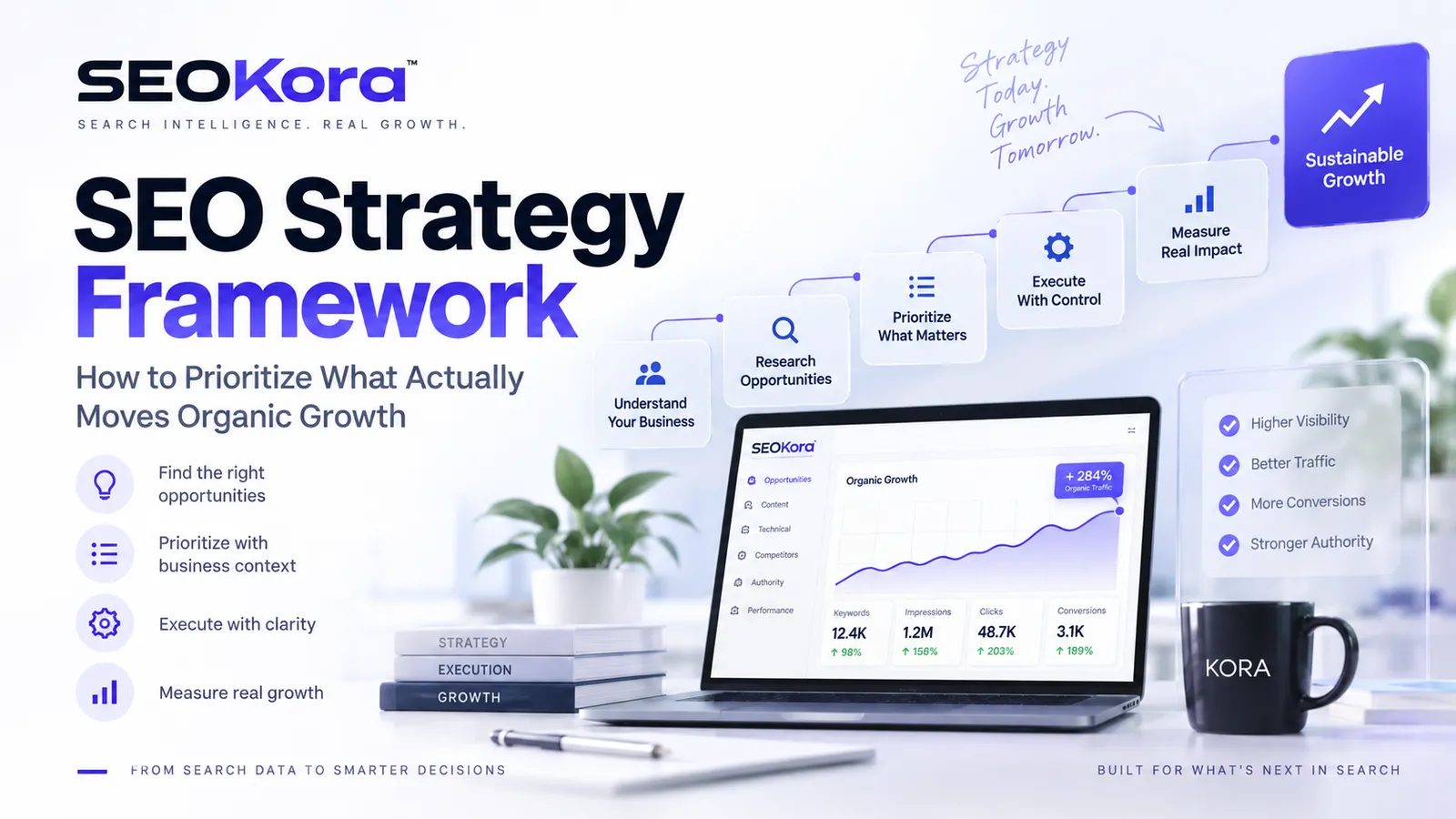
SEO Strategy Framework: How to Prioritize What Actually Moves Organic Growth
Learn how to build an SEO strategy framework that prioritizes opportunities using search demand, business value, competition, content, authority and measurable
SEO rarely fails because a business has nothing left to optimize.
It fails because there are too many possible things to do.
Publish another article. Fix technical errors. Build backlinks. Rewrite old pages. Target a new keyword. Improve internal links. Analyze competitors. Optimize conversion paths. Create location pages. Add structured data. Work on AI search visibility.
Every one of those actions can be useful.
The harder question is:
Which one should you do first?
That is where an SEO strategy becomes different from an SEO checklist.
A strong SEO strategy connects search demand, business relevance, website performance, competition, technical health, authority, content quality, and conversion potential into a system for deciding what deserves attention now, what can wait, and what should not be done at all.
This guide introduces a practical framework for making those decisions and turning SEO research into prioritized, measurable work.
What Is an SEO Strategy Framework?
An SEO strategy framework is a repeatable decision-making system for identifying, prioritizing, executing, and measuring the search opportunities most likely to contribute to meaningful business growth.
That definition matters because SEO strategy is often confused with SEO activity.
A list such as:
- publish four articles,
- acquire ten backlinks,
- fix broken links,
- improve title tags,
- update old pages,
- or optimize internal links
is not necessarily a strategy.
Those are actions.
A strategy explains why those actions deserve resources compared with everything else the business could be doing.
A useful SEO framework therefore needs to answer six fundamental questions:
- What is the business trying to achieve?
- Who is it trying to reach?
- Where does relevant search demand exist?
- What currently prevents the site from capturing that demand?
- Which opportunities have the strongest combination of value and feasibility?
- How will we know whether the work produced a meaningful result?
Without those answers, SEO can become a stream of activity without direction.
SEO Strategy vs. SEO Tactics
SEO tactics are individual actions. SEO strategy determines when and why those actions should be used.
Consider two websites.
Website A has excellent content but weak authority in a highly competitive market.
Website B has strong authority but poor site architecture and dozens of valuable pages that search engines struggle to discover.
Telling both businesses to “publish more content” ignores their actual constraints.
Website A may benefit more from relevant authority acquisition, digital PR, industry citations, expert contributions, or content assets capable of earning genuine references.
Website B may have greater upside from technical cleanup, internal linking, navigation improvements, crawl-path improvements, and better information architecture.
The tactic changes because the constraint changes.
SEO priorities should be determined by the current growth constraint, not by a universal checklist.
The SEOKora SEO Strategy Framework
A practical SEO strategy can be organized into twelve connected stages:
Business Context → Audience & Market → Search Demand → Existing Performance → Competitive Landscape → Technical Constraints → Content Opportunities → Authority Gap → Conversion Potential → Prioritization → Execution → Measurement & Learning
The sequence is intentional.
Keyword research should not come before understanding the business. Content production should not come before understanding search demand. Backlink acquisition should not automatically come before diagnosing whether authority is actually limiting performance.
And execution should never come before prioritization.
1. Start With the Business, Not the Keyword
One of the easiest SEO mistakes to make is opening a keyword tool before understanding the company.
A keyword may have impressive search volume and still be commercially irrelevant.
Before research begins, establish the business context.
What does the business actually offer?
Identify its products, services, categories, expertise, differentiators, and the problems those offerings solve.
Who is the customer?
A search strategy for enterprise buyers should look different from one targeting individual consumers. A business should understand not only who its audience is, but also what that audience is trying to accomplish.
Where does the business operate?
Geography can radically change search demand, competition, terminology, and intent.
A local service company operating in Madrid has a different search universe from an international SaaS company serving customers across multiple countries.
Which languages matter?
Do not assume that translating keywords creates an equivalent SEO strategy.
Search behavior, terminology, competitors, cultural context, and intent can differ across languages and markets. International SEO therefore requires market research, not simply translation.
What produces business value?
A thousand visits to a loosely related informational article may be less valuable than twenty visits to a high-intent service or product page.
Traffic is an input. Business outcomes are the objective.
2. Define the Audience and Search Market
Once the business is understood, define the market in which it competes for attention.
This requires more than writing down demographic information.
Ask what problems potential customers are trying to solve and what information they need at different stages of their journey.
A useful audience map can include:
- problems,
- desired outcomes,
- questions,
- objections,
- comparison behavior,
- buying triggers,
- terminology,
- expertise level,
- location,
- language,
- and stage of the customer journey.
This creates the bridge between business understanding and search behavior.
For example, someone searching for “what is technical SEO?” has a different need from someone searching for “enterprise technical SEO software.”
The subjects are related. The intent is not.
A good strategy can account for both without treating them as interchangeable opportunities.
3. Build Search Intelligence Beyond a Single Data Source
Google Search Console is extremely valuable. It shows how an existing website is appearing and performing in Google Search.
But existing performance data cannot reveal every opportunity the website has never captured.
This distinction is important.
If a website has never published useful material around a valuable subject, there may be little or no existing query data for that subject.
A mature research process should therefore combine multiple signals.
These can include:
- existing search performance,
- keyword and topic research,
- SERP analysis,
- customer questions,
- competitor coverage,
- industry terminology,
- content gaps,
- commercial priorities,
- related entities and subtopics,
- trend changes,
- and internal business knowledge.
Existing performance answers:
“Where are we visible today?”
Independent research helps answer:
“Where could relevant demand exist that we are not capturing yet?”
A strong SEO strategy needs both.
4. Find the Real Search Competitors
Business competitors and search competitors are not always the same.
A company might compete commercially with five recognizable brands while its search results are dominated by publishers, directories, marketplaces, review sites, community discussions, educational resources, or entirely different companies.
For every important topic, inspect who actually occupies the search landscape.
Then determine:
- which competitors repeatedly appear,
- what types of pages rank,
- which search intents appear to be satisfied,
- how deeply competitors cover the subject,
- what authority supports those pages,
- which formats dominate the results,
- and what useful information is still missing.
The purpose is not to copy competitors.
The purpose is to understand the competitive environment.
Competitor research should reveal gaps, not create clones.
5. Diagnose the Current Growth Constraint
Before generating a large task list, identify what is currently limiting growth.
Most SEO constraints can be grouped into several areas.
Technical constraints
Examples can include:
- important pages that cannot be crawled,
- accidental noindex directives,
- poor canonicalization,
- broken internal paths,
- rendering problems,
- duplicate URL patterns,
- weak site architecture,
- serious performance problems,
- or incorrect redirects.
Content constraints
The site may lack pages that adequately satisfy valuable search intents.
Or it may already have content, but that content is outdated, thin, duplicated, poorly structured, inaccurate, or misaligned with intent.
Authority constraints
A website may have technically sound, useful pages but lack enough credible signals and references to compete effectively in its market.
Relevance constraints
A page may target a term that is technically related to the business but not sufficiently aligned with what the searcher actually wants.
Entity and brand constraints
Search and discovery systems may have weak or inconsistent information about the organization, product, person, location, or subject represented by the website.
Conversion constraints
A page may attract qualified visitors but fail to turn that attention into meaningful action.
This is why rankings alone cannot diagnose an SEO system.
The constraint needs to be identified before the treatment is chosen.
6. Map Content Opportunities Instead of Chasing Keywords
Modern content planning works better when keywords are treated as evidence of demand rather than isolated publishing instructions.
Suppose research discovers twenty keyword variations around essentially the same problem.
Creating twenty near-identical articles may create duplication, cannibalization, and a poor reader experience.
Instead, determine:
- what the underlying intent is,
- whether a dedicated page is justified,
- which related questions belong together,
- what level of detail the user needs,
- what information competitors fail to provide,
- and where the topic fits within the broader site architecture.
This produces a topic and intent map, not merely a keyword list.
A useful model is:
Topic → Search Intent → Audience → Business Relevance → Existing URL → Content Gap → Recommended Action
The recommended action may be:
- create,
- improve,
- consolidate,
- redirect,
- internally link,
- monitor,
- or deliberately do nothing.
That final option matters.
Good SEO strategy includes deciding what not to publish.
7. Measure the Authority Gap
Authority should not be reduced to a single third-party score.
Instead, ask a more useful question:
Why would the web and its users treat this source as credible enough to reference?
Authority can be strengthened through multiple forms of evidence, including:
- relevant editorial links,
- genuine citations,
- expert contributions,
- original research,
- useful tools and resources,
- industry references,
- reputable directories,
- partnerships,
- digital PR,
- and meaningful brand mentions.
The correct authority strategy depends on the market.
A local business may benefit from consistent local citations, reviews, partnerships, and relevant local references.
A research-driven SaaS company may gain more from original datasets, technical studies, benchmarks, integrations, expert commentary, and resources other publishers genuinely want to cite.
The objective is not to collect the largest possible number of links.
It is to build credible and relevant evidence of authority.
8. Evaluate Conversion Potential Before Prioritizing Traffic
SEO traffic without a meaningful destination can become a vanity metric.
Before assigning high priority to an opportunity, ask:
- What will the visitor want next?
- Does this topic connect naturally to what the business provides?
- Is there an appropriate conversion path?
- Can the page move the reader deeper into the site?
- Is the search intent commercial, informational, navigational, local, or mixed?
- What outcome would make this traffic valuable?
Not every article needs to generate an immediate sale.
Informational content can introduce a brand, build trust, attract references, create future demand, answer pre-purchase questions, and support commercially important pages.
But its strategic role should be understood.
Every important page should have a reason to exist beyond generating an impression.
9. Prioritize Opportunities With a Decision Model
Once opportunities and constraints are known, prioritization begins.
A useful conceptual model is:
Opportunity Priority = Relevance × Demand × Business Value × Achievability ÷ Effort & Risk
This is not intended as a universal mathematical ranking formula.
It is a decision framework designed to force better questions before resources are committed.
Relevance
How closely does the opportunity match the business and its intended audience?
High traffic with weak relevance may be less useful than smaller but strongly relevant demand.
Demand
Is there meaningful evidence that people need or search for this information, product, service, or solution?
Demand can appear through search data, existing impressions, related searches, customer conversations, community questions, competitor performance, and other market signals.
Business Value
If the opportunity succeeds, does it contribute to a meaningful business objective?
Achievability
Can the website realistically compete?
Consider factors such as:
- existing authority,
- topical depth,
- current rankings,
- SERP competition,
- available expertise,
- technical condition,
- content quality,
- and available resources.
Effort and Risk
What will implementation require?
A title improvement on an already strong page may take minutes.
Building an authoritative research hub may take weeks.
A site migration can have enormous strategic value while also carrying substantial risk.
Prioritization should account for those differences.
10. A Simple SEO Prioritization Example
Imagine a B2B software company discovers three opportunities.
Opportunity A
A broad keyword with approximately 20,000 estimated monthly searches, weak product relevance, and extremely strong competition.
Opportunity B
A specific problem with lower search volume, strong product relevance, moderate competition, and clear commercial intent.
Opportunity C
An existing page already close to stronger search visibility for a valuable commercial query, but with incomplete content and weak internal linking.
A volume-first strategy may immediately choose Opportunity A.
A strategic system may instead prioritize improving Opportunity C, then develop Opportunity B, while potentially deprioritizing Opportunity A.
Why?
Because opportunity is not the same as volume.
The objective is not to accumulate the largest keyword numbers.
The objective is to deploy limited resources where they have the strongest plausible impact.
11. Turn SEO Recommendations Into Executable Work
An SEO audit can contain hundreds of findings and still produce little improvement.
The missing layer is often execution.
Every approved priority should become an actionable unit with:
- a defined action,
- a reason,
- an owner,
- a destination,
- dependencies,
- expected output,
- completion criteria,
- and verification.
Consider the difference between these two instructions.
Weak recommendation:
Improve internal linking.
Executable recommendation:
Add contextual internal links from three existing high-relevance resources to the technical SEO guide using descriptive anchors where they naturally help readers navigate to deeper technical information. Verify those links on the live pages after publication.
The second instruction can be executed and verified.
That distinction becomes even more important when automation is involved.
Automation should not simply create more SEO activity.
It should help move validated opportunities through a controlled process:
Research → Decide → Execute → Verify → Measure → Learn
12. Build SEO for Humans, Search Engines, and AI Discovery
Search discovery is evolving, but the fundamentals have not disappeared.
The strongest content still needs to be useful, clear, accessible, crawlable, original, well structured, trustworthy, and relevant.
For AI-assisted discovery, clarity becomes particularly valuable.
Useful practices include:
- answer important questions directly,
- use descriptive headings,
- explain entities and relationships clearly,
- provide evidence for factual claims,
- distinguish facts from interpretation,
- use tables and lists where they genuinely improve comprehension,
- include original analysis and useful examples,
- keep important information available in indexable text,
- and connect related resources through meaningful internal links.
Do not create a separate “AI version” of every article merely to chase a new acronym.
Build information that deserves to be retrieved, understood, referenced, and visited.
13. Measure Outcomes, Not Just Activity
Publishing ten articles is activity.
Acquiring twenty links is activity.
Fixing fifty technical issues is activity.
None of those numbers alone proves growth.
Measurement should connect work to outcomes.
Search visibility
- impressions,
- query coverage,
- position trends,
- eligible page visibility,
- and relevant search-feature exposure.
Traffic quality
- organic sessions,
- engaged visits,
- landing-page behavior,
- geographic relevance,
- and new versus returning visitors.
Business outcomes
Depending on the business, these can include:
- leads,
- qualified inquiries,
- registrations,
- trials,
- purchases,
- bookings,
- subscriptions,
- or revenue.
Authority outcomes
Measure whether authority work produced real, relevant references and whether strategically important pages gained stronger support.
Delivery outcomes
Was the recommended work actually published or implemented?
A recommendation sitting in a dashboard is not an SEO result.
Learning outcomes
Perhaps most importantly:
What did the result teach us about the next priority?
SEO strategy should operate as a feedback loop.
A Practical 90-Day SEO Strategy Model
A useful way to operationalize the framework is through four phases.
Days 1–15: Discover
Understand:
- the business,
- customers,
- market,
- languages,
- locations,
- existing search performance,
- technical state,
- content inventory,
- competitors,
- authority,
- and conversion paths.
The objective is diagnosis, not mass production.
Days 16–30: Prioritize
Turn research into a prioritized opportunity backlog.
Separate:
- urgent technical risks,
- quick improvements,
- existing-page opportunities,
- new content opportunities,
- authority initiatives,
- conversion improvements,
- and longer-term strategic projects.
Each priority should have evidence behind it.
Days 31–75: Execute
Implement the highest-value work.
This may involve:
- improving existing pages,
- publishing missing resources,
- fixing technical constraints,
- strengthening internal links,
- earning relevant authority,
- improving conversion paths,
- and expanding useful topic coverage.
The exact mix should follow the diagnosis.
Days 76–90: Verify and Learn
Check what actually went live.
Then measure early signals.
Some SEO outcomes require considerably more time, so 90 days should not be treated as a universal ranking deadline.
Instead, use the period to verify execution, identify initial movement, validate assumptions, and determine what the next cycle should prioritize.
Then repeat:
Discover → Prioritize → Execute → Verify → Learn
Common SEO Strategy Mistakes
Mistake 1: Treating Search Console as the Entire Market
Search Console is an essential source of performance data, but it primarily reveals search visibility the website has already earned.
Use it alongside independent market and opportunity research.
Mistake 2: Choosing Keywords Only by Search Volume
Volume without relevance, intent, feasibility, or business value can waste resources.
Mistake 3: Copying Competitor Content
Competitor analysis should reveal what the market already covers and where useful information is missing.
If the final article is simply a rearranged version of existing top-ranking pages, little new value has been created.
Mistake 4: Publishing Only to Hit a Quota
Publishing frequency can support execution discipline.
It should not override quality or strategic relevance.
A content quota is an operational target, not a reason to publish unnecessary pages.
Mistake 5: Assuming Every SEO Problem Needs More Content
Sometimes the highest-value action is technical.
Sometimes it is authority.
Sometimes it is improving an existing page.
Sometimes it is conversion.
And sometimes the correct action is to leave a page alone.
Mistake 6: Measuring Work Instead of Results
“30 articles published” is not the same as “organic growth improved.”
Track delivery, but connect delivery to visibility, qualified traffic, authority, conversions, and business outcomes.
Mistake 7: Automating Decisions That Have Not Been Validated
Automation can accelerate good processes.
It can also accelerate bad assumptions.
A scalable SEO system needs guardrails, evidence, verification, and clear rules for when human judgment is required.
Where SEOKora Fits Into This Framework
The challenge with modern SEO is rarely a shortage of data.
The challenge is turning fragmented signals into prioritized and verifiable work.
That is the problem SEOKora is designed around.
Instead of treating keyword research, technical SEO, content, competitive intelligence, authority, analytics, and execution as isolated activities, the objective is to connect them into a continuous operating loop.
A system can collect evidence.
It can detect opportunities.
It can help prioritize work.
It can execute authorized actions.
It can verify whether those actions actually happened.
And it can use subsequent performance data to inform the next cycle.
But automation should not remove business context from SEO.
A stronger operating model is:
Human direction + reliable data + controlled automation + verified execution + continuous learning.
That creates a system capable of scaling SEO work without turning optimization into mass production.
SEO Strategy Checklist
Before committing resources to an SEO initiative, ask:
- Do we understand the business model?
- Do we know the target audience?
- Have we defined the correct markets, locations, and languages?
- Do we understand the real search competitors?
- Are we using independent research alongside existing performance data?
- Do we know the current growth constraint?
- Is this opportunity relevant to the business?
- Is there evidence of demand?
- Does the opportunity have meaningful business value?
- Can the site realistically compete?
- Are we improving an existing page when appropriate instead of automatically creating another?
- Do we understand the required effort and risk?
- Does the action have an owner and completion criteria?
- Can implementation be verified?
- Are we measuring outcomes rather than activity alone?
- Will the result inform the next decision?
If several of these answers are unknown, the strategy probably needs more research before execution.
Frequently Asked Questions
What is an SEO strategy framework?
An SEO strategy framework is a structured process for connecting business goals, audience needs, search demand, competition, technical health, content, authority, conversion potential, execution, and measurement. Its purpose is to help determine which SEO opportunities deserve priority.
How is an SEO strategy different from an SEO checklist?
A checklist tells you what activities can be performed. A strategy determines which activities matter for a particular business, in what order, and why.
Should SEO strategy start with keyword research?
Usually, business and audience understanding should come first. Keyword research becomes more useful when the market, customer, geography, language, products, services, and business objectives are already understood.
Should businesses only target high-volume keywords?
No. Search volume is only one signal. Relevance, intent, business value, competition, authority requirements, and achievability can make a lower-volume query much more strategically valuable.
How often should an SEO strategy be updated?
The core business direction may remain stable, but prioritization should be revisited as new performance data, competitors, technical issues, market changes, customer behavior, and business objectives emerge. SEO works better as a continuous learning cycle than as a one-time document.
Does AI search require a completely different SEO strategy?
Not necessarily. Strong technical accessibility, useful content, clear structure, credible evidence, relevance, and a good user experience remain important. AI-assisted discovery increases the value of producing information that is easy to understand, substantiate, connect, and retrieve.
Final Takeaway
The most important SEO question is not:
“What else can we optimize?”
It is:
“What should we improve next, and what evidence supports that decision?”
That shift changes SEO from a collection of tasks into a growth system.
Understand the business first.
Study the audience and market.
Measure existing visibility without allowing existing data to define the entire opportunity.
Find the real competitors.
Identify the current constraint.
Map relevant demand.
Evaluate authority and conversion potential.
Prioritize by relevance, demand, business value, achievability, effort, and risk.
Then execute, verify, measure, and learn.
Because sustainable organic growth is not created by doing everything.
It comes from repeatedly doing the right work, for the right reason, at the right time.
Turn SEO Intelligence Into Action
SEOKora is built to connect SEO research, prioritization, execution, verification, and continuous learning into one growth system.
Instead of producing another disconnected list of SEO recommendations, the goal is to identify what matters, turn it into actionable work, verify what was actually delivered, and use real performance signals to determine what should happen next.
Discover opportunities. Prioritize intelligently. Execute with control. Verify the outcome. Keep learning.