
SEO Competitor Analysis: How to Find the Competitors That Actually Matter in Search
Learn how to identify real SEO competitors, uncover content and authority gaps, compare search visibility, and turn competitive intelligence into smarter growth
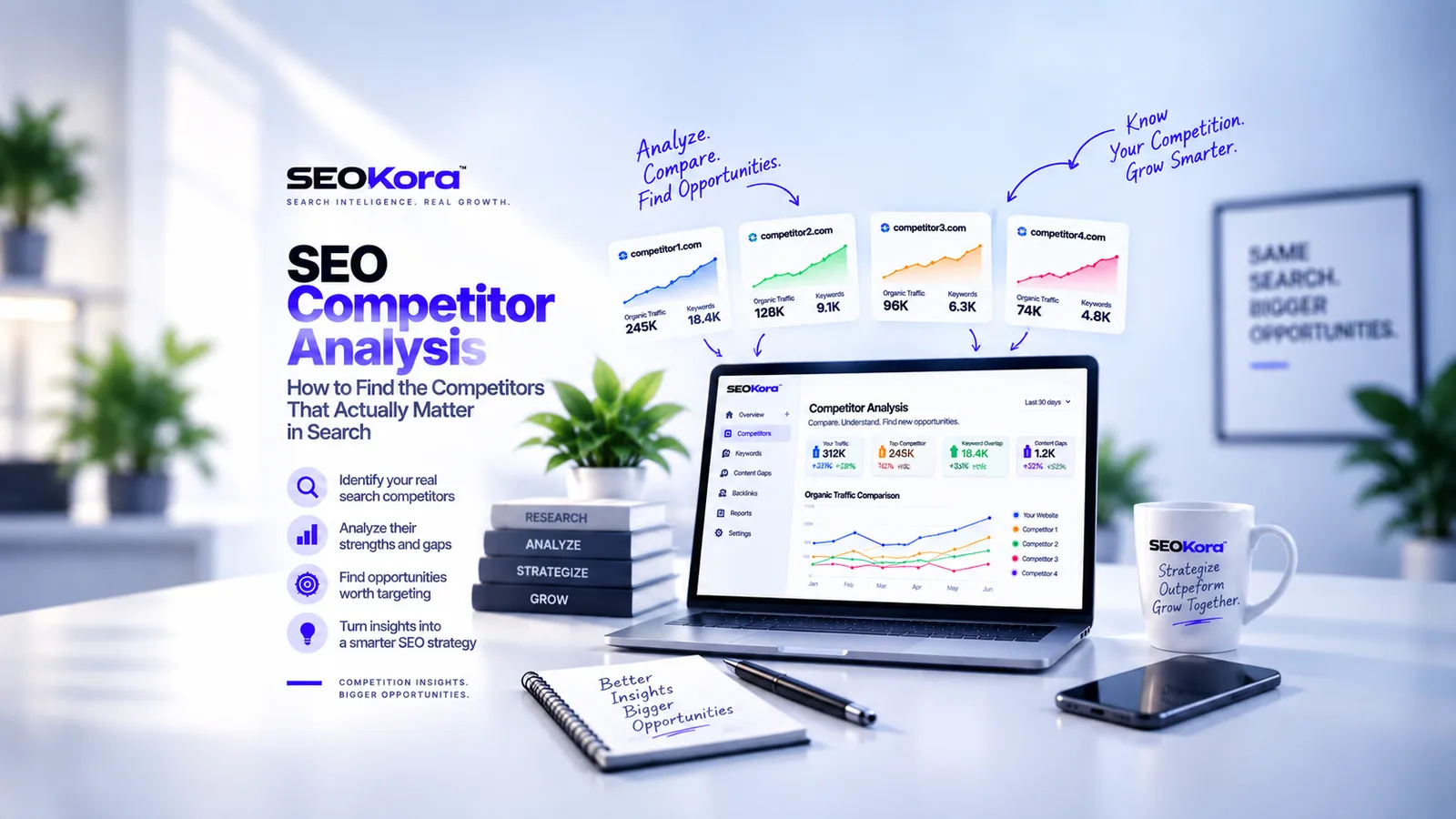
You probably already know who your business competitors are.
But those may not be the websites competing with you in search.
A company can compete with you for customers while barely appearing for the searches your audience makes.
At the same time, a publisher, marketplace, directory, comparison site, community, or software company you have never considered a commercial competitor may appear above you again and again.
That creates an important distinction:
Your business competitors and your search competitors are not always the same.
A useful SEO competitor analysis therefore should not begin with a list of companies somebody already knows.
It should begin with the market.
Who is earning visibility?
For which customer needs?
With what content?
With what authority?
And most importantly:
What can your business realistically learn and act on?
What Is SEO Competitor Analysis?
SEO competitor analysis is the process of identifying and studying the websites that compete for visibility across searches relevant to your audience and business.
A useful analysis can examine:
- search visibility,
- topic coverage,
- search intent,
- content quality,
- site architecture,
- internal linking,
- authority and external references,
- technical execution,
- SERP ownership,
- brand presence,
- and emerging AI-search visibility.
But the purpose is not to create a giant competitor spreadsheet.
The purpose is to answer:
Why are other websites earning visibility where we want to compete, and which of those differences represent opportunities worth acting on?
Why Your Commercial Competitors Are Not Enough
Imagine you sell SEO software.
Your obvious commercial competitors might be other SEO platforms.
But search for different questions and the landscape can change completely.
A query about technical SEO might surface:
- software companies,
- SEO publications,
- consultancies,
- individual experts,
- Google documentation,
- community discussions,
- and educational websites.
A query about local SEO could produce another competitor set.
A query about programmatic SEO could produce another.
So asking:
“Who are our five competitors?”
can be too simplistic.
A stronger question is:
“Who competes with us for attention across each important part of our search market?”
The SEOKora Competitive Intelligence Framework
A practical competitive research process can follow this sequence:
Business Context → Market Definition → Search Demand → SERP Competitors → Topic Competitors → Authority Competitors → Gap Analysis → Advantage Analysis → Opportunity Validation → Prioritization → Execution → Measurement
This fits inside the broader SEO Strategy FrameworkSEOKora.
It also connects directly with Content Gap AnalysisSEOKora, because competitor coverage can reveal opportunities — but competitor keywords should never automatically become your publishing plan.
The important distinction is:
Competitor data is evidence. It is not instruction.
1. Define Your Market Before Choosing Competitors
Competitor research becomes unreliable when the market itself is unclear.
Before selecting domains, define:
- what the business offers,
- who the customer is,
- which geography matters,
- which languages matter,
- which products or services matter most,
- which customer problems matter,
- and which business outcomes SEO is expected to support.
A global English-language competitor set may be almost useless for a local Spanish service business.
Likewise, a competitor relevant to enterprise customers may not represent the search environment of a small-business product.
Competitive intelligence needs context.
2. Discover Competitors From Real Search Results
Once important topics and search intents are understood, examine who actually appears.
Do not rely on a single keyword.
Look across groups of meaningful queries.
Then identify domains that repeatedly appear.
This can reveal several types of competitors:
Direct Search Competitors
Businesses offering similar products or services and competing for similar searches.
Content Competitors
Publishers, blogs, educational resources, and experts competing for informational attention.
Marketplace and Directory Competitors
Platforms aggregating products, services, businesses, or listings.
Authority Competitors
Sources that repeatedly earn references, citations, links, or trust around important subjects.
SERP Feature Competitors
Websites repeatedly appearing in videos, discussions, images, local results, featured elements, or other search surfaces relevant to the market.
One domain can belong to several categories.
3. Measure Overlap — But Do Not Stop There
A common competitor metric is keyword overlap.
That is useful.
If another website ranks for many queries relevant to your business, it deserves investigation.
But raw overlap can mislead.
A huge publisher may share thousands of keywords with your website while competing directly for very little commercial value.
Instead, evaluate overlap alongside:
- business relevance,
- intent similarity,
- audience similarity,
- geographic relevance,
- topic concentration,
- and commercial importance.
A smaller competitor with strong overlap in your highest-value topic may matter more than a giant website sharing thousands of incidental keywords.
4. Separate Branded and Non-Branded Competition
Branded queries tell you something different from non-branded queries.
If somebody searches your company name, your brand should naturally have an advantage.
Competitive discovery becomes particularly interesting when customers search for the problem rather than a specific company.
Examples include:
- SEO automation software,
- how to find content gaps,
- technical SEO audit,
- AI search optimization,
- local SEO platform,
- SEO competitor analysis.
These queries reveal who owns attention before the customer has decided which brand to trust.
That is often where the largest discovery opportunities exist.
5. Compare Topic Coverage, Not Just Keywords
Suppose a competitor ranks for 4,000 keywords that you do not.
That sounds impressive.
But perhaps 2,500 belong to topics irrelevant to your business.
Another 1,000 may be minor variations of the same intent.
Another 300 may belong to old pages with little strategic value.
The useful opportunity might be hidden inside the remaining 200.
Group competitor visibility into meaningful themes:
- topics,
- entities,
- customer problems,
- journey stages,
- content formats,
- commercial categories,
- and search intent.
This transforms competitor research from keyword counting into market understanding.
6. Find the Gap — Then Validate It
A competitor covers a topic.
You do not.
Is that a content gap?
Possibly.
But first ask:
- Does our audience care?
- Does this fit our business?
- Is there meaningful demand?
- Does an existing page already cover the intent?
- Can we add something useful?
- Can we realistically compete?
- Would this support a customer journey?
If the answer is no, the competitor's keyword remains their keyword.
It does not need to become yours.
This is why competitive analysis and content gap analysisSEOKora need to work together.
7. Study Why the Competitor Page Works
Finding a competitor URL is only the beginning.
Study the page itself.
Ask:
- What intent does it satisfy?
- How quickly does it answer the main question?
- How is the information structured?
- Does it contain original data?
- Does it demonstrate experience?
- Does it provide examples?
- Does it contain useful visuals?
- How fresh is the information?
- What internal pages link to it?
- What external websites reference it?
- What makes the page difficult to replace?
The goal is not to copy the page.
The goal is to understand the advantage.
8. Find Information-Gain Opportunities
A competitor ranking first does not mean your strategy should be:
“Write the same article, but 20% longer.”
That produces a web full of interchangeable content.
Instead ask:
What useful information is still missing?
You might add:
- new research,
- first-party data,
- a better framework,
- practical examples,
- customer experience,
- original screenshots,
- better comparisons,
- new calculations,
- more current evidence,
- or a clearer explanation.
The competitor shows that an opportunity exists.
Your job is to decide whether you can improve the information environment.
9. Analyze Internal Architecture
A competitor may not rank because one article is exceptional.
It may rank because the entire website supports that article.
Look at:
- topic hubs,
- category structure,
- contextual internal links,
- navigation,
- supporting articles,
- product connections,
- and how authority flows through the site.
A competitor with twenty logically connected resources around a topic may have a structural advantage over a website with one isolated article.
Our Technical SEO Audit guideSEOKora explains why internal architecture and crawl paths matter.
10. Analyze Authority — Not Just Backlink Counts
Backlink counts can be useful.
They can also be misleading.
One competitor may have 50,000 links generated from irrelevant directories, sitewide placements, or old low-value pages.
Another may have 500 highly relevant editorial references.
The second profile may teach you more.
When studying authority, ask:
- Who references the competitor?
- Why did they link?
- Which pages attract references?
- Are the sources relevant?
- Are competitors earning mentions through data or tools?
- Do they have strong industry partnerships?
- Are experts citing their research?
- Are they visible in relevant communities?
The useful question is not:
“How do we copy their backlinks?”
It is:
“What makes this competitor worth referencing?”
11. Look for Linkable Assets
Sometimes one competitor page attracts a disproportionate share of external authority.
It might be:
- a free tool,
- a calculator,
- a research report,
- a benchmark,
- a dataset,
- a template,
- a glossary,
- an interactive resource,
- or an unusually useful guide.
These are useful clues.
Do not simply clone the asset.
Understand why people reference it, then ask whether your business can create something genuinely valuable in the same problem space.
12. Technical Advantages Can Be Competitive Advantages
Sometimes competitors win because their websites simply work better.
Possible advantages include:
- clean crawlable architecture,
- fast templates,
- strong mobile experience,
- logical canonicalization,
- good internal linking,
- clear structured data,
- stable URLs,
- and fewer indexation problems.
This is another reason competitive intelligence should not be separated from technical SEO.
If the real gap is technical, publishing another article will not solve it.
13. Competitor Research in AI Search
Competitive discovery now extends beyond traditional search-result positions.
Customers increasingly use AI-assisted search and answer systems to research products, companies, and topics.
That creates new competitive questions:
- Which brands appear in relevant AI answers?
- Which sources are referenced?
- Which companies are described accurately?
- Which attributes are used when comparing solutions?
- Which publishers influence the conversation?
- Where is our brand missing?
This does not create a universal “AI ranking.”
AI outputs can vary.
But repeated observation across meaningful prompts can provide useful competitive intelligence.
Our Generative Engine Optimization guideSEOKora explains this measurement challenge in more detail.
14. Competitors Can Reveal Programmatic Opportunities
Competitive analysis can also reveal repeatable search patterns.
You may discover that a competitor successfully serves hundreds of:
- locations,
- integrations,
- product combinations,
- comparisons,
- industries,
- or other structured search needs.
That can indicate a programmatic opportunity.
But do not automatically reproduce the model.
Validate whether your business has the data, demand, uniqueness, architecture, and customer value required to support it.
Our Programmatic SEO guideSEOKora covers how to make that decision safely.
15. Find Competitor Weaknesses Too
Competitive research should not only identify what competitors do well.
Look for weaknesses.
Examples might include:
- outdated information,
- poor mobile experience,
- weak explanations,
- missing customer questions,
- thin comparison pages,
- broken tools,
- slow templates,
- limited first-hand evidence,
- poor internal navigation,
- or topics competitors have ignored entirely.
Sometimes the easiest opportunity is not beating a competitor at their strongest asset.
It is serving a need they have neglected.
16. Do Not Copy Competitors Blindly
This is one of the most important rules in competitive SEO.
A competitor ranking for something does not prove that:
- the keyword converts,
- the traffic is valuable,
- the page is profitable,
- their strategy is efficient,
- the topic fits your business,
- or the same approach will work for you.
You can observe their visibility.
You usually cannot see their complete economics.
Competitive intelligence should therefore influence decisions, not replace them.
17. Prioritize Competitive Opportunities
After research, you may have hundreds of possible opportunities.
They need prioritization.
A useful conceptual model is:
Competitive Opportunity = Market Relevance × Customer Demand × Business Value × Competitor Weakness × Achievability ÷ Effort & Risk
This is not a universal mathematical SEO formula.
It is a decision framework.
For each opportunity, ask:
- Does this matter to our customer?
- Does it support our business?
- Is there real demand?
- Why is the competitor currently stronger?
- Can we add something better or different?
- What resources would be required?
- How long might the opportunity take?
- What could prevent success?
18. How SEOKora Turns Competitor Data Into Competitive Intelligence
Most SEO platforms can produce competitor data.
That is not the difficult part anymore.
You can generate:
- keyword overlaps,
- ranking comparisons,
- backlink lists,
- top pages,
- traffic estimates,
- and content gaps.
The difficult part is deciding what the customer should do with it.
SEOKora is designed to connect competitive intelligence with business context, independent market research, prioritization, execution, and verification.
SEOKora does not define competitors from GSC alone
Existing search performance tells us where a website currently has visibility.
It does not define the entire market.
A newer website may not yet appear for some of its most important future opportunities.
SEOKora can combine existing search evidence with independent market and competitor discovery so current rankings do not become the boundary of the strategy.
SEOKora uses customer-specific market direction
A useful competitor for one customer may be irrelevant to another.
Market, geography, language, audience, product, service, and business model should influence competitor selection.
Where necessary, human market direction can correct or refine the system's understanding rather than forcing the customer into an incorrect automated competitor set.
SEOKora separates search competitors from business competitors
The system can evaluate competitors according to the role they play:
Commercial → Search → Content → Authority → AI Visibility.
That produces a more useful competitive map than one static list of domains.
SEOKora looks for gaps and advantages
The purpose is not simply to report:
“Competitor A ranks for 8,423 keywords you don't.”
A more useful system asks:
- Which topics matter?
- Which intents are missing?
- Which pages already exist?
- Where does the competitor have stronger authority?
- Where is our content better?
- Where is the competitor technically stronger?
- Where are both sides weak?
- Which opportunities are realistic?
SEOKora prevents competitor research from becoming automatic publishing
A discovered competitor gap should not automatically create an article.
It should move through validation.
The correct action might be:
CREATE → IMPROVE → CONSOLIDATE → INTERNAL LINK → TECHNICAL FIX → AUTHORITY BUILD → PROGRAMMATIC EXPANSION → MONITOR → IGNORE.
That is a much more efficient use of customer resources.
SEOKora connects intelligence to execution
A competitor report that sits untouched in a dashboard does not create growth.
Once an opportunity is validated and authorized, it should be able to move toward the relevant workflow.
Content opportunities can become content work.
Technical gaps can become technical actions.
Internal-link gaps can become architecture improvements.
Authority gaps can become authority opportunities.
And repeatable validated patterns can inform programmatic strategies.
SEOKora verifies delivery
Creating a task does not mean the customer received an improvement.
Generating a draft does not mean the article is live.
Sending an update to a CMS does not prove the public website reflects it.
For verifiable website work, a stronger completion model is:
Intelligence → Decision → Execution → Delivery → Live Verification → Measurement
SEOKora keeps learning
Competitors change.
Search results change.
New companies appear.
Existing competitors expand into new topics.
AI discovery surfaces different sources.
Customer priorities change.
Competitive intelligence therefore needs a feedback loop:
Discover → Compare → Understand → Prioritize → Act → Verify → Measure → Learn → Discover Again
19. What SEOKora Should Never Do With Competitor Data
A responsible competitive-intelligence system should not:
- copy competitor content,
- treat every competitor keyword as a customer opportunity,
- recommend irrelevant topics simply because they have high search volume,
- create pages automatically without checking existing content,
- confuse estimated competitor traffic with verified revenue,
- treat backlink quantity as authority quality,
- claim certainty where competitor data is estimated,
- or chase competitors at the expense of the customer's own positioning.
The goal is not to become a copy of whoever currently ranks.
The goal is to understand the market well enough to build a stronger position of your own.
20. A Practical SEO Competitor Analysis Workflow
- Define the business. Clarify audience, market, geography, language, products, and objectives.
- Map important search demand. Identify customer problems and commercially relevant topics.
- Discover real search competitors. Look for domains repeatedly appearing across meaningful queries.
- Classify competitors. Separate commercial, content, authority, search, and AI-discovery competitors.
- Compare topic coverage. Group visibility by intent rather than raw keyword count.
- Analyze winning pages. Understand content, information gain, structure, internal support, and authority.
- Analyze weaknesses. Find needs competitors serve poorly or ignore.
- Compare authority. Study why useful sources reference competitors.
- Compare technical execution. Identify architecture or performance advantages.
- Validate opportunities. Check business fit, demand, existing coverage, and feasibility.
- Choose the right action. Do not assume every gap requires new content.
- Execute and verify. Confirm the intended improvement actually reaches the live environment.
- Measure outcomes. Watch visibility, engagement, conversions, authority, and competitor movement.
SEO Competitor Analysis Checklist
Frequently Asked Questions
What is SEO competitor analysis?
SEO competitor analysis identifies and evaluates websites competing for organic visibility across searches relevant to your audience and business. It examines areas such as topic coverage, search intent, content, authority, architecture, technical execution, and emerging AI-search visibility.
Who are my SEO competitors?
Your SEO competitors are websites repeatedly competing for searches important to your audience. They may include direct businesses, publishers, directories, marketplaces, communities, or other resources even when they do not sell the same product.
How do I find SEO competitors?
Start with meaningful topic and query groups, observe which domains repeatedly appear, measure relevant search overlap, and evaluate whether those domains compete for the same audience and intent. Do not rely only on a pre-existing list of commercial competitors.
Should I target every keyword my competitors rank for?
No. Validate competitor keywords against your audience, business relevance, search intent, existing content, commercial value, and ability to add something useful. Many competitor keywords will not belong in your strategy.
Should I copy competitor content that ranks well?
No. Analyze why the resource is useful and identify what is still missing. The objective is to create additional value through expertise, data, experience, better explanations, tools, frameworks, or other genuine information gain.
Are backlinks part of competitor analysis?
Yes, but focus on why relevant sources reference a competitor rather than simply comparing total backlink counts. Strong competitor analysis can reveal linkable assets, editorial relationships, research, tools, and other authority-building opportunities.
Can AI-search competitors be different from Google competitors?
Yes. AI-assisted systems may surface different brands and sources depending on the question and available evidence. Monitor meaningful prompt sets over time rather than assuming traditional rankings and AI visibility are identical.
How often should competitor analysis be updated?
There is no universal schedule, but competitive intelligence should be refreshed as search results, competitors, content, authority, products, customer behavior, and AI-discovery environments change.
Final Takeaway
SEO competitor analysis is not about watching what another company does and copying it.
It is about understanding the market you are actually competing in.
Find who earns attention.
Understand why.
Separate relevant opportunities from noise.
Study content, authority, architecture, technical execution, and emerging AI visibility.
Identify what competitors do well.
Identify what they miss.
Then compare those insights with your own business, audience, resources, and strengths.
The practical cycle is:
Discover → Compare → Understand → Validate → Prioritize → Act → Verify → Learn.
Your competitors can show you where opportunities exist.
They should never be allowed to define your entire strategy.
Turn Competitive Intelligence Into Action
SEOKora connects independent market research, existing search performance, competitor discovery, content gaps, technical intelligence, authority, AI visibility, prioritization, execution, and live verification.
Instead of giving customers another list of competitor keywords, the goal is to answer:
Who actually matters in our search market, why are they ahead, where is the realistic opportunity, and what should we do next?