The Uncomfortable Truth About Compare Seo with Competitors
Compare SEO with competitors the practical way: identify true search rivals, gaps, trade-offs, and how fits the workflow.

What it really means to compare SEO with competitors
To compare SEO with competitors, do not start by asking who sells the same product. Start by asking who is taking the search demand you want. The uncomfortable truth is that your strongest SEO competitors may be publishers, marketplaces, review pages, integration partners, or smaller sites with better topical coverage—not only the companies your sales team mentions.
You want to know which topics are worth pursuing, which pages need improvement, where your authority is thin, and which competitors are winning because their content, internal linking, technical setup, or search intent match is stronger than yours.
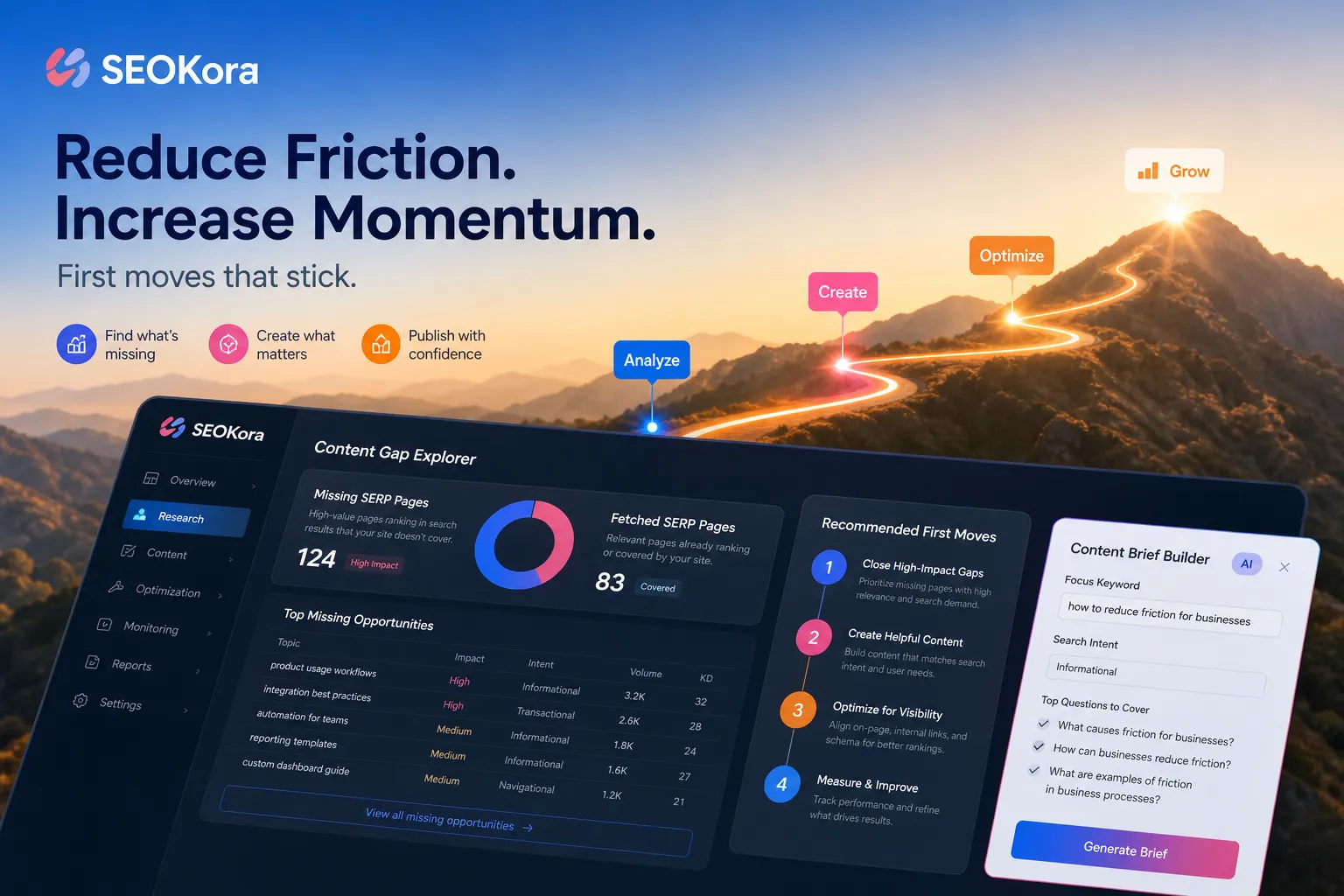
SEOKora is built around that practical search-growth problem: turning search intelligence into growth with ranking opportunities, competitive intelligence, authority insights, site optimization, SEO automation, and content optimization. The point is not to admire competitor data. The point is to decide what to fix, create, consolidate, or stop chasing.
The competitors that actually matter in search
A commercial competitor is the company a buyer might compare you against. A search competitor is any domain that wins the query before you do. Those two groups often overlap, but they are rarely identical.
Say a SaaS company sells project planning software. Its commercial competitors may be other SaaS vendors. If the company only studies vendor homepages, it misses the pages shaping demand before buyers even reach a demo page.
A useful SEO competitor analysis separates competitors into search roles:
- Direct commercial alternatives: companies buyers would evaluate instead of you.
- Technical or marketplace competitors: sites that win because of scale, structured information, programmatic pages, or strong domain authority.
- Local or niche specialists: smaller domains that own a narrow topic cluster better than broader competitors.
SEOKora’s own resource library includes a deeper guide to SEO competitor analysis (opens in new tab), and the practical lesson is simple: if a domain repeatedly appears for the keywords that influence your pipeline, it belongs in your analysis even if it is not a sales competitor.
What SEO competitor analysis should include
Good competitor analysis is not a screenshot of rankings.
At minimum, compare these areas:
- Keyword overlap: which queries you both target, where they outrank you, and where you have no page at all.
- Intent match: whether the winning page is informational, commercial, transactional, local, or navigational.
- Content depth and usefulness: whether the competitor answers the real buying or learning question more clearly than your page.
- Topical coverage: whether they have a cluster of related pages supporting the ranking page.
- Internal linking: whether important pages are connected from relevant hubs and supporting content.
- Authority signals: whether the competitor has stronger credibility, backlinks, brand demand, or topical trust around the subject.
- Technical accessibility: whether search engines can crawl, render, and understand the page more easily than yours.
The mistake is treating every gap as an instruction to copy. If a competitor wins because it has a strong hub, publishing one isolated article is unlikely to close the gap. SEOKora’s angle is to turn those observations into defensible SEO decisions rather than a stock content outline.
Why commercial competitors are not enough
Commercial comparison is still useful, especially when buyers are looking at alternatives. SEOKora has comparison-focused resources such as SEOKora vs Ahrefs (opens in new tab) and BabyLoveGrowth Alternative (opens in new tab), which reflect a common buying pattern: prospects want to understand how tools differ before they commit to a workflow.
But SEO growth does not happen only on “alternative” and “versus” searches. It often starts earlier, when someone searches for a problem, a process, a checklist, or a template.
This is where the trade-off becomes important. A pure competitive intelligence tool may help you discover who ranks. A content optimization workflow may help you improve an individual page. An SEO growth platform like SEOKora is positioned around connecting those inputs: ranking opportunities, competitive intelligence, authority insights, site optimization, and content decisions. For a business, the question is not “which tool has more data?” but “which workflow helps us act on the right data without losing context?”
That distinction matters for agencies too. A client may ask why a known rival outranks them, but the answer may involve a publisher, a resource hub, a technical issue, or a missing middle-of-funnel page. The agency needs evidence it can explain, not just exports it can attach to a report. SEOKora’s agency-focused resource on SEO automation for agencies (opens in new tab) speaks to that same need: automation should support decisions, not replace judgment.
A practical SEOKora-style competitive intelligence workflow
A useful workflow keeps the analysis close to action. The following approach is intentionally practical for website owners, SaaS teams, content marketers, and agencies comparing SEO performance against competitors.
- Do not analyze a competitor’s entire site unless it helps you make a decision.
- Identify the true search competitors for that set. Look at recurring domains across the queries, not just brands you already know. Group them by role: vendor, publisher, marketplace, review site, template library, or niche expert.
- Compare page type and intent. If the winners are listicles, your product page may not rank for that query.
- Map gaps to action types. A missing topic may need a new page. A weak existing page may need a rewrite. A strong page with poor discovery may need internal links. A technically blocked page may need site optimization before content work.
- Check authority and support content. If competitors have a full hub around the topic, one page is unlikely to compete alone. Consider supporting guides and hub-and-spoke linking; SEOKora has a resource on hub and spoke linking for content teams .
- Prioritize by recoverable opportunity. Chasing every competitor keyword wastes effort. Prioritize queries where intent fits your offer, your site can credibly answer, and the page has a clear next step for the reader.
For example, if a competitor outranks you for a “how to choose” query, the right response may not be a product page. It may be a buyer-focused guide that explains criteria, trade-offs, and mistakes, then links naturally to a relevant product or resource. If another competitor outranks you for a technical SEO query, the fix may involve rendering, crawlability, or multilingual setup rather than adding more paragraphs. SEOKora’s resources on JavaScript SEO rendering (opens in new tab) and hreflang conflicts (opens in new tab) show how technical issues can change the decision.
How to compare SEO software for this job
If you are investigating SEO software, compare platforms by the decisions they help you make. More metrics can be useful, but only when they reduce uncertainty about what to do next.
Use these criteria when evaluating alternatives:
- Competitor discovery: Can the platform reveal search competitors you did not already know?
- Opportunity clarity: Does it distinguish between new content, content refreshes, internal linking, authority gaps, and technical fixes?
- Content optimization: Does it help improve pages for the intent behind the query rather than simply adding keywords?
- Execution support: Does it help you move from analysis to workflow, especially if you manage many pages or clients?
- Explainability: Can you defend the recommendation to a stakeholder, client, or founder without hiding behind a score?
- Fit for your operating model: A solo website owner, an agency, and a SaaS content team may need different levels of automation, reporting, and editorial control.
The pros and cons are real. A specialist SEO intelligence platform can be strong for research, but may leave execution to separate workflows. Autopilot-style platforms can reduce manual work, but buyers should look closely at how much control they retain over strategy and content quality. SEOKora competes in the middle of that decision: it is an SEO growth software platform for teams that want intelligence connected to execution, with practical guidance rather than vague marketing claims.
If you are comparing SEOKora with other tools, look at the type of SEO work you need to improve first. If your blocker is knowing where competitors win, prioritize competitive intelligence. If your blocker is turning insights into publishable, optimized content, prioritize content optimization and workflow. If your blocker is technical visibility, prioritize site optimization. The best choice is the one that removes your actual growth bottleneck, not the one with the longest feature list.
SEO competitor analysis checklist
Use this checklist before you brief a writer, update a page, or buy another SEO tool.
- Record the domains that appear repeatedly across those groups, including non-commercial sites.
- Label each competitor by search role, not just by company category.
- Compare the winning page type with your current page type.
- Check whether the competitor answers a different intent than your page.
- Identify missing pages, weak pages, and pages that need better internal links.
- Look for topical clusters, not only individual rankings.
- Review whether technical issues could be suppressing your page before ordering more content.
- Separate “copy this competitor” from “understand why this competitor wins.”
The final step is the one many teams skip: decide what not to pursue. Some competitor rankings are not worth chasing because the intent is wrong, the topic is too far from your offer, or the page would attract traffic that never becomes useful demand. Organic growth is stronger when competitor analysis narrows focus, not when it expands the to-do list without discipline.
Common mistakes that distort the comparison
The first mistake is comparing whole domains when the real battle is page by page. A competitor may have stronger visibility overall, but your opportunity may sit in one underserved topic cluster.
The second mistake is assuming the highest-ranking page is the best model to follow. A page may rank because of authority, age, links, brand demand, or the lack of better alternatives. If you copy its structure without improving usefulness, you inherit its weaknesses without its advantages.
The third mistake is treating AI-generated outlines as strategy. An outline can help structure a draft, but it cannot decide whether the page should exist, how it fits a hub, which competitor is relevant, or whether technical SEO is blocking growth. That is why SEOKora’s positioning around SEO automation and search growth should be read as decision support, not a promise that automation removes judgment.
The fourth mistake is ignoring existing pages. Many sites do not need more content first; they need to repair thin pages, consolidate overlapping pages, strengthen internal links, or align a page with the intent of the query. SEOKora’s broader resources on strategy, systems, and decision frameworks (opens in new tab) are useful when you need to connect competitor analysis to a larger organic growth plan.
What to do next
If you want to compare SEO with competitors in a way that improves rankings and search visibility, pick one topic cluster and run the workflow above before expanding. Identify the real search competitors, compare intent and page type, decide whether the fix is content, links, authority, or technical work, and only then create the brief.
What does “compare SEO with competitors” mean in practical terms?
It means comparing the pages, topics, rankings, intent, authority, technical setup, and content workflows that help other sites earn visibility for the searches you care about. The goal is to decide what action will improve your own search performance.
How should a business get started without overcomplicating the analysis?
Start with one commercially relevant topic cluster, not your entire market. Identify the recurring ranking domains, label their role in search, compare their winning pages against yours, and turn the findings into a small set of content, linking, or technical actions.
Should I only compare against direct competitors?
No. If they rank for queries that influence your buyers, they deserve attention in your SEO analysis.