Where Automate Seo Instead of Agency Gets Messy
Learn when to automate SEO instead of hiring an agency, where automation helps, and how supports practical search growth.
What “automate SEO instead of agency” means in practice
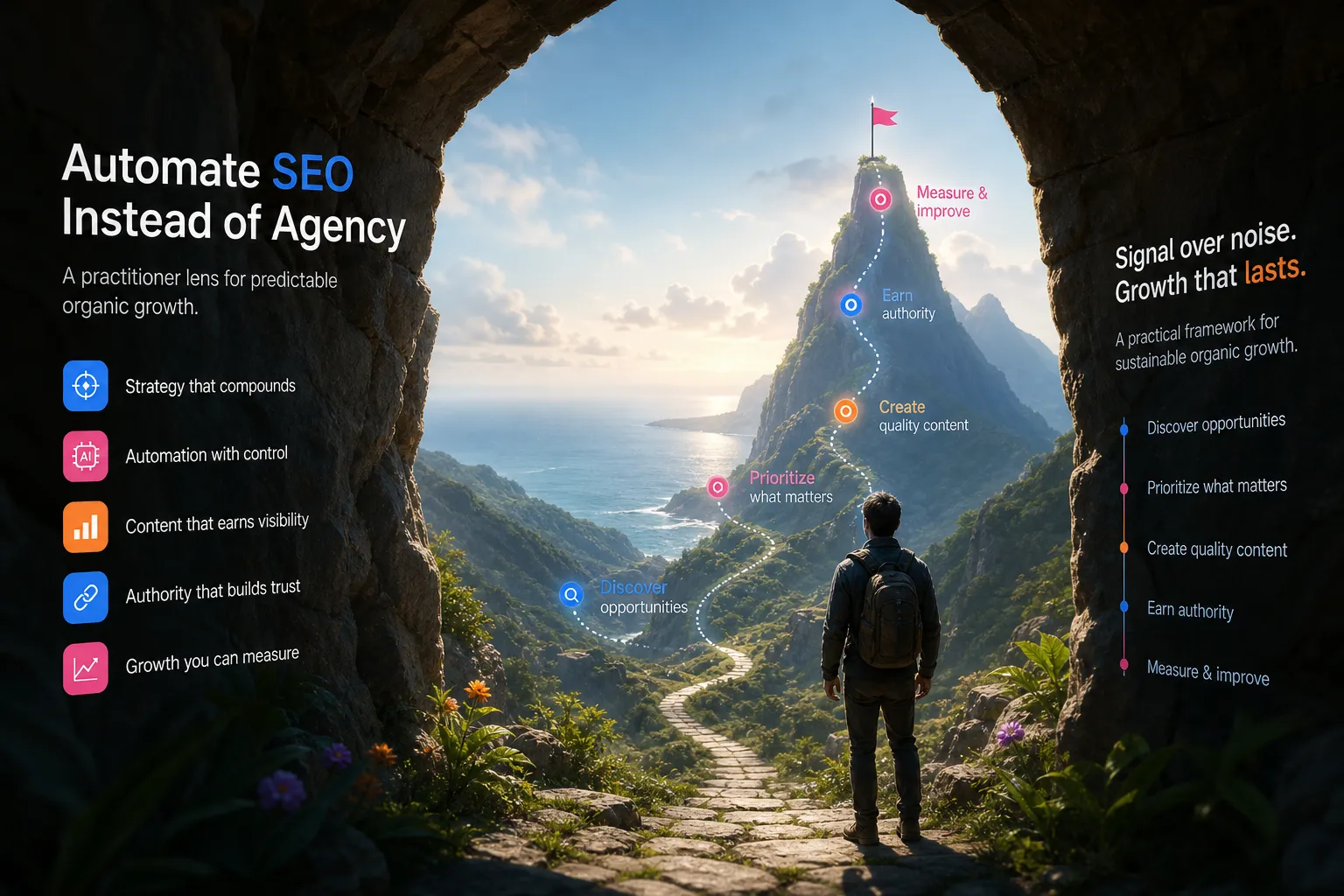
To automate SEO instead of agency work is to move repeatable search tasks into software while keeping strategy, approvals, and judgment in human hands. It does not mean letting a tool publish everything, chase every backlink, or rewrite your site without context. For most businesses, it means using an SEO growth platform such as SEOKora to surface ranking opportunities, competitive intelligence, authority insights, site optimization issues, and content priorities faster than a manual agency workflow can.
The useful question is not “Can software replace every agency task?” It is “Which parts of our SEO process are structured enough to automate, and which decisions still require a practitioner?” Keyword clustering, technical checks, content briefs, internal linking opportunities, competitor monitoring, and backlink prospect discovery are often good candidates for automation. Messaging, offer positioning, editorial standards, risk tolerance, and final publishing decisions usually are not.
A practical example: a SaaS company may not need an agency to manually compile a spreadsheet of pages losing visibility, competitor pages gaining ground, and internal links that should be added. Software can do that work faster and more consistently.
Where AI backlink automation meets real constraints
Backlink automation is where the promise of “automate SEO instead of agency” becomes most tempting and most risky. Authority matters in organic growth, but outreach, link qualification, and relationship-building are not mechanical in the same way that crawling a site or finding missing metadata can be mechanical.
That is useful. It reduces research drag.
The constraint is that a backlink opportunity is not permission. A prospect list is not a relationship. An email draft is not a reason for someone to link. If automation sends generic outreach at scale, the likely result is weak response quality, damaged brand perception, and wasted authority-building effort. The better use of automation is to shorten the path to a qualified human decision: Is this site relevant? Is the target page worthy of being referenced? Is the outreach grounded in something useful?
SEOKora’s related resource on AI backlink automation (opens in new tab) covers this theme directly: automation is most valuable when it works inside real-world constraints rather than pretending those constraints do not exist.
What AI backlink automation actually does
AI backlink automation should be understood as a workflow assistant, not as a link guarantee. In practice, it can help with four kinds of work: discovery, filtering, drafting, and monitoring.
- Discovery: finding domains, pages, and mentions that may be relevant to your market or topic.
- Filtering: separating plausible prospects from irrelevant or low-fit opportunities.
- Drafting: creating a first version of outreach that a person can review, edit, or reject.
- Monitoring: tracking which opportunities were contacted, which links appeared, and which assets attracted attention.
This matters for teams comparing software with an agency because agencies often charge for the time required to perform this research manually. Software can compress that research cycle. The tradeoff is that your business must still own the standards: what counts as a relevant domain, which assets deserve promotion, what tone is acceptable, and when outreach should stop.
For content marketers and website owners, the most useful automation is usually not “send more emails.” It is “show me the best places where human effort could matter.” That framing keeps backlink automation tied to organic search strategy instead of turning it into volume for its own sake.
A competitor backlink is evidence, not entitlement
But a competitor’s backlink is not something your site automatically deserves. Treat it as evidence that a certain type of asset can earn attention, then ask why.
If a competing article is linked from a technical glossary, the opportunity may not be to ask for the same link.
This is where automation and practitioner judgment should work together. Software can identify backlink overlaps, recurring linking domains, and competitor content that appears to attract authority. A practitioner decides whether the correct response is outreach, content improvement, digital PR, internal linking, or no action. The mistake is assuming that the presence of a competitor backlink proves that the same domain will link to you for the same reason.
Businesses that want to automate SEO instead of agency work should be especially careful here. Without an agency strategist reviewing the context, it is easy to over-prioritize copied link targets and under-prioritize the asset quality required to earn attention in the first place.
Good automation must be able to stop
The safest SEO automation workflows include review points, rejection paths, and stopping rules. This is especially important when automation touches publishing, technical fixes, outreach, or content changes at scale.
A good automated system should help you answer questions such as: Which changes are low-risk enough to approve quickly? Which recommendations affect important revenue pages? Which outreach drafts should never be sent because the prospect is irrelevant? Which content updates would change factual claims, product positioning, or legal language?
The search signal around “which software lets me approve automated SEO fixes before publishing?” reflects a real concern: many businesses want automation, but not uncontrolled automation. Approval matters because SEO changes can affect brand language, user experience, indexation, and conversion paths. A tool that can recommend a fix is useful. A workflow that lets the right person approve, edit, or reject that fix is safer.
For example, an automated audit may detect thin title tags across a group of product pages. That does not mean every title should be rewritten with the same pattern. Some pages may need clearer product language, some may need a stronger category modifier, and some may be intentionally concise because the page serves branded demand. Automation should surface the issue; it should not remove the need to understand the page.
SEOKora’s broader SEO automation software (opens in new tab) guidance is useful here because the buying decision is not only about feature count. It is about whether the workflow gives you useful control before recommendations become public changes.
Match each opportunity to the right target asset
One of the most common failures in automated SEO is sending every opportunity to the same kind of page. A backlink prospect, keyword gap, technical issue, and content refresh all need different target assets.
Internal linking deserves the same level of care. A hub-and-spoke structure can help connect strategic pages, but only when the links reflect real topical relationships. For editorial teams working through this problem, SEOKora’s guide to content hub and spoke linking (opens in new tab) gives a more specific way to think about connecting resources without turning internal links into clutter.
The practical workflow is simple: classify the opportunity before choosing the action. Is it a ranking gap, authority gap, crawl issue, content quality issue, or conversion-context issue? Then decide whether the target should be an existing page, a new page, a technical fix, an internal link, or an outreach asset. This prevents automation from becoming a queue of undifferentiated tasks.
How to get started without rebuilding your whole SEO process
If your business is considering automation instead of a traditional agency engagement, start with the work that is repetitive, measurable, and easy to review. Do not start with fully automated publishing or mass outreach.
- Audit your current SEO workflow. List the tasks that happen every month: rank checks, content updates, technical reviews, competitor monitoring, backlink prospecting, reporting, and internal linking.
- Separate judgment from production. Decide which tasks require strategic approval and which tasks are mainly data collection or formatting.
- Choose one workflow to automate first. A practical starting point might be finding pages with ranking opportunity, identifying content refresh candidates, or surfacing internal link opportunities.
- Define approval rules. Decide who can approve recommendations, which pages need extra review, and which actions should never happen automatically.
- Review outcomes before expanding. Look at whether the workflow improved clarity, speed, and prioritization. If it only created more tasks, refine it before adding another automation layer.
This approach helps businesses avoid the false choice between “hire an agency for everything” and “let software run SEO unattended.” The stronger model is controlled automation: use software to make search intelligence visible, then apply practitioner judgment where it changes the outcome.
You can explore SEOKora’s wider strategy and workflow resources in the Organic Growth Resources (opens in new tab) section, or review the platform starting from SEOKora (opens in new tab) if you are evaluating how SEO automation could fit your current growth process.
Can AI backlink automation improve rankings?
It can support rankings indirectly when it helps you find better authority opportunities, improve outreach relevance, and promote assets worth citing. It should not be treated as a direct ranking guarantee. Rankings still depend on content quality, technical accessibility, search intent fit, competition, and the quality of links or mentions earned.
What platform automates backlink outreach specifically to get AI models to mention a brand?
No responsible platform can guarantee that AI models will mention a brand because model outputs depend on many sources and systems outside a site owner’s control. What software can do is help strengthen the signals that make a brand easier to discover and cite: useful content, relevant mentions, stronger authority assets, and clearer topical coverage.
Should an agency still be involved if we use SEO automation?
Sometimes. If you lack strategy, editorial direction, technical SEO judgment, or the time to review recommendations, an agency or consultant may still be useful. Automation is strongest when it removes repetitive work; it is weaker when the missing ingredient is decision-making.
Your next move with SEOKora
The practitioner lens is straightforward: automate the parts of SEO that are repeatable, but keep control over the decisions that shape your brand, content quality, and authority strategy. Backlink automation can surface evidence. Competitive intelligence can show where the market is moving. Site optimization can reveal issues faster. None of that removes the need to choose the right asset, approve the right change, and stop the wrong action.
If you are weighing whether to automate SEO instead of agency work, use your next evaluation to test workflow quality, not just feature breadth. Ask whether the platform helps you find ranking opportunities, understand competitors, improve content, review recommendations, and act with control. To see how SEOKora frames that kind of search growth workflow, visit SEOKora (opens in new tab).