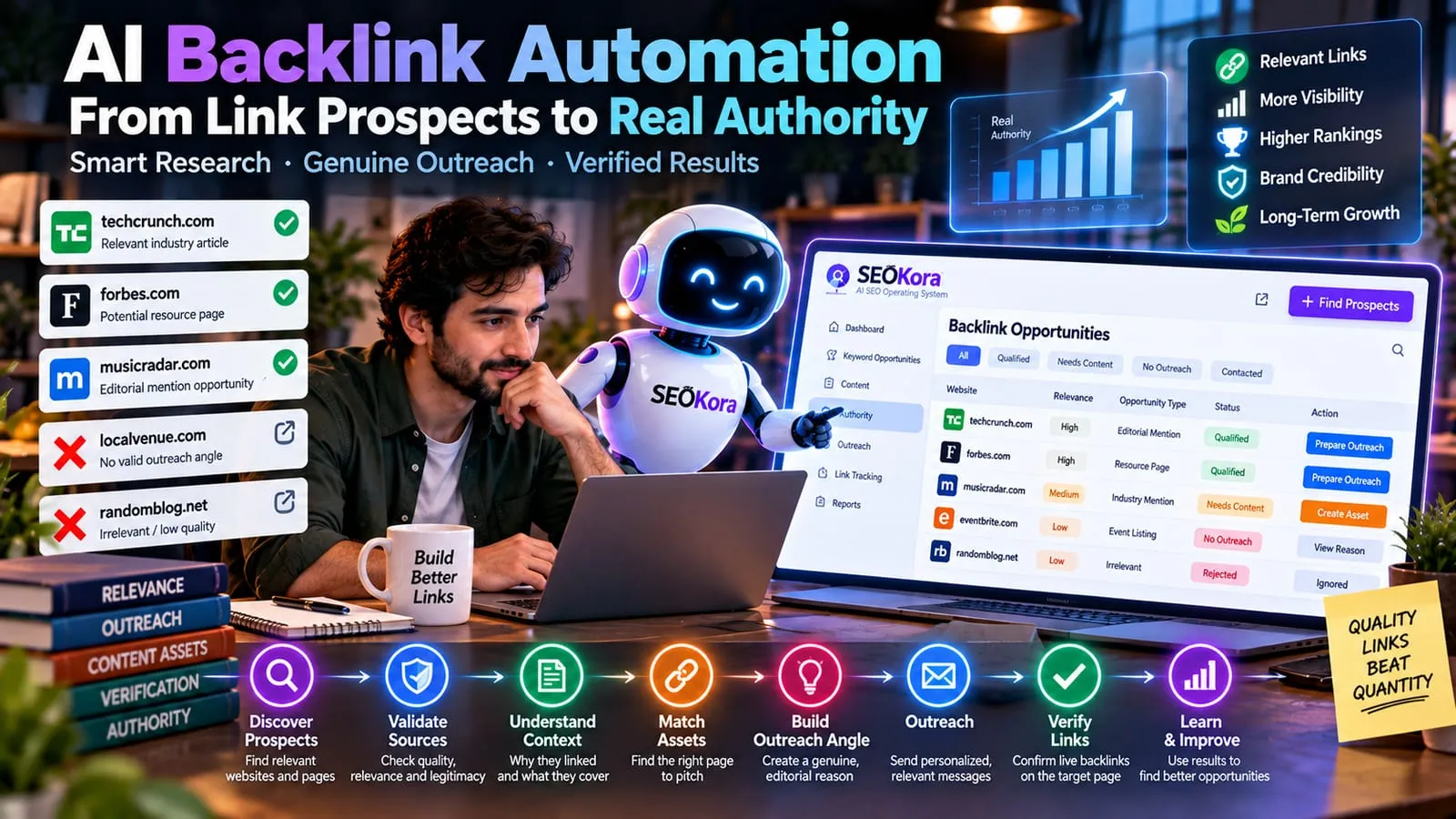
SEOKora vs Ahrefs: From SEO Intelligence to Continuous Execution
Compare SEOKora vs Ahrefs for keywords, backlinks, competitor research, AI visibility, SEO automation and continuous execution for your business.
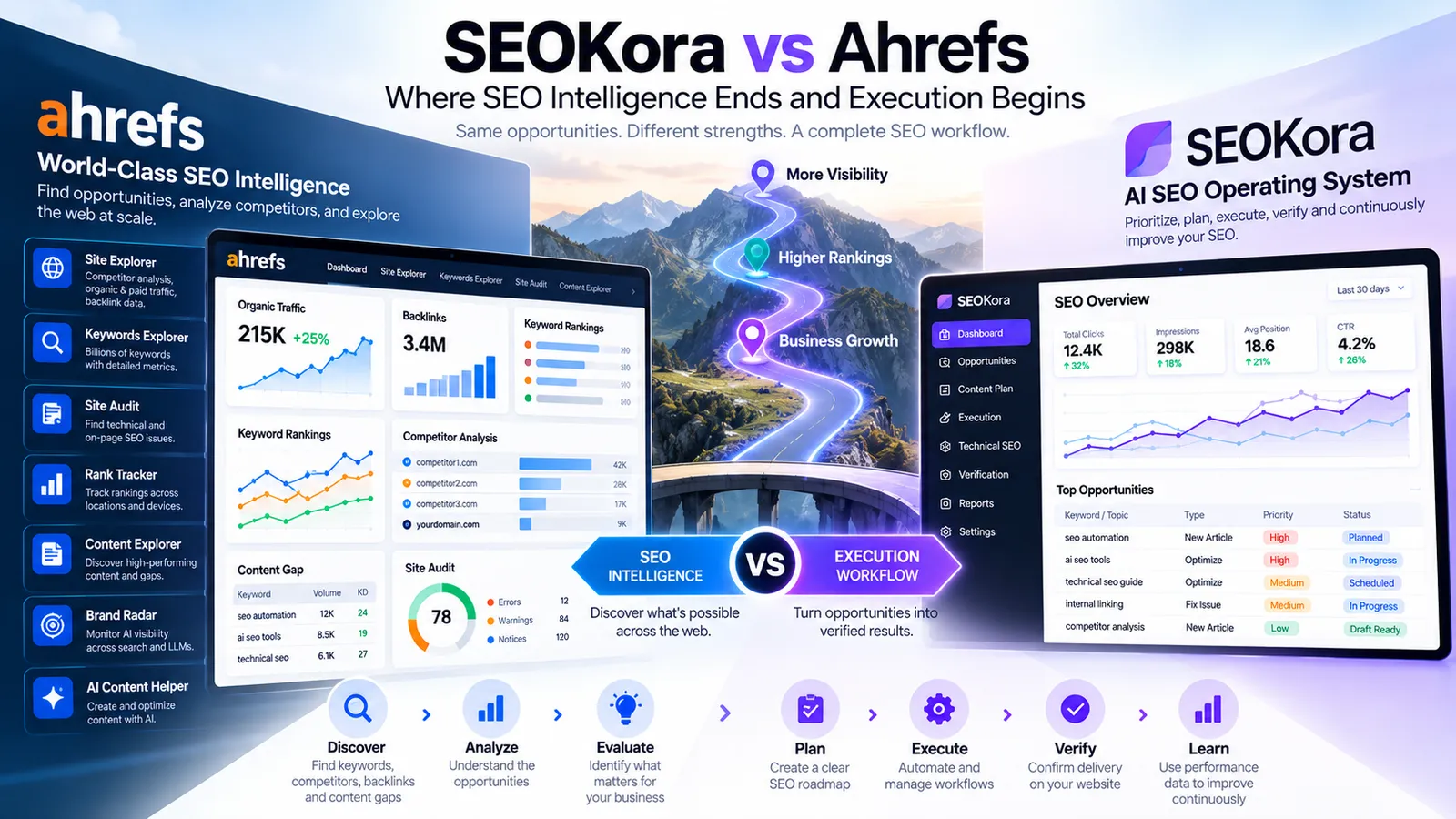
Finding an SEO opportunity is easier than it has ever been.
Modern platforms can reveal which keywords competitors rank for, where their backlinks come from, which pages attract traffic, what technical problems exist on a website and even how brands appear inside AI-generated answers.
But finding an opportunity and completing useful SEO work are two different things.
That distinction makes the SEOKora vs Ahrefs comparison more interesting than a conventional feature checklist.
Ahrefs has spent more than a decade building a formidable search and web intelligence ecosystem. Its current platform extends well beyond backlinks into keyword research, competitor analysis, technical auditing, rank tracking, content research, AI-assisted optimization and AI-search visibility.
SEOKora approaches the SEO problem from another direction.
Its central idea is an AI SEO operating system: a system intended to continuously identify relevant opportunities, prioritize them, coordinate work, execute approved actions, verify delivery and use subsequent evidence to influence what happens next.
There is overlap between these approaches.
There are also meaningful differences.
The right question therefore is not simply:
“Which tool has more SEO features?”
A more useful question is:
“Where is the bottleneck in your SEO operation: intelligence, execution, or the connection between the two?”
SEOKora vs Ahrefs at a Glance
| Area | Ahrefs | SEOKora |
|---|---|---|
| Core emphasis | Search, web and marketing intelligence | Continuous SEO operations |
| Competitor research | Major strength through Site Explorer and related tools | Competitive evidence used as an input to decisions |
| Keyword research | Large specialist Keywords Explorer ecosystem | Relevant keyword opportunities enter prioritization |
| Backlink intelligence | Major specialist strength | Authority evidence can inform operational actions |
| Technical SEO | Large-scale Site Audit and diagnostics | Selected issues can enter managed execution workflows |
| Content research | Content Explorer, Content Gap and AI content tools | Content decisions coordinated with the wider site plan |
| Rank tracking | Dedicated Rank Tracker | Performance evidence feeds prioritization and reassessment |
| AI visibility | Brand Radar and AI-search datasets | AI presence considered within broader visibility operations |
| AI execution | AI features plus Letaido execution workflows | Execution built into the core operating model |
| Planning | Available through different tools/workflows | Central part of ongoing operations |
| Delivery verification | Depends on the action and workflow | Explicit distinction between attempted and verified delivery |
| Customer operating model | Research and specialist tools operated by marketer/SEO team | Designed to reduce routine customer operation |
This is not a winner-versus-loser table.
It illustrates that two SEO products can overlap significantly while still being designed around different operating assumptions.
What Ahrefs Actually Is in 2026
Ahrefs is sometimes still described as a backlink checker.
That description is badly outdated.
Its current marketing platform covers several major areas of modern discovery.
Site Explorer analyzes organic and paid traffic, website structure and backlink profiles.
Keywords Explorer provides large-scale keyword discovery and SEO metrics.
Rank Tracker monitors Google rankings across devices and locations.
Site Audit crawls websites for technical and on-page SEO problems.
Content Explorer helps identify successful content and link opportunities.
Brand Radar extends visibility research into AI environments.
Ahrefs also provides AI-assisted content functionality and other workflow capabilities.
That breadth matters because an honest SEOKora comparison cannot be based on the idea that Ahrefs merely shows backlinks while SEOKora “does everything else.”
It does not.
Ahrefs' Real Superpower: Seeing the Web at Scale
Consider one deceptively simple question:
“Why is my competitor outperforming me?”
Answering it can require several layers of evidence.
You may need to investigate:
- which pages generate their organic visibility;
- which queries those pages rank for;
- how their website is structured;
- which domains link to them;
- which competing pages are gaining or losing visibility;
- which topics they cover that you do not;
- how their paid search activity differs;
- and where their brand appears across AI discovery environments.
This is precisely the kind of problem a large web intelligence platform is designed to investigate.
For an SEO professional, consultant or agency, that research depth can be enormously valuable.
But Intelligence Creates a Second Problem
Suppose Ahrefs reveals 100 content opportunities.
It identifies dozens of backlink prospects.
Site Audit finds technical problems.
Content Gap identifies queries your competitors rank for and you do not.
Site Explorer reveals competitor pages that consistently attract organic traffic.
You have gained intelligence.
But the business now has another problem:
Which of those things should actually happen?
More specifically:
- Which opportunity matters most?
- Which keyword is irrelevant despite attractive metrics?
- Which content gap is genuinely a gap for this business?
- Which topic already has adequate coverage?
- Which technical problem deserves immediate resources?
- Which backlink opportunity is realistic?
- What should happen today?
- What should happen next week?
- Who executes it?
- And how do we know the work actually happened?
This is where research intelligence becomes an operating problem.
Discovery Is Not the Same as Priority
This distinction is fundamental to SEOKora's philosophy.
An SEO opportunity can be real and still not deserve action.
Imagine that competitor analysis uncovers four topics:
| Discovered Opportunity | Research Signal | Operational Question |
|---|---|---|
| Topic A | High search demand | Is it commercially relevant to us? |
| Topic B | Competitors rank strongly | Does our audience actually need it? |
| Topic C | Our page ranks weakly | Should we improve the existing page? |
| Topic D | We have no ranking page | Do we need a new page at all? |
A research system helps reveal the signals.
An operating system needs to determine which signals deserve resources.
Discovery tells you what is possible. Prioritization determines what becomes work.
The Content Gap Trap
Content Gap analysis is one of the most useful forms of competitor research.
It can also be misunderstood.
Suppose three competitors rank for a topic and your website does not.
Is that automatically a content gap?
From a competitive dataset perspective, potentially yes.
From a business strategy perspective, not necessarily.
The missing topic might be:
- irrelevant to your product;
- outside your geographic market;
- too far from customer intent;
- already addressed indirectly by another page;
- likely to create cannibalization;
- or simply not worth the resources required.
This is why competitor intelligence should inform strategy rather than automatically become strategy.
From “Ahrefs Found It” to “What Happens Next?”
Consider a practical scenario.
Ahrefs identifies a competitor page receiving meaningful organic traffic from a topic your website barely covers.
A simplistic automation system could respond:
Gap found → generate article.
A more disciplined operating workflow looks different.
| Stage | Question | Possible Outcome |
|---|---|---|
| Discover | What opportunity was found? | Competitor content gap |
| Validate | Does it belong to our business? | Relevant / irrelevant |
| Map | Do we already have related coverage? | Existing page identified |
| Decide | New page or improve existing page? | Best action selected |
| Prioritize | Does it matter more than other opportunities? | Priority assigned |
| Plan | When should work happen? | Scheduled workload |
| Execute | Can approved work be delivered? | Action performed |
| Verify | Did the intended change go live? | Delivery confirmed |
| Learn | What happened afterward? | New evidence feeds next cycle |
The competitive intelligence remains valuable.
SEOKora's intended contribution begins with turning that intelligence into a controlled operating decision.
Backlinks: Where Ahrefs Is Particularly Strong
No SEOKora vs Ahrefs comparison would be credible without discussing backlinks.
Backlink analysis has historically been one of Ahrefs' defining strengths.
Site Explorer allows marketers to investigate who links to a website, how competitors acquire links and which pages attract authority.
This supports several important SEO activities:
- competitor backlink research;
- link-gap discovery;
- prospect identification;
- broken-link research;
- authority analysis;
- and content promotion strategy.
SEOKora should not attempt to win this comparison by pretending a specialist web index has no value.
The more useful question is:
Once backlink intelligence reveals a realistic opportunity, how does that opportunity enter an accountable workflow?
Backlink Data vs Backlink Operations
Imagine finding 500 potential link prospects.
The number sounds impressive.
But operationally, several questions remain:
- Is the site actually relevant?
- Why would it reasonably link to us?
- Which page should earn the link?
- Do we have an asset worth referencing?
- Is there a genuine relationship or editorial angle?
- Is outreach appropriate?
- Has this prospect already been contacted?
- What happened previously?
Without those controls, backlink automation can quickly become spam.
The difference between a list and an outreach strategy is context.
Technical SEO: Finding Problems vs Managing Resolution
Ahrefs Site Audit can crawl websites and identify a large range of technical and on-page issues.
That diagnostic capability is useful because technical SEO problems are often difficult to discover manually at scale.
But technical auditing presents the same operational question.
Suppose an audit finds:
- broken internal links;
- redirect chains;
- missing metadata;
- indexability problems;
- slow pages;
- or duplicate elements.
A diagnostic system tells you the issue exists.
An operational system must determine:
Can this be fixed safely? Does it need approval? Who owns the action? Was the fix applied? Did it remain fixed?
These are different layers of the same SEO problem.
AI Changes the Comparison
A few years ago it would have been easier to characterize Ahrefs as primarily a research platform.
That comparison is no longer sufficient.
Ahrefs now incorporates AI throughout its ecosystem.
Its AI capabilities include content assistance, keyword-related features, search-intent analysis and AI visibility research.
Brand Radar extends competitive visibility analysis into AI-generated discovery environments.
Ahrefs also describes Letaido as an AI marketing platform that works with Ahrefs data to create assets such as briefs, audits, landing pages and reports and push work into external productivity systems.
That matters.
It means the real comparison is no longer:
“Ahrefs gives data; SEOKora executes.”
That statement would be too simplistic.
The better distinction is architectural.
Execution Feature vs Operating System
An execution feature helps perform a task.
An operating system coordinates the lifecycle around many tasks.
For SEOKora, that lifecycle is intended to look like:
Observe → Understand → Prioritize → Plan → Execute → Verify → Learn.
The important question is not simply whether AI can create an article or technical recommendation.
It is whether the surrounding system understands:
- why that work exists;
- how important it is;
- whether similar work already exists;
- whether it conflicts with previous decisions;
- when it should happen;
- whether approval is necessary;
- whether execution succeeded;
- and what should happen afterward.
That lifecycle is the stronger basis for evaluating an SEO operating system.
Why “Generated” Should Never Mean “Delivered”
Imagine an AI generates an optimized article.
The generation succeeds.
The system sends it to the CMS.
The CMS fails.
The article never becomes publicly available.
Has the customer received the intended delivery?
No.
This creates a crucial distinction:
Generated ≠ Published ≠ Verified.
| State | Meaning |
|---|---|
| Discovered | An opportunity exists |
| Planned | Work has entered the plan |
| Generated | An asset exists internally |
| Approved | Required quality/control gate passed |
| Scheduled | Delivery has a planned time |
| Published | CMS accepted publication |
| Verified | The intended live result was confirmed |
| Recovery | A failed delivery requires corrective action |
This may sound like an engineering detail.
For a customer paying for ongoing SEO delivery, it is an accountability issue.
Where Ahrefs Has the Stronger Fit
There are situations where Ahrefs' product model is particularly compelling.
Deep Competitor Investigation
If your work requires repeatedly reverse-engineering competitor websites, rankings, pages, links and market movements, Ahrefs has extensive specialist capabilities for that purpose.
Backlink Research
Teams whose workflows depend heavily on link intelligence will naturally value a mature backlink index and specialist link-analysis tools.
Large-Scale Keyword Exploration
SEO professionals conducting broad keyword discovery across markets and countries can benefit from a dedicated research environment.
Technical Diagnosis
Site Audit provides structured technical and on-page analysis at scale.
Professional SEO Analysis
Consultants and agencies often need granular access to raw research because interpreting that data is itself part of their professional service.
In these cases, the complexity of a research platform can be an advantage rather than a burden.
Where SEOKora's Operating Model Has the Stronger Fit
Now imagine a different customer.
They run a business rather than an SEO consultancy.
They do not want to spend every morning inside Site Explorer, export keyword lists, inspect every technical warning or manually build a content calendar.
They want answers to operational questions:
- What is being worked on?
- Why was it selected?
- What is scheduled next?
- What needs my approval?
- What has been completed?
- What failed?
- Is the system recovering automatically?
- What was actually delivered?
This customer is solving a different problem.
They do not necessarily need less intelligence.
They need less manual operation of that intelligence.
Small Business vs SEO Professional
| User | Likely Priority | Relevant Model |
|---|---|---|
| SEO consultant | Deep manual investigation | Specialist intelligence platform |
| Link-building specialist | Detailed backlink analysis | Large web/link database |
| Content strategist | Demand and competitor research | Research + content intelligence |
| Small-business owner | Useful SEO work without daily tool operation | Operating-system approach |
| Lean internal team | Research plus reduced coordination overhead | Potential hybrid stack |
| Agency | Research across many clients plus execution management | Potential combination of both layers |
Can SEOKora and Ahrefs Work Together?
Yes.
In fact, viewing the products as complementary layers can sometimes make more sense than forcing an artificial replacement narrative.
A specialist intelligence platform can answer:
What is happening across the search market?
An operating system can answer:
Given the evidence we trust, what should this business do next?
A simplified hybrid model could look like:
Market Intelligence → Business Context → Prioritization → Execution → Verification → Performance Feedback.
Not every organization needs both.
But organizations should choose based on workflow requirements rather than assuming every SEO product belongs in the same category.
The Hidden Cost of SEO Software
Software pricing pages tell you the subscription cost.
They rarely tell you the operating cost.
Imagine a sophisticated research platform identifies 50 opportunities.
Someone still has to:
- review them;
- remove irrelevant ones;
- compare them with existing content;
- decide priorities;
- create briefs;
- assign work;
- review output;
- publish changes;
- handle failures;
- and return later to assess results.
For an SEO professional, that expertise is valuable work.
For a small-business owner, it may be the reason the SEO tool stops being used after three months.
Therefore, total cost should include:
Software cost + human operating time + coordination overhead.
Do More Keywords Mean Better SEO?
No.
A database containing billions of keywords is valuable for research because it expands what can be discovered.
But the business does not need to target billions of keywords.
It needs to identify the subset that intersects with:
- its products or services;
- its audience;
- its expertise;
- its existing website;
- its commercial goals;
- and realistic search opportunities.
Large datasets expand discovery.
Context narrows discovery into strategy.
Does More Automation Mean Better SEO?
Also no.
Automation amplifies whatever decision precedes it.
A good decision can become faster.
A bad decision can become faster too.
This is why useful SEO automation needs constraints.
A responsible system should be capable of saying:
- this keyword is irrelevant;
- this topic was already rejected;
- this page already covers the intent;
- this recommendation would create duplication;
- this action requires approval;
- this publication failed;
- or simply, no action is justified yet.
Sometimes the smartest automated action is not to act.
Human Intervention Should Become System Knowledge
This principle becomes especially important in continuous automation.
Suppose an administrator rejects an irrelevant keyword today.
If the same system recommends it tomorrow, then again next week, the automation has learned nothing.
A better workflow preserves meaningful interventions.
This can include:
- rejected keywords;
- irrelevant topics;
- content that should not be duplicated;
- unwanted outreach targets;
- business-specific preferences;
- and strategic exclusions.
The objective is straightforward:
Human judgment today should reduce unnecessary human work tomorrow.
What About AI Search Visibility?
Ahrefs has moved aggressively into this area.
Brand Radar allows businesses to investigate brand visibility across AI discovery environments and compare that visibility with competitors.
This makes AI visibility another form of intelligence available to marketers.
But the operating question remains familiar:
What do we do with that information?
If a competitor is cited frequently for a particular topic, the appropriate response is not automatically “generate an AI article.”
The business may need stronger original research, clearer entity relationships, better topical coverage, improved sourceworthiness, stronger authority signals or no action at all.
AI visibility therefore strengthens rather than removes the need for contextual decision-making.
A Practical Buying Framework
| If Your Main Problem Is... | Prioritize... |
|---|---|
| I need to understand competitor traffic | Site/competitive intelligence |
| I need deep backlink research | Specialist backlink database |
| I need broad keyword discovery | Keyword intelligence |
| I need technical diagnosis | Advanced site crawler/audit |
| I need AI visibility research | AI visibility intelligence |
| I have plenty of findings but weak execution | Operating workflow |
| I want less manual SEO coordination | Automation and orchestration |
| I need proof that planned work actually happened | Delivery verification |
| I want SEO to continue between my interventions | Continuous operating model |
What Neither SEOKora nor Ahrefs Can Guarantee
Neither platform controls Google's ranking systems.
SEO platforms can discover evidence, estimate opportunities, identify problems, assist decisions and automate parts of the work.
They cannot legitimately guarantee that a page will reach a specific organic position.
This distinction is important when evaluating any SEO product.
SEOKora should therefore be evaluated on whether it improves the quality and consistency of SEO operations—not on unrealistic promises of guaranteed rankings.
The Most Useful SEOKora vs Ahrefs Question
Instead of asking:
“Which one is the better SEO tool?”
ask:
“What job do I need the software to perform?”
| If You Need... | Think About... |
|---|---|
| Explore enormous amounts of web/search data | Intelligence platform |
| Reverse-engineer competitors | Competitive research |
| Analyze backlinks deeply | Specialist backlink intelligence |
| Turn selected opportunities into a workload | Operating system |
| Coordinate recurring SEO execution | Automation/orchestration |
| Know whether work was truly delivered | Verification |
Once the problem is defined correctly, the software decision becomes much easier.
Frequently Asked Questions
Is SEOKora an Ahrefs alternative?
There is overlap within the SEO market, but the platforms emphasize different problems. Ahrefs provides extensive search, competitor, backlink, technical, content and AI visibility intelligence. SEOKora is designed around turning selected intelligence into prioritized and verified ongoing SEO operations. Depending on the workflow, they can be alternatives in some areas or complementary in others.
Is Ahrefs only for backlink research?
No. Ahrefs has evolved far beyond backlinks. Its platform includes Site Explorer, Keywords Explorer, Site Audit, Rank Tracker, Content Explorer, Brand Radar, content tools, analytics and multiple AI-assisted capabilities.
Which is stronger for backlink analysis?
Ahrefs is a specialist web and backlink intelligence platform with a large link index and dedicated backlink research capabilities. Businesses requiring deep backlink investigation should treat the quality and scale of that specialist data as an important purchasing factor.
Which is better for keyword research?
Ahrefs provides a mature specialist keyword research environment through Keywords Explorer. SEOKora's operating model places more emphasis on determining which relevant opportunities should actually become work rather than maximizing exploratory keyword discovery.
Does Ahrefs have AI features?
Yes. Ahrefs currently provides multiple AI-assisted features, content tools and AI visibility capabilities. Brand Radar is specifically designed for researching brand visibility across AI discovery environments.
Does Ahrefs have execution capabilities?
Yes. It would be inaccurate to describe current Ahrefs as data-only. Ahrefs offers AI-assisted workflows and describes Letaido as an AI marketing platform capable of creating marketing assets and pushing work into external tools. The useful comparison with SEOKora is therefore the architecture and degree of ongoing operational orchestration rather than the existence of execution features.
Can SEOKora and Ahrefs work together?
Potentially. Ahrefs can provide specialist market and competitor intelligence while an operating layer can coordinate selected opportunities through planning, execution and verification. Whether using both is worthwhile depends on the business's needs and budget.
Can SEOKora guarantee rankings?
No. Search rankings depend on search-engine systems and many external factors. The purpose of an SEO operating system is to improve how SEO work is selected, coordinated, executed and measured—not to promise control over search results.
Who is SEOKora designed for?
The operating-system model is particularly relevant to businesses and lean teams that want SEO work to continue systematically without manually operating every research, production and monitoring step themselves.
Conclusion: Intelligence Is Powerful. Execution Makes It Operational.
Ahrefs demonstrates how sophisticated SEO intelligence has become.
A marketer can investigate billions of keywords, enormous backlink networks, competitor websites, technical problems, content opportunities and increasingly the emerging world of AI discovery.
That intelligence is valuable.
But intelligence creates value for a business only when it influences appropriate action.
SEOKora is being built around that second half of the problem.
Its central operating cycle is:
Discover → Understand → Prioritize → Plan → Execute → Verify → Learn.
The distinction is not that one platform knows while the other acts.
Modern Ahrefs increasingly does both.
The distinction is where each system places its center of gravity.
Ahrefs' strength begins with understanding the search, web and competitive landscape at enormous scale.
SEOKora's operating thesis begins with making sure the right work keeps moving through a controlled lifecycle until its outcome can be verified.
For some organizations, deep intelligence is the missing piece.
For others, execution is the bottleneck.
And for mature SEO operations, the strongest architecture may connect both:
Intelligence → Context → Decision → Action → Verification → Learning.