Businesses and Seo Without an Agency
Practical guidance for businesses doing SEO without an agency, including software choice, workflow, AI, and automation control.
What SEO without an agency really means
SEO without an agency means your business keeps the strategy, decisions, and execution close to the people who understand the product, customer, and sales cycle. It does not mean guessing your way through search. It means using a clear workflow, reliable SEO software, and disciplined review so you can find ranking opportunities, improve content, and grow organic visibility without outsourcing every decision.
For a small business, SaaS team, website owner, or content marketer, the real question is not “Can we do SEO ourselves?” The better question is “Which parts of SEO can we run well in-house, and where do we still need expert help?” Keyword research, page optimization, content briefs, competitor checks, internal linking, and performance review can often be managed with the right system. Complex migrations, technical investigations, or high-risk site changes may still justify specialist support.
This is where SEO software matters. A platform should not simply produce a long list of keywords or errors. It should help you understand what deserves attention, why it matters, and what action is reasonable next. SEOKora fits this category as an SEO growth software platform focused on turning search intelligence into growth through ranking opportunities, competitive intelligence, authority insights, site optimization, and content optimization.
If you are comparing the broader category, SEOKora’s organic search platform guide (opens in new tab) is a useful companion because it frames SEO software around context, not just features.
How to sort signal from noise when choosing SEO software
Businesses searching for “best SEO software for small business” quickly run into a familiar problem: most tools promise more data, more reports, and more automation. More is not always better. When you are doing SEO without an agency, every extra dashboard has to earn its place because the same person may be writing content, reviewing analytics, fixing pages, and reporting progress.
The strongest filter is decision quality. Good SEO software should help you answer practical questions:
- Which existing pages are close enough to improve with focused optimization?
- Which topics match real search demand and your ability to create useful content?
- Which competitors are visible for the terms you care about, and why?
- Which technical or on-page issues are likely to block performance?
- Which work should happen now, and which can wait?
Weak software makes every issue look equally urgent. A title tag warning, a thin category page, a missing internal link, and a competitive topic gap may appear side by side without context. That creates busywork. The business feels active but may not be improving the pages that can actually win traffic.
A practical way to evaluate a tool is to run one real page through it. Choose a page that matters commercially but is not performing as well as it should. If the software helps you see the search intent, compare the page against visible competitors, and identify a small set of defensible changes, it is supporting your in-house SEO process. If it only produces generic scores or vague recommendations, it may not reduce your dependence on outside interpretation.
SEOKora’s guide to SEO software for small businesses (opens in new tab) goes deeper on this buying question for teams that need practical capability rather than a feature checklist.
What “best” means for a small business doing SEO in-house
The best SEO software for a small business is the one that matches the business’s actual capacity. A founder-led company with one marketer needs different support than an agency team managing many client sites or a SaaS company publishing technical content every week. A tool can be powerful and still be a poor fit if it assumes more time, expertise, or process maturity than the business has.
For SEO without an agency, “best” usually means five things.
- Clarity: The tool should explain what is happening in search, not bury the user in disconnected metrics.
- Actionability: Recommendations should point toward concrete edits, briefs, internal links, content gaps, or technical checks.
- Control: The business should be able to review and approve decisions instead of accepting black-box changes.
- Repeatability: The workflow should be usable every month, not only during an initial audit.
- Fit: The software should support your content type, site size, and organic growth goals without requiring a full agency process to operate it.
A local service business may care more about fixing service pages, answering practical customer questions, and improving pages that already receive impressions. Both are doing SEO, but their software needs are not identical.
This is also why businesses should be careful with one-size-fits-all rankings. A tool that works well for a full-time SEO professional may overwhelm a lean marketing team. A lighter tool may feel easier at first but fail when the business needs competitive analysis or content optimization at scale. The right choice is the one that improves decisions at your level of expertise today while leaving room for a more mature workflow later.
The workflow your SEO platform needs to support
SEO without an agency works best when the business stops treating SEO as a collection of tasks and starts treating it as a repeatable operating rhythm. The workflow does not have to be complicated, but it does need to be complete enough to prevent random acts of optimization.
A useful in-house SEO workflow usually looks like this:
- Establish the baseline. Review the pages that already exist, the topics they target, and where visibility is weak or improving.
- Find opportunities. Look for keywords, competitor pages, content gaps, and existing pages that could improve with better structure or depth.
- Prioritize the work. Choose tasks based on likely impact and effort, not only search volume or tool scores.
- Create or improve content. Build pages that answer the search intent clearly, include the right supporting detail, and connect to relevant pages on the site.
- Check technical and on-page quality. Fix issues that affect crawling, indexability, page relevance, and user experience.
- Measure and revise. Track what changes after publishing or optimization, then refine the next round of work.
Software should make this rhythm easier. It should help the user move from discovery to action without losing the reasoning behind each decision. If a platform finds a ranking opportunity, the next question should be obvious: create a new page, improve an existing one, adjust internal links, or leave it alone because the fit is weak.
SEOKora’s resources are organized around practical SEO strategy, systems, and decision frameworks. If you want to compare related guidance, the resources library (opens in new tab) is a useful starting point.
AI is useful when it improves SEO judgment, not when it hides it
AI SEO software can help businesses work faster, but it should not remove human review from the process. The risk is not simply that AI may produce imperfect text. The bigger risk is that a business accepts recommendations without understanding the search intent, competitive context, or brand implications behind them.
AI is most useful when it helps with constrained, reviewable work: clustering topics, identifying likely content gaps, drafting outlines for human editing, summarizing competitor patterns, or suggesting improvements to an existing page. Those outputs still need judgment. A content marketer should be able to ask: does this answer the buyer’s real question, does it fit our product, and can we support the claim?
AI is weaker when it is used as a substitute for strategy. If it generates pages at scale without verifying accuracy, originality, or usefulness, the business may create content that looks complete but does not deserve to rank. If it rewrites pages only to satisfy a score, the page may become less clear for the reader. If it recommends topics without understanding the business model, the team may chase traffic that does not help the company.
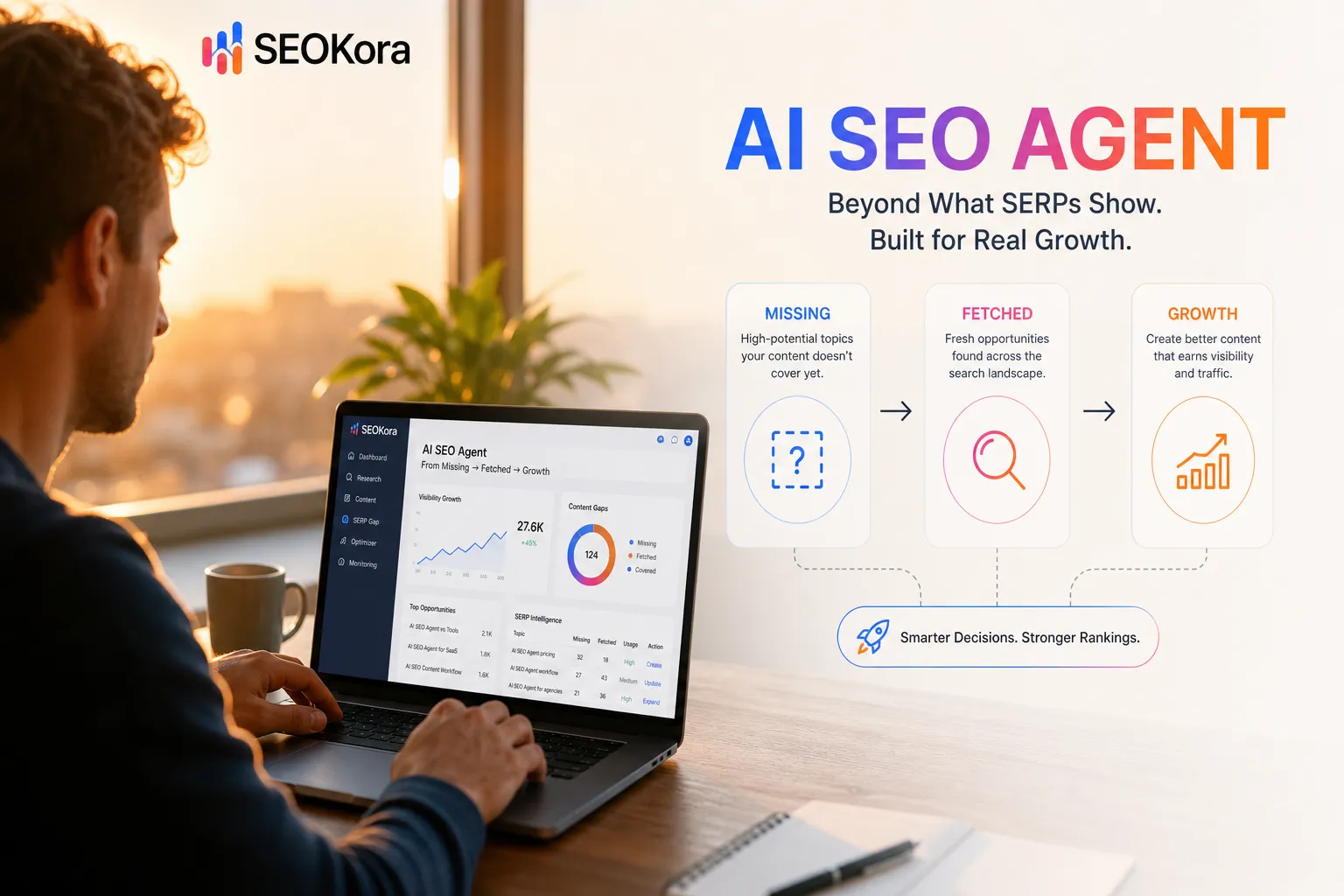
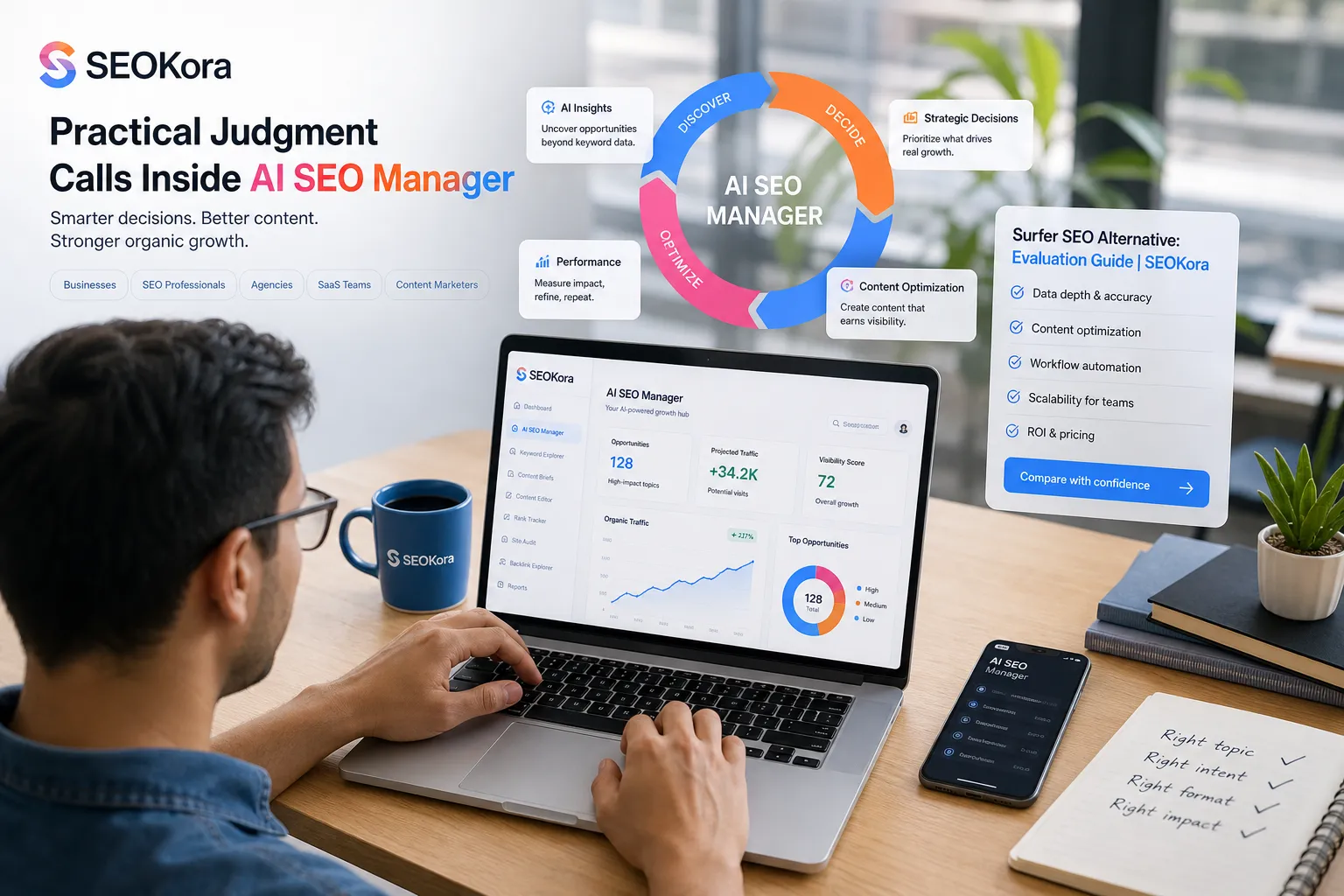
A safer standard is simple: AI should make the reasoning easier to inspect. If a tool suggests an optimization, the user should be able to see why that recommendation exists and decide whether it belongs on the page. SEOKora has related guidance on this distinction in AI that does SEO (opens in new tab) and its guide to an AI SEO agent (opens in new tab).
Automation should remove repetition without removing control
Automation is attractive when a business wants to run SEO without an agency because it reduces the repetitive work that slows teams down. The right automation can help monitor opportunities, surface issues, organize tasks, or support recurring optimization. The wrong automation turns SEO into a set of unchecked changes.
The distinction is control. It should be much more careful about automating public-facing changes, strategic decisions, or content publication without review.
For example, it is reasonable for software to flag that an important page has lost visibility, that a competitor covers a missing subtopic, or that several related pages lack useful internal links. It is less reasonable to automatically rewrite the page, change the target keyword, and publish new copy without someone checking the business context. The software can accelerate the work, but the business still owns the decision.
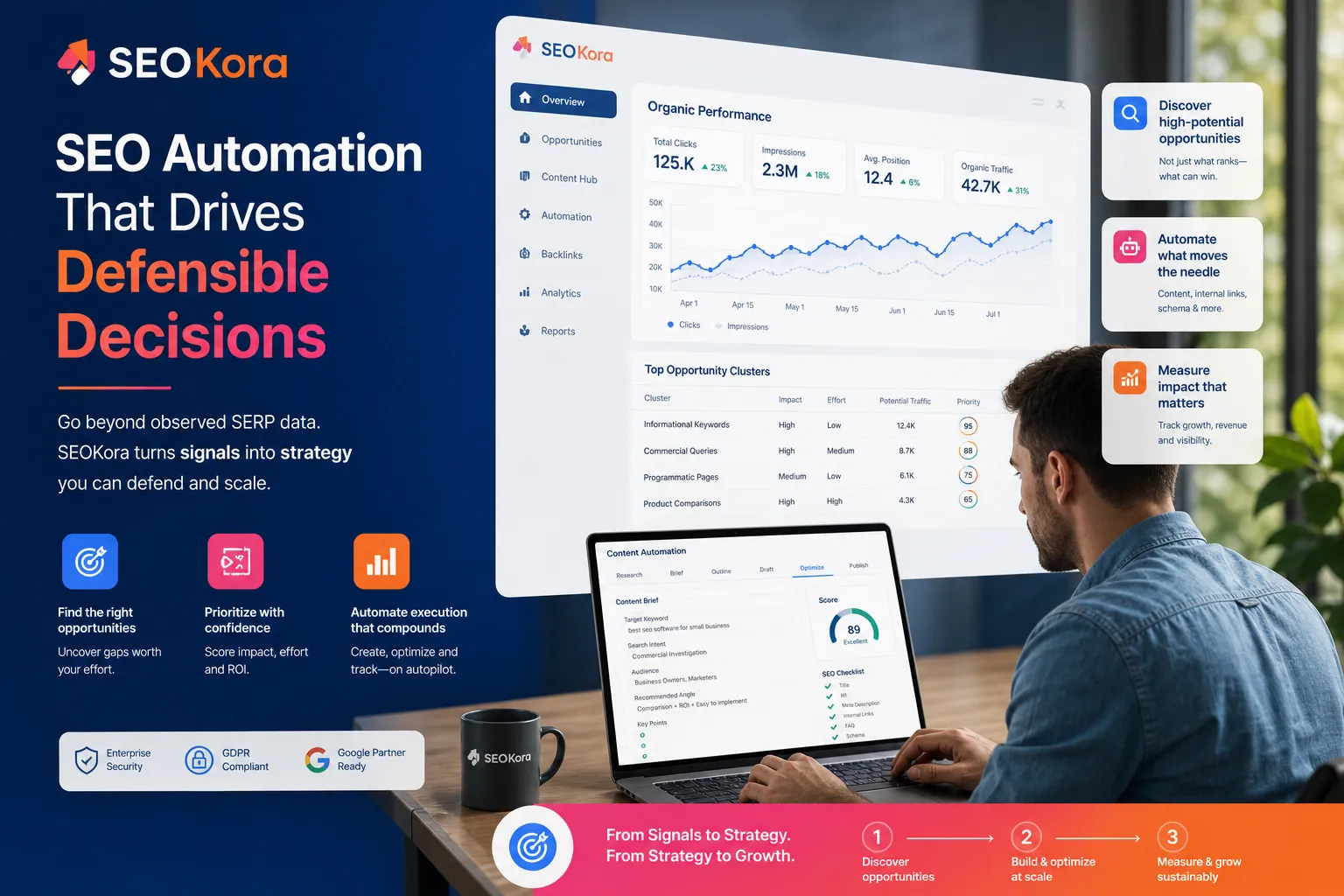
This is especially important for small teams. When time is limited, automation can create the feeling that SEO is “handled.” But organic growth still depends on choosing the right opportunities, improving pages with care, and learning from results. SEOKora’s article on turning SEO automation software into defensible decisions (opens in new tab) is useful if you are evaluating how much automation to trust.
What is the best SEO software for a small business?
The best SEO software for a small business is the one that supports the work the business can actually perform: finding opportunities, improving pages, checking competitors, optimizing content, and reviewing results. A feature-heavy platform is not automatically better if it requires expertise the team does not have. Look for software that makes decisions clearer and helps you repeat the workflow consistently.
Is AI SEO software safe to use for business content?
AI SEO software can be safe and useful when the business keeps human review in the loop. It becomes risky when it publishes unsupported claims, rewrites content without subject-matter review, or hides the reasoning behind recommendations.
Should a small business choose automation or manual SEO tools?
Most small businesses need a mix. Manual review is important for strategy, positioning, and final content quality. Automation is helpful for repetitive monitoring, issue detection, opportunity discovery, and organizing recurring work. The goal is not to remove people from SEO; it is to stop wasting human attention on tasks software can handle reliably.
What mistakes should businesses avoid when doing SEO in-house?
Common mistakes include chasing high-volume keywords with weak business fit, publishing AI-assisted content without review, fixing low-impact issues before important pages, and treating tool scores as the goal. The correction is to connect every SEO action to a page, a search intent, and a reason the work should improve visibility or usefulness.
Your next move with SEOKora
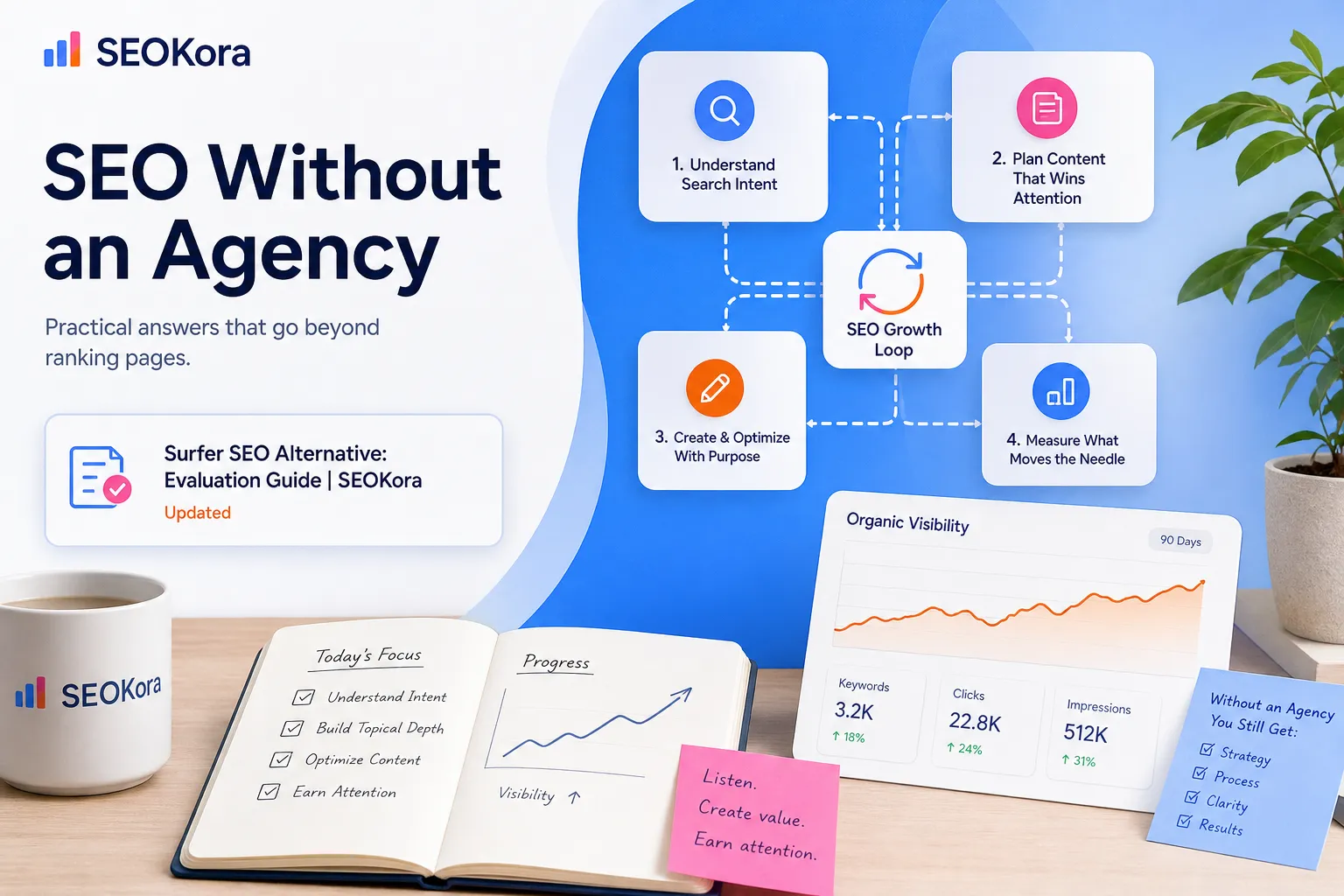
If your business wants to do SEO without an agency, start with one focused review rather than a full-site overhaul. Pick a page that already matters to the business. Check the search intent, compare visible competitors, identify missing or weak content, review on-page quality, and decide on a small set of changes you can defend. Then measure what happens and repeat the process on the next priority page.
That small loop is the foundation of in-house SEO: understand the opportunity, make a clear decision, improve the asset, and learn from the result. SEOKora is built around that kind of practical search growth work, with software for SEO automation, content optimization, search growth, and organic search decision-making.
To explore the platform, visit SEOKora (opens in new tab). If you want to compare related strategic guidance first, browse the SEOKora resources (opens in new tab) for SEO strategy, systems, and decision frameworks.