Reduce Friction for Businesses for Businesses — First Moves That Stick
Reduce SEO friction with clearer software choices, workflow steps, AI guardrails, and automation that keeps business control.
What reducing friction means in SEO growth work
To reduce friction for businesses in SEO, remove the delays between seeing an opportunity and acting on it: unclear priorities, scattered keyword data, slow content reviews, repeated technical checks, and tools that create more interpretation work than decisions. The first moves that stick are usually simple: define the workflow, decide what “good” software must help you do, use AI where it improves judgment, and automate repetition without handing over control.
For a business owner, agency, SaaS team, or content marketer, friction rarely looks like one big obstacle. It looks like five small ones happening at once. A page has impressions but no clicks. A competitor is ranking with a cleaner topic cluster. A technical issue may be suppressing performance, but nobody is sure whether it matters. A content brief is generated, then rewritten because it does not match the business. The team has data, but the next action is still vague.
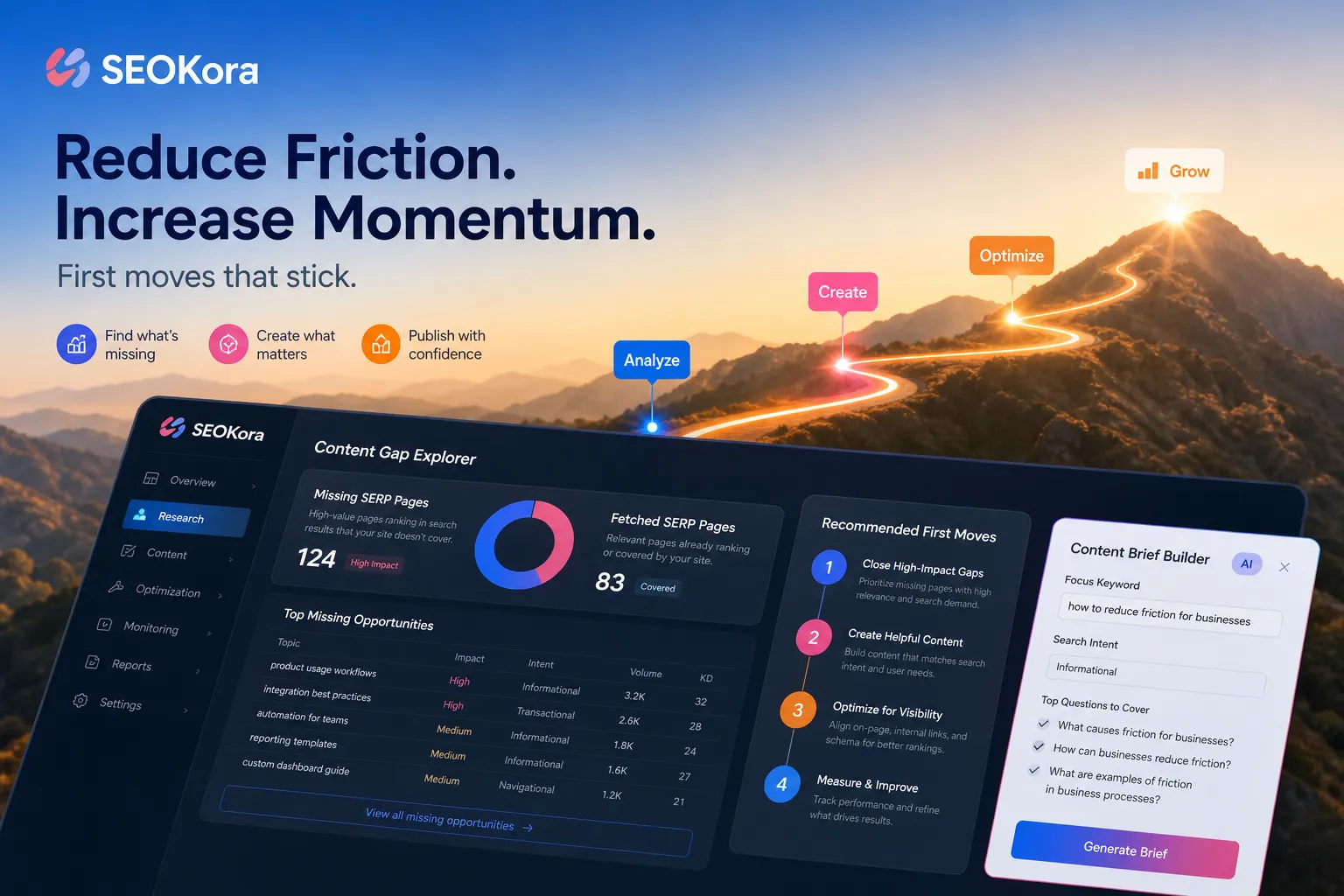
SEOKora sits in that practical space: SEO growth software for turning search intelligence into growth through ranking opportunities, competitive intelligence, authority insights, site optimization, and content optimization. The useful question is not “Can software do SEO?” It is “Can the software reduce the number of steps between evidence and a defensible action?”
Sort signal from noise before choosing SEO software
The fastest way to add friction is to compare SEO platforms by feature count alone. Small businesses and lean teams do not need every possible chart first; they need a clear path from diagnosis to decision. That is why SEOKora’s guidance on choosing SEO software for a small business (opens in new tab) is a useful starting point: “best” depends on the work the business actually has to complete.
Signal is information that changes what you do next. Noise is information that looks impressive but does not change the decision. A ranking report is signal if it shows which pages are close enough to improve, which queries deserve expansion, or which competitors explain the gap. It is noise if it produces a weekly ritual of exporting data and debating what it means without shipping improvements.
A practical filter helps:
- Does this insight change a page, brief, internal link, technical fix, or publishing priority? If not, park it.
- Can the team understand why the recommendation exists? If the reasoning is hidden, review time increases.
- Does the tool connect discovery with execution? Separate dashboards can be useful, but constant tool-switching slows decisions.
- Can the business ignore low-impact issues? Prioritization matters because small teams cannot treat every alert as urgent.
The lower-friction move is not to create ten new articles immediately. It may be to strengthen the existing page, clarify intent, add internal links from a relevant hub, and improve the content brief for the next related page.
Define “best” by the decision you need to make
“Best SEO software” is not one universal category. It changes depending on whether the business is trying to recover stalled traffic, build topical coverage, support agency delivery, improve content quality, or reduce reliance on a single SEO specialist. A platform that is excellent for deep research can still create friction if it does not help the user decide what to change first.
Before comparing tools, write down the decision the software must support. Good examples include:
- Which existing pages deserve optimization before we publish anything new?
- Which keywords are realistic opportunities, not just high-volume distractions?
- Where do competitors have content or authority advantages we can actually respond to?
- Which technical issues are likely to affect organic visibility?
- What should a content brief include so writers do not start from a blank page?
This matters because SEO friction often comes from pretending every business has the same bottleneck. A local service business may need clearer page priorities and basic content improvements. An ecommerce site may need technical visibility around rendering or international issues; SEOKora has separate resources on topics such as JavaScript SEO rendering for ecommerce product pages (opens in new tab) and hreflang conflicts on multilingual ecommerce (opens in new tab). An agency may need repeatable automation that still leaves room for expert review, a theme covered in SEO automation for agencies (opens in new tab).
The first move that sticks is choosing software around the real decision, not the broadest promise. If the business cannot name the decision, the tool will not magically make it clearer.
Use a workflow that removes handoffs, not judgment
A low-friction SEO workflow should be easy to repeat. It should also leave enough room for business context: margin, positioning, sales priorities, product changes, and brand constraints. The goal is not to turn SEO into a blind checklist. The goal is to make the checklist handle the repetitive parts so people can focus on judgment.
Use this sequence when you are trying to reduce friction quickly:
- Start with current demand. Identify pages and queries that already show signs of visibility, even if performance is weak. Existing impressions, rankings, or topic relevance can shorten the path to results.
- Separate opportunity types. Put content gaps, on-page improvements, internal linking needs, authority gaps, and technical issues in different buckets. A mixed list is harder to act on.
- Attach each opportunity to one next action. “Improve content” is too vague.
- Measure whether the workflow got faster. Look for fewer stalled briefs, fewer unresolved recommendations, and clearer publishing decisions. Do not judge the workflow only by the number of tasks created.
This sequence also prevents a common mistake: treating content, technical SEO, and authority as separate worlds. Organic growth works better when those inputs inform each other. SEOKora’s broader resource library on strategy, systems, and decision frameworks (opens in new tab) reflects that reality: SEO decisions become easier when the system connects evidence, constraints, and execution.
Use AI when it improves the decision, not when it hides the reasoning
AI SEO software can reduce friction, especially around clustering ideas, drafting briefs, surfacing optimization opportunities, and turning repeated analysis into a faster workflow. It can also create a new kind of friction if the output looks polished but the reasoning is unclear.
A safe working rule is this: use AI to accelerate the parts of SEO where the evidence can be checked. If AI suggests a content angle, compare it with the search intent and the business’s actual offer. If it recommends a page update, ask what query, competitor gap, or on-page weakness supports the recommendation. If it drafts copy, review whether it makes claims the business can stand behind.
For business content, the risk is rarely that AI exists in the workflow. The risk is publishing generic material that sounds plausible but does not match the product, audience, or evidence. SEOKora’s positioning around AI SEO agents and automation is strongest when it is treated as decision support rather than a black box. That means the user should still be able to see the opportunity, understand the priority, edit the output, and decide whether it fits the site.
A practical example: if a tool recommends expanding a page about organic traffic, the business should know whether the gap is definitional, strategic, technical, or intent-based. SEOKora’s resource on organic traffic growth (opens in new tab) frames growth around traffic that actually helps the business, not traffic for its own sake. That distinction matters because AI can generate more content quickly, but more content is not automatically less friction.
Automate repetition while keeping control of priorities
Automation should remove repeated work: scanning pages, spotting patterns, drafting first-pass recommendations, surfacing opportunities, and keeping workflows moving. It should not remove the business’s ability to decide what matters. When automation starts publishing, prioritizing, or rewriting without clear review points, friction often returns later as cleanup.
The better pattern is controlled automation:
- Automate discovery so opportunities are not dependent on someone remembering to check every report.
- Automate grouping so related pages, keywords, and issues are easier to review together.
- Automate drafts and briefs where the output is editable and grounded in the target intent.
- Keep priorities visible so the business knows why one task comes before another.
This is especially important for agencies and small businesses without a full in-house SEO team. A business may want to move faster without hiring a specialist for every decision; SEOKora’s guide on SEO without an SEO expert (opens in new tab) addresses that kind of operating reality. The point is not to pretend expertise is unnecessary. It is to make the recurring parts of SEO easier to manage so expert attention is used where it matters.
Common friction points and the correction to make first
Most SEO friction has a visible symptom. The useful move is to correct the operating pattern behind it, not just the symptom itself.
| Col 1 | Col 2 | Col 3 |
|---|---|---|
| Friction point | What it causes | First correction |
| Too many disconnected reports | Meetings about data instead of decisions | Reduce each report to the page, issue, and next action it supports |
| Keyword lists without intent | Content that ranks poorly or attracts the wrong visitor | Group terms by the job the searcher is trying to complete |
| Automation without review | Generic content, weak claims, or brand mismatch | Add approval points for strategy, claims, and final publishing |
| Technical alerts with no priority | Teams spend time on issues that may not affect visibility | Separate likely ranking blockers from routine hygiene |
| No internal linking system | Good pages stay isolated and under-supported | Use hub-and-spoke planning where topics need connected authority |
Internal linking is a good example of a small operational change that reduces future friction. Instead of remembering links page by page, teams can plan topic relationships deliberately. SEOKora’s resource on hub and spoke linking for content teams (opens in new tab) goes deeper into that kind of structure.
What is the best SEO software for a small business?
The best choice is the one that supports the business’s actual SEO workflow: finding ranking opportunities, understanding competition, improving pages, and deciding what to publish or fix next. A feature-rich platform can still be the wrong fit if it leaves the team with more interpretation work and no clear action.
Is AI SEO software safe to use for business content?
It can be safe when it is used with review, evidence, and clear editing control. The business should check factual claims, product positioning, search intent, and brand fit before publishing. AI is most useful when it speeds analysis and drafting without hiding the basis for the recommendation.
Should a small business choose automation or manual SEO tools?
Most businesses need both. Automation is useful for repeated discovery, monitoring, grouping, and draft creation. Manual judgment is still needed for priorities, positioning, claims, and trade-offs. The wrong choice is not automation; it is automation that removes visibility into why a decision is being made.
How should businesses get started?
Pick one part of the SEO workflow where work repeatedly stalls: choosing topics, updating existing pages, writing briefs, reviewing technical issues, or building internal links. Fix that bottleneck first instead of trying to rebuild the entire SEO program at once. If you want a broader view of SEOKora’s approach to search growth systems, visit SEOKora (opens in new tab) and explore the resources that match your current workflow problem.