Making Sense of Seo Without Hiring an Agency on the Ground
Learn how to run SEO without an agency using software, AI, automation, and a workflow that keeps decisions in your hands.
What SEO without an agency really means
SEO without hiring an agency means keeping the core decisions inside your business: what topics to pursue, which pages to improve, how to prioritize technical fixes, and when to publish or update content. It does not mean doing everything manually or guessing from a blank spreadsheet. The practical version is a repeatable workflow supported by SEO software, automation, and clear human review.
For a small business, SaaS team, content marketer, or in-house SEO lead, the question is usually not “Can we replace every outside expert?” It is “Can we understand the work well enough to make defensible decisions without handing the whole growth engine to someone else?” That distinction matters. Agencies can still be useful for specialist work, but many day-to-day SEO tasks are knowable: finding ranking opportunities, checking search intent, improving existing pages, identifying content gaps, and tracking whether the work is moving in the right direction.
SEOKora fits this problem as an SEO growth software platform focused on turning search intelligence into action across ranking opportunities, competitive intelligence, authority insights, site optimization, and content optimization. Used well, software should make the next decision clearer. It should not bury the business owner or marketer under disconnected scores, dashboards, and generic recommendations.
Start by separating SEO signal from software noise
The market for SEO tools can make “doing SEO yourself” feel more complicated than hiring an agency. One tool shows a content score. Another shows backlink gaps. Another flags technical issues. Another generates outlines. The problem is not a lack of data; it is knowing which data changes the next move.
If you are trying to grow organic search without an agency, sort every recommendation into one of four buckets:
- Relevance: Does the topic match what your business can credibly explain, sell, or support?
- Difficulty: What would it take to compete: better content, stronger authority, clearer technical structure, or all three?
- Action: What will you change this week: create, update, consolidate, internally link, fix, or monitor?
That filter keeps SEO software from turning into a task generator. Say your site has a service page that gets impressions but no clicks. The wrong response is to rewrite the page because a tool says the score is low. A better response is to check whether the page matches the query intent, whether the title makes a clear promise, whether competing pages answer a question you skipped, and whether the page has enough internal support. The software should help you see those conditions faster.
SEOKora’s resource library on SEO strategy, systems, and decision frameworks (opens in new tab) is useful here because the recurring theme is decision quality, not more activity for its own sake.
What “best SEO software” should mean for a small business
For a small business, the best SEO software is not the tool with the longest feature list. It is the tool that supports the decisions you are actually ready to make. A local service business with twenty pages does not need the same workflow as a large content operation publishing hundreds of articles. A SaaS team working on product-led pages does not evaluate opportunities the same way as an ecommerce brand.
When choosing software for SEO without hiring an agency, judge it by practical fit:
- Can it show where existing pages have room to grow? Updating a page that already has impressions is often easier than starting from nothing.
- Can it connect keyword data to page-level action? A keyword list alone does not tell you whether to create a new page, revise an old one, or merge overlapping content.
- Can it help with content optimization without flattening your expertise? The goal is not to sound like every competing page. The goal is to answer the searcher better while staying true to what your business knows.
- Can it support repeatable review? SEO is not one launch. You need a way to revisit pages, spot movement, and decide what deserves attention next.
This is where “best” becomes contextual. If your main bottleneck is unclear content briefs, AI-assisted content optimization may help. If your bottleneck is technical cleanup, you need issue discovery and prioritization. If your bottleneck is knowing what to write next, ranking opportunities and competitive intelligence matter more than another writing assistant.
SEOKora has related reading on SEO software for small business (opens in new tab), which is a better next step if your immediate question is tool selection rather than the broader operating model.
The workflow your software has to support
SEO without an agency works best when the workflow is simple enough to repeat. Complexity is what usually breaks the effort. A business starts with enthusiasm, publishes a few articles, runs a site audit, fixes a handful of warnings, and then stalls because no one knows what matters next.
A practical in-house workflow looks like this:
- Find the opportunity. Identify topics, pages, or queries where search demand and business relevance overlap.
- Diagnose the page or gap. Decide whether the answer is a new page, a stronger existing page, better internal linking, technical cleanup, or authority building.
- Create or improve the asset. Write, edit, optimize, restructure, or consolidate with search intent in mind.
- Publish with control. Check titles, headings, internal links, schema where relevant, and page quality before changes go live.
- Review performance. Use search data to see whether impressions, rankings, and clicks suggest improvement or a new problem.
The workflow is deliberately plain because SEO work becomes expensive when every task feels like a custom project. Does it answer buyer objections? Does it link to the right product or feature pages? Does it have authority signals from related content? Those questions turn optimization into a decision rather than a rewrite request.
If Search Console data is part of your workflow, SEOKora’s article on Search Console automation (opens in new tab) is relevant because it focuses on moving from data to SEO action, not just reporting.
Use AI to improve decisions, not to hide them
AI SEO software is useful when it reduces the time between evidence and decision. It is risky when it produces content, recommendations, or priority lists that no one can explain. That risk matters more when you are doing SEO without an agency, because there is no external strategist absorbing the consequences of a bad brief or an irrelevant page.
A good AI-assisted SEO workflow should make reasoning visible. If the tool recommends a new topic, you should know why: search demand, competitor coverage, missing support content, internal linking potential, or alignment with an existing page cluster. If the tool recommends content changes, you should be able to tell whether it is addressing search intent, completeness, structure, or clarity.
AI is less useful when it encourages stock outlines. A page can include every common subheading and still fail because it does not answer the reader’s real concern. For instance, a business writing about “SEO automation” does not need another generic definition if the searcher is trying to decide which tasks can be automated safely. The stronger page explains where automation helps, where human judgment stays necessary, and what the reader should check before trusting an output.
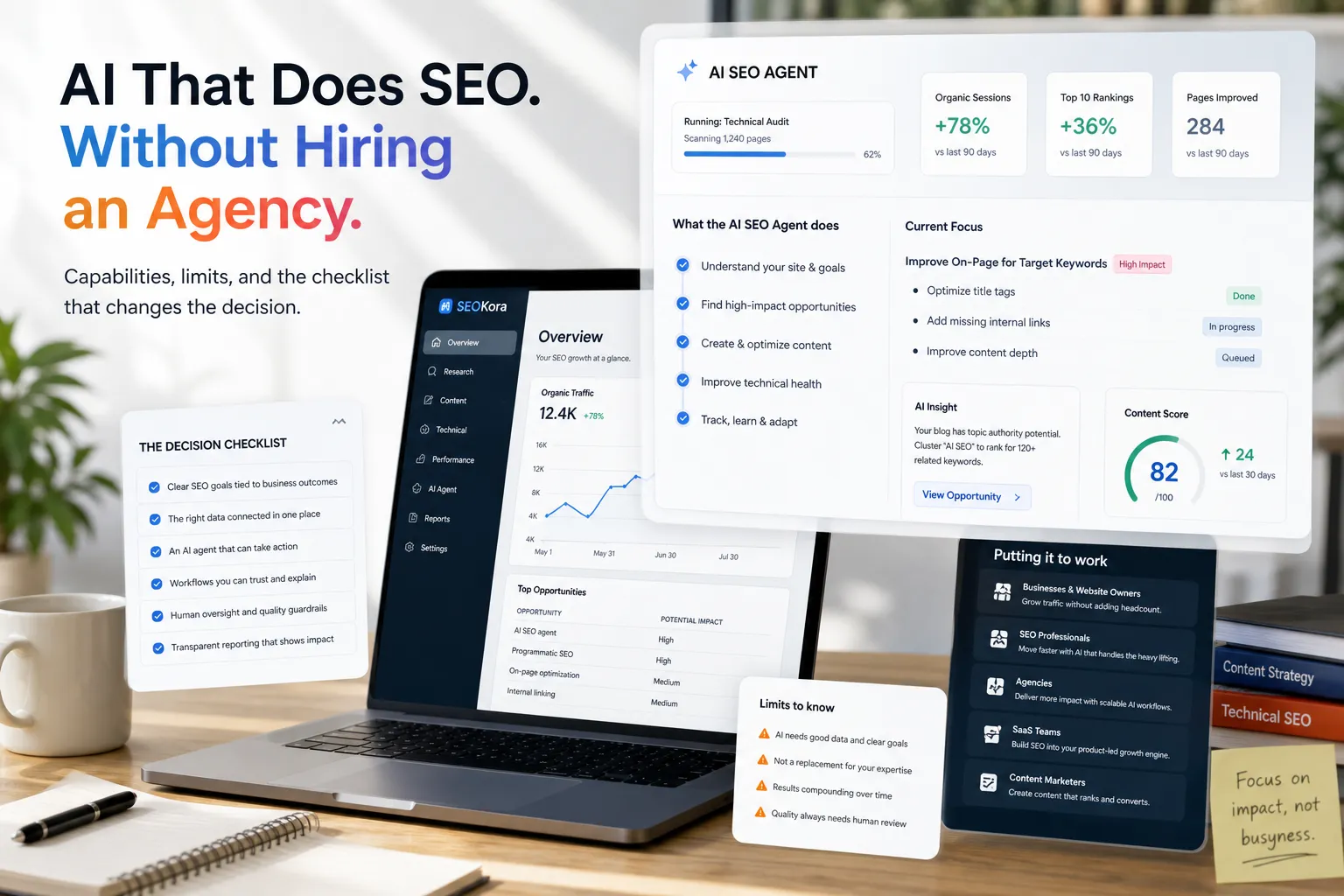
SEOKora covers this distinction in AI That Does SEO: Capabilities, Limits and Checklist (opens in new tab) and in its AI SEO Specialist (opens in new tab) guide. The useful takeaway is not that AI replaces SEO judgment. It is that AI can support research, pattern recognition, drafting, and review when the business keeps control of the final decision.
Automation should remove repetition without removing control
Automation has a different job from strategy. It should remove repetitive work: collecting search data, surfacing pages that need attention, clustering related opportunities, checking recurring issues, or preparing first-pass recommendations. It should not quietly publish changes, create a pile of thin pages, or treat every detected issue as equally urgent.
For businesses handling SEO themselves, the safest automation rule is simple: automate collection and preparation before you automate publication. Let software gather signals, structure options, and reduce manual checks. Keep human approval around anything that affects brand positioning, factual accuracy, page consolidation, internal links to important pages, and claims about your products or services.
Common mistakes tend to come from skipping that control layer:
- Publishing AI content without review: The page may be readable but still miss the business context, product nuance, or search intent.
- Chasing every audit warning: Some issues matter; others are low-impact distractions. Prioritize based on page value and likely search impact.
- Creating a new page for every keyword variation: This can create overlap and weaken the site’s topical structure. Often, one stronger page is better.
- Measuring activity instead of movement: Publishing more pages is not the same as improving rankings, clicks, or qualified visibility.
If your interest is specifically automation for smaller teams, SEOKora has related resources on automated SEO for small business (opens in new tab) and AI SEO automation for small business (opens in new tab). Use them to refine the parts of the workflow you want software to handle first.
What does SEO without hiring an agency include?
It usually includes keyword and topic research, content planning, on-page optimization, internal linking, technical checks, performance review, and ongoing updates. The business may still bring in outside help for specialized projects, but the operating system and priorities stay internal.
Is AI SEO software safe to use for business content?
It can be safe when it is used for research, structure, optimization suggestions, and first drafts that receive expert review. It becomes risky when AI-generated recommendations are published without checking accuracy, brand fit, search intent, and whether the page adds anything useful beyond generic wording.
Should a small business choose automation or manual SEO tools?
Most small businesses need both. Manual review protects judgment and accuracy; automation reduces repetitive work and helps surface opportunities faster. The better question is which steps should be automated first. Start with data collection, monitoring, and opportunity discovery before automating content or site changes.
Your next move with SEOKora
If you want to handle SEO without hiring an agency, start by choosing one workflow to make repeatable. Pick a high-value page, review the search intent, identify the missing or weak sections, improve the content, strengthen internal links, and monitor what changes. That single loop teaches more than installing another tool and waiting for a dashboard to tell you what matters.
SEOKora is built for businesses that want search intelligence translated into clearer growth decisions across ranking opportunities, competitive intelligence, authority insights, site optimization, and content optimization. If that is the operating model you want, visit SEOKora (opens in new tab) and use the resource library to keep building a practical SEO system you can understand, defend, and improve over time.
Practical examples
For example, when Businesses, website owners, SEO professionals, agencies, SaaS teams and content marketers who want to increase organic traffic, rankings and search visibility. compare options around “seo without hiring an agency”, open one live page on SEOKora and check whether the title, first paragraph, and primary next step all describe the same offer before anyone shares or publishes the link.
For example, consider a release or campaign where social captions promise one story while the public page still says another — align the page copy with the real deliverable first, then update discovery links so searchers land on the same narrative.