Seo Software for Small Business for Businesses
Seo Software For Small Business — practical guidance for Businesses in B2B software, from.

SEO Software for Small Business: A Practical Guide to Sustainable Organic Growth
For a small business, SEO can quickly become overwhelming. Keyword research, content creation, technical fixes, competitor monitoring, page optimization, backlinks, and performance tracking are often handled by the same small team—or even one person.
That is why choosing the right SEO software for small business is less about finding a tool with the longest feature list and more about finding a system that turns SEO data into clear, manageable actions.
Good SEO software should help a business answer three practical questions: What should we work on? Why does it matter? What should we do next?
This guide explains how small businesses can evaluate SEO software, which capabilities matter most, where automation helps, and where human judgment is still essential.
What Is SEO Software for Small Business?
SEO software for small business is a platform or toolset that helps a company research search demand, improve website content, identify technical SEO problems, monitor rankings, analyze competitors, and measure organic search performance.
Unlike enterprise SEO teams, small businesses usually have limited time, staff, and budgets. Their software therefore needs to reduce complexity rather than create another dashboard that someone has to interpret manually.
A useful platform should move beyond simply identifying problems. It should help turn SEO opportunities into prioritized actions that a business can realistically complete.
Why SEO Software Matters for Small Businesses
SEO involves dozens of recurring decisions. A business may need to decide which keyword deserves a new article, which existing page should be improved, why an important page has stopped gaining visibility, or whether a competitor is capturing searches the business should be targeting.
Doing this manually across spreadsheets and disconnected tools can consume more time than the actual optimization work.
For example, imagine a local accounting firm that has 60 service pages and articles. Several pages receive impressions from search engines but very few clicks. Instead of manually reviewing every URL, SEO software can help identify pages with promising search visibility, weak rankings, outdated content, or missing optimization opportunities.
The team can then prioritize a small number of pages with the strongest potential instead of rewriting the entire website.
Limitation: software can identify patterns and opportunities, but it cannot guarantee ranking improvements. Search results are influenced by competition, website authority, content quality, technical accessibility, user intent, and search-engine changes.
What Should Small Businesses Look for in SEO Software?
The best SEO platform depends on the business, but several capabilities are especially useful for smaller teams.
1. Keyword Research and Tracking
Keyword research helps a business understand how potential customers search for its products, services, and problems.
Useful SEO software should help distinguish between a keyword that merely has search volume and one that actually matches the business's commercial or informational goals.
Rank tracking can then show whether important queries are gaining or losing search visibility over time.
2. Existing Page Optimization
Publishing new articles is not always the fastest route to growth. Small businesses often already have pages that search engines understand but that are underperforming.
SEO software can help surface opportunities such as pages with declining visibility, weak metadata, incomplete topic coverage, internal-linking gaps, or rankings close enough to page one that further improvement may be worthwhile.
The important distinction is that recommendations should be treated as hypotheses to test—not automatic guarantees of higher rankings.
3. Content Planning
A strong content system should help answer:
- What questions are potential customers asking?
- Which topics support the company's products or services?
- Which existing pages should be improved before new pages are created?
- Which search intents are not adequately covered?
- How should related pages connect through internal links?
This prevents the common small-business mistake of publishing large volumes of disconnected content simply because keywords appear attractive.
4. Competitor Analysis
Competitor analysis can reveal where another company is gaining search visibility and which topics, pages, or search queries may deserve investigation.
However, competitor data needs context. A keyword that works for a national marketplace may be irrelevant to a small local service business.
Small businesses should use competitor intelligence to discover opportunities, not blindly reproduce another company's SEO strategy.
5. Technical SEO Monitoring
Strong content cannot perform reliably if search engines have difficulty accessing or understanding the website.
SEO software should therefore help identify important technical issues such as broken links, indexing problems, canonical inconsistencies, missing metadata, redirect problems, or pages that should be investigated for crawlability.
Not every technical warning deserves immediate attention. Prioritization matters: issues affecting important revenue or search pages generally deserve attention before cosmetic warnings on low-value URLs.
6. Backlink and Authority Monitoring
Links and external mentions can contribute to how search engines discover and evaluate websites, but small businesses should be cautious about treating backlink quantity as the objective.
A smaller number of relevant, legitimate mentions can be more useful than large volumes of low-quality links.
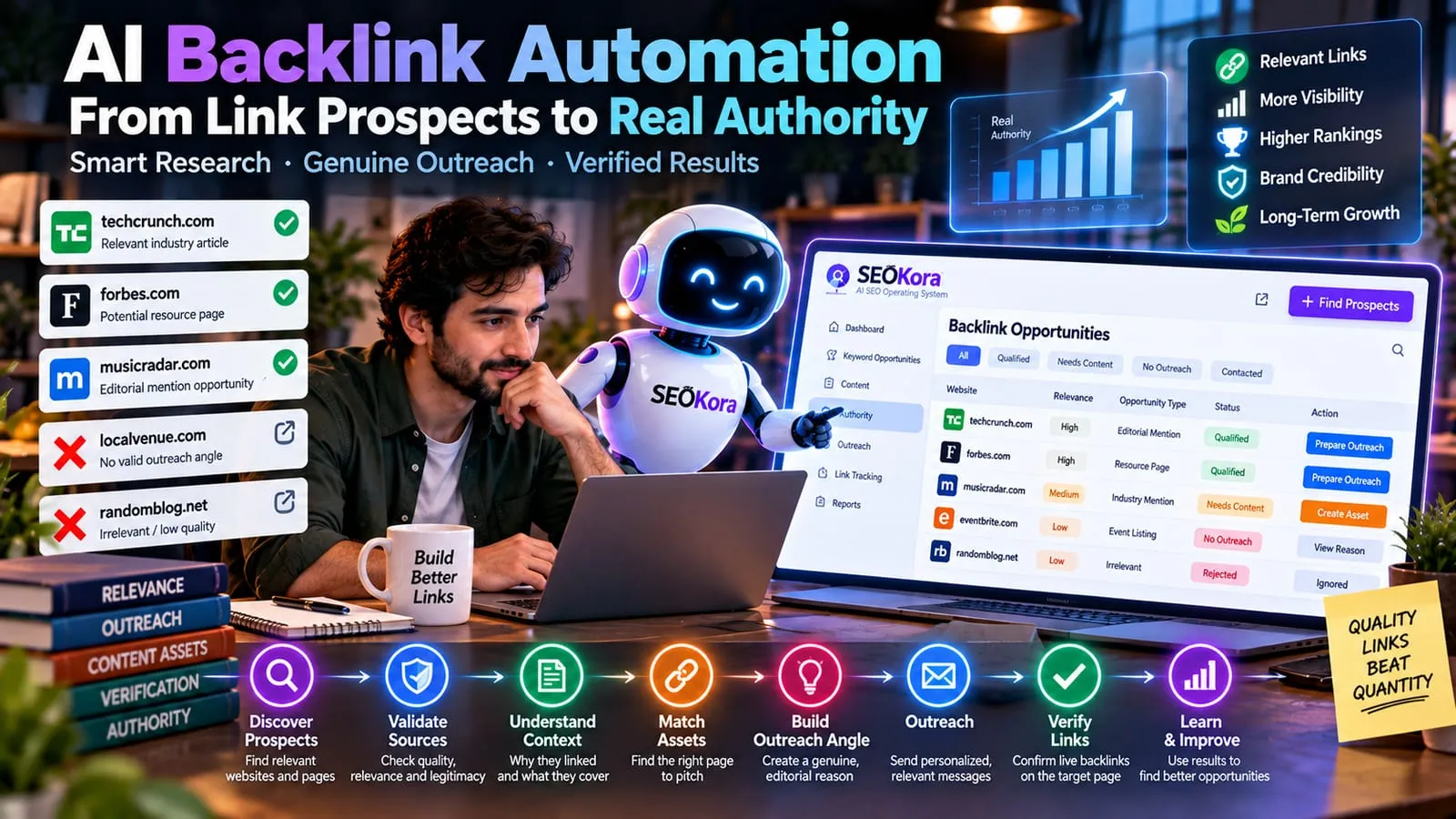
SEO software can support this process by helping identify relevant prospects, monitor discovered links, and document outreach or authority-building activity. Human review remains important because relevance and editorial quality cannot always be reduced to a single metric.
7. Reporting That Leads to Decisions
A report is only useful when it changes what the business does next.
Instead of showing dozens of disconnected charts, useful SEO reporting should connect activity with outcomes such as:
- organic visibility trends;
- important keyword movements;
- pages improved or published;
- technical issues resolved;
- traffic or conversion trends where reliable analytics data is available;
- authority-building activity and verified outcomes.
The objective is not to produce more SEO data. It is to make the next decision easier.
SEO Software vs. Traditional SEO Tools
Traditional SEO tools are often excellent at collecting specialized data. One tool may focus on keywords, another on technical crawling, another on backlinks, and another on analytics.
That approach can work well for experienced SEO professionals. For a small business, however, combining multiple systems can create additional cost and operational complexity.
A broader SEO platform attempts to connect research, recommendations, execution, and measurement into a more continuous workflow.
| Traditional Tool Approach | Integrated SEO Platform Approach |
|---|---|
| Provides specialized SEO data | Connects data with prioritized actions |
| Often requires manual interpretation | Can assist with prioritization and workflows |
| Multiple separate dashboards may be required | More SEO activity can be managed centrally |
| Best suited to users who know what to investigate | Can be easier for smaller teams that need guidance |
| Execution frequently happens elsewhere | Some platforms can connect recommendations with execution |
How AI Is Changing SEO Software for Small Businesses
AI is making SEO software capable of assisting with tasks that previously required substantial manual analysis. These can include grouping search queries, generating content briefs, identifying optimization opportunities, summarizing competitor patterns, assisting with drafts, and prioritizing potential actions.
The useful application of AI is not simply generating more text.
For a small business, the larger opportunity is reducing the distance between data → decision → execution → verification.
For example, instead of presenting a business owner with 300 keyword rows, an AI-assisted system could identify a smaller set of relevant opportunities, explain why they matter, propose appropriate actions, and help track whether those actions were completed.
AI output should still be reviewed when accuracy, brand claims, business information, or consequential website changes are involved. Automation increases speed; it does not eliminate the need for trustworthy source data and human oversight.
SEO and AI Search Visibility
Search discovery is no longer limited to traditional search-result pages. People increasingly encounter answers through AI-assisted search experiences and answer engines as well.
This makes clear entity information, useful answers, structured content, first-party evidence, and consistent business information increasingly valuable components of a broader organic visibility strategy.
There is no legitimate way to guarantee that a particular business will be cited by an AI system. Different systems use different retrieval methods, indexes, models, and source-selection processes.
Businesses can, however, make their content easier to understand and reference by publishing specific answers, clearly identifying entities, supporting important claims with reliable sources, keeping information current, and using appropriate structured data where it accurately represents visible page content.
A Practical SEO Workflow for a Small Business
Small businesses do not need to fix everything simultaneously. A repeatable workflow is usually more sustainable.
- Measure the baseline: identify important pages, queries, current visibility, and measurable business goals.
- Find the strongest opportunity: prioritize work according to relevance, potential impact, and realistic effort.
- Choose one action: improve an existing page, create missing content, repair a technical issue, strengthen internal linking, or investigate an authority opportunity.
- Publish or implement: move the recommendation into a real website change rather than leaving it in a report.
- Verify: confirm that the intended change is actually live and technically accessible.
- Measure again: monitor the relevant metrics over an appropriate period and decide whether to continue, adjust, or stop.
This creates a simple operating loop: discover → prioritize → execute → verify → measure.
Example: How a Small Business Could Use SEO Software
Consider a small home-renovation company. Its website already contains service pages for kitchen remodeling, bathroom renovation, flooring, and painting, but organic traffic has remained flat.
SEO software might reveal that the bathroom-renovation page already appears for several commercially relevant searches but sits below the strongest results.
Instead of immediately creating ten new articles, the business could review that existing page first. It might improve service information, answer genuine customer questions, clarify geographic coverage, strengthen internal links, update metadata, and add appropriate structured information where relevant.
After publishing the improvements, the business can monitor search visibility, traffic, and qualified enquiries over time.
If performance does not improve, the next step is not to manufacture a success story. The team should review competing results, search intent, technical conditions, authority signals, and whether the page genuinely deserves stronger visibility.
Common SEO Software Mistakes Small Businesses Should Avoid
Choosing Software Based on Feature Count
A platform with hundreds of features is not automatically more useful. If the business regularly uses only five of them, workflow quality may matter more than the size of the feature list.
Publishing AI Content Without Quality Control
AI can accelerate research and drafting, but automatically publishing generic, repetitive, or unsupported content can create poor user experiences. Content should provide a clear reason to exist beyond targeting a keyword.
Tracking Rankings Without Taking Action
Watching a keyword move from position 18 to 14 is information, not a strategy. The business still needs to determine whether the query matters and what reasonable action could improve the relevant page.
Changing Too Many Things at Once
If titles, page copy, URLs, internal links, and site structure all change simultaneously, it becomes difficult to understand what helped or harmed performance. Smaller, reversible changes are easier to evaluate.
Expecting Guaranteed Rankings
No credible SEO software can guarantee a specific Google ranking, traffic increase, backlink, or AI citation. SEO software should improve decision-making and execution—not manufacture certainty where none exists.
Where SEOKora Fits
SEOKora is designed as an SEO growth platform that brings multiple organic-growth workflows into one operating environment. Rather than treating SEO as a collection of isolated reports, the platform is built around identifying opportunities, turning them into actions, and tracking completed work and results.
Depending on the available plan and connected data sources, these workflows can include areas such as keyword intelligence, content and page optimization, competitor analysis, technical SEO, authority-building workflows, performance reporting, and visibility analysis.
The distinction is important for a small business: software should not simply tell the owner that there are more things to do. It should help make the workload understandable and prioritized.
SEOKora should therefore be evaluated the same way as any other SEO platform: by checking whether its available features match the business's website, goals, resources, integrations, and preferred level of automation.
Can SEO Software Replace an SEO Expert?
Not completely.
SEO software can automate repetitive analysis, organize large datasets, identify patterns, assist with content workflows, and reduce the amount of manual monitoring required.
Human judgment remains particularly valuable for business positioning, editorial quality, sensitive website changes, unusual technical problems, brand decisions, and interpreting ambiguous evidence.
For many small businesses, the practical goal is therefore not total replacement. It is to automate repeatable work so limited human attention can be used where judgment has the highest value.
How to Choose SEO Software for Your Small Business
Before subscribing to a platform, ask:
- Does it help identify what we should do next?
- Can it improve existing pages as well as support new content?
- Does it cover the SEO workflows we actually need?
- Can recommendations be traced back to meaningful data?
- Can completed work and outcomes be verified?
- Does it fit our technical ability and available time?
- Can important changes remain under human control?
- Will we still understand the reports three months from now?
If a platform creates more analysis work than it removes, it may not be the right system for a small team.
Frequently Asked Questions About SEO Software for Small Business
What is the best SEO software for a small business?
There is no single best SEO platform for every small business. The right choice depends on budget, website size, industry, technical experience, content requirements, integrations, and whether the business needs research tools, execution workflows, or both.
Can a small business do SEO without an agency?
Yes. Many small businesses can manage significant parts of SEO internally when they have suitable software, clear processes, and enough time to implement recommendations. Complex migrations, technical problems, or competitive strategies may still benefit from specialist support.
How much should a small business spend on SEO software?
The useful budget depends on the value of organic search to the business and which manual tasks the software replaces. Evaluate total value rather than subscription price alone. A cheaper tool that requires extensive manual work may ultimately cost more in staff time.
How long does SEO software take to produce results?
SEO software itself does not create a fixed ranking timeline. It helps businesses research, prioritize, execute, and monitor SEO work. Results depend on the website's starting position, competition, technical health, content quality, authority, implementation speed, and changes in search systems.
Can AI SEO software guarantee AI citations?
No. AI assistants and AI-powered search systems determine their own sources and responses. SEO software can help businesses create clearer, well-supported, machine-understandable content and monitor visibility, but it cannot legitimately guarantee inclusion or citation by an external AI platform.
Is SEO software worth it for a very small business?
It can be, particularly when the software saves meaningful manual work or helps the business prioritize limited resources. A very small business should avoid paying for capabilities it will not use and focus on software that supports its highest-value search opportunities.
Final Takeaway
The best SEO software for small business is not necessarily the platform that produces the most charts, recommendations, or AI-generated content. It is the one that helps a business consistently turn useful evidence into completed, measurable work.
For most small teams, that means identifying relevant opportunities, prioritizing them, making controlled improvements, verifying that those improvements are live, and measuring what happens next.
Platforms such as SEOKora can support this approach by bringing SEO intelligence and execution workflows closer together. The final decision should still be based on the business's actual requirements rather than feature claims alone.
A practical next step: choose one commercially important page on your website, establish its current search performance, identify one evidence-backed improvement, implement it, and measure the result before expanding the scope.