Practical Judgment Calls Inside Ai Seo Manager
Learn the practical judgment calls behind an AI SEO manager, from brand visibility to content optimization and human review.
What an AI SEO manager actually manages
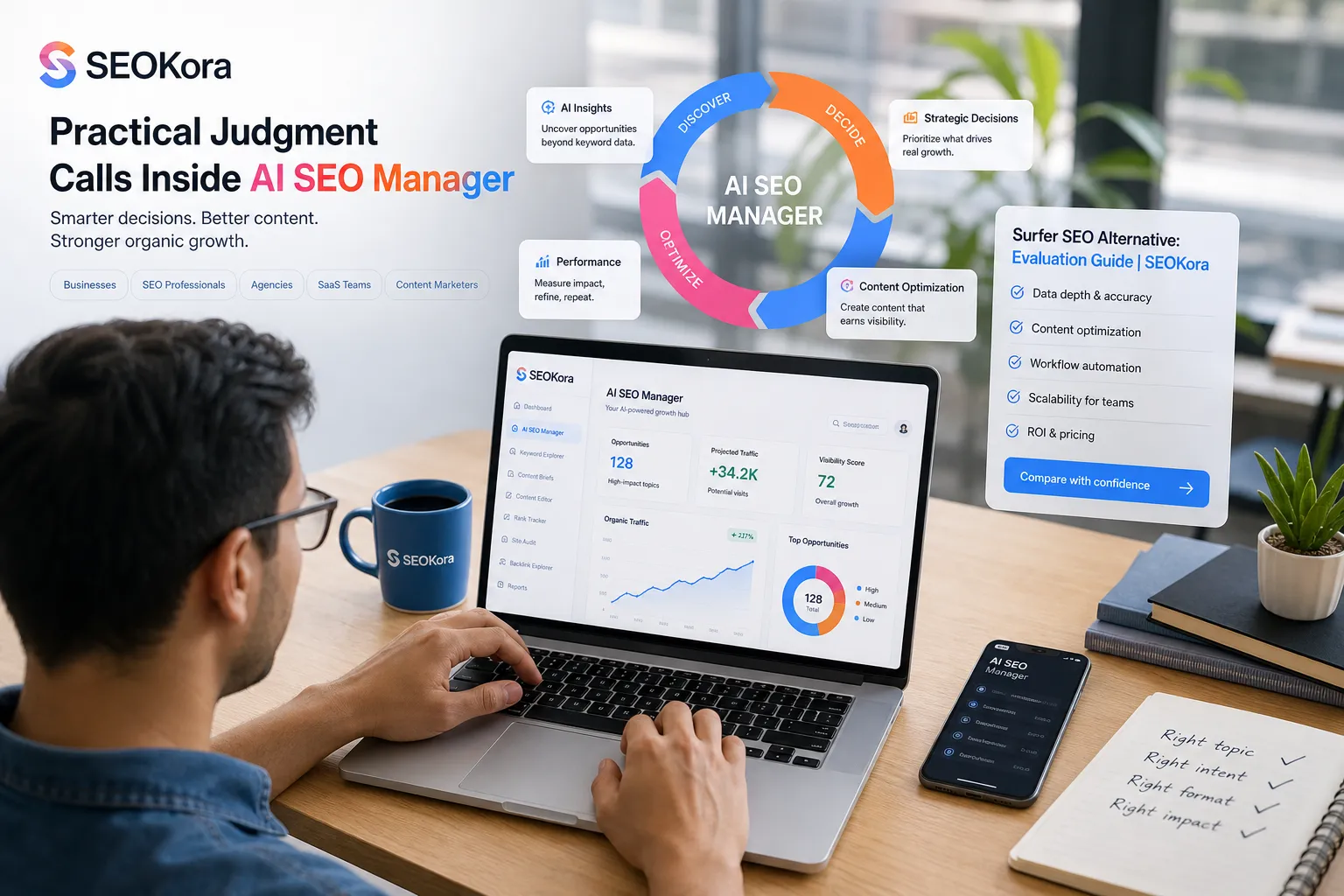
An AI SEO manager is best understood as a workflow for turning search intelligence into better organic decisions, not as a replacement for SEO judgment. It can help surface ranking opportunities, compare pages, organize content priorities, support optimization, and reduce manual research time. The practical work is deciding what deserves action, what should wait, and where automation needs human review.
For a business owner, that may mean spotting pages that already have search potential and improving them before commissioning new content. For an agency, it may mean using AI-assisted analysis to separate genuine client opportunities from noise. For a SaaS team, it may mean connecting product-led content, competitive intelligence, and site optimization into one repeatable growth workflow.
The word “manager” matters. A useful AI SEO manager does not merely write drafts or produce keyword lists. It helps manage the moving parts of organic growth: which topics are worth pursuing, which pages need clearer intent alignment, which competitors are shaping the search result, where authority signals are missing, and how content should be updated after publication.
SEOKora sits in that operating layer as an SEO growth software platform, with a focus on turning search intelligence into growth through ranking opportunities, competitive intelligence, authority insights, site optimization, and content optimization. That is the right lens for this topic: the value is not “AI for its own sake,” but better SEO decisions made with less friction.
Why brand visibility belongs inside the AI SEO manager conversation
Organic visibility is no longer limited to ranking a blue link for a single keyword. Businesses also need to understand how their brand, products, categories, and expertise appear across search experiences and AI-assisted discovery. That is where AI brand visibility connects directly to the AI SEO manager role.
A practical AI SEO manager should help answer questions such as: Are we visible for the topics buyers associate with our category? Do our important pages explain the entity clearly enough? Are we creating content that search systems can connect to our brand, or are we publishing generic articles that could belong to anyone?
For example, a content marketer may see that a product page explains features well but does not clearly connect the product to the broader problem buyers search for. The judgment call is not simply “add more keywords.” It is to clarify the page’s role: define the problem, explain the use case, show how the product fits, and support that explanation with related resources. SEOKora’s resource library includes guidance on AI brand visibility for businesses (opens in new tab), which is relevant when SEO work expands from rankings into how a company is understood by search and AI systems.
This is also where automation has to be careful. AI can surface phrases and patterns, but it cannot decide your positioning for you. If your brand is vague, your category language is inconsistent, or your site has thin explanations of core offers, automation may simply scale that confusion.
Why this matters for SEO software and organic growth
The useful promise of an AI SEO manager is continuity. Traditional SEO workflows often break into disconnected steps: keyword research in one place, competitive review in another, content briefs somewhere else, and performance review later if time allows. That fragmentation makes it easy to publish content without a clear reason or to miss pages that already have momentum.
For businesses trying to grow through organic search, the sharper question is: what should we do next, and why? SEO software should help narrow that decision. A practical AI SEO manager should support a sequence like this:
- Identify topics, queries, or pages with realistic search potential.
- Review competitor coverage and search intent without copying what already ranks.
- Map the opportunity to an existing page, a new page, or a content refresh.
- Improve the page structure, internal relevance, and on-page clarity.
- Track whether the work creates better visibility over time.
That sequence keeps the work grounded. It avoids the common trap of treating AI-generated output as SEO progress. A draft is not growth. A keyword list is not growth. A recommendation becomes useful only when it leads to a better page, a clearer internal link path, stronger topical coverage, or a more informed publishing decision.
If you are evaluating broader options for organic growth, SEOKora’s resources on strategy, systems, and decision frameworks (opens in new tab) are a safer place to start than chasing isolated tool features. The point is to build a workflow that makes repeated SEO decisions easier, not to collect more dashboards.
The judgment calls an AI SEO manager should help you make
The most important decisions are usually not dramatic. They are small calls made repeatedly: update or create, consolidate or separate, automate or review, pursue or ignore. A good AI SEO manager makes those calls more visible.
When to optimize an existing page instead of creating a new one
If a page already targets the right intent but is incomplete, creating another similar page can split relevance and confuse your own site structure. This is especially important when an existing article is close to the target topic but does not fully answer what searchers mean by “AI SEO manager.”
When to let AI assist the brief but not own the argument
AI can help gather angles, outline recurring questions, and identify content gaps. The argument still needs editorial judgment. A page about AI SEO management should not become a generic list of tool benefits. It should explain how SEO operators decide what to automate, what to inspect manually, and how to avoid turning every recommendation into a task.
When competitive intelligence is useful and when it is a distraction
Competitor pages can show what search results already reward, but they do not define your strategy. If every article in the result explains the same surface-level definition, the opportunity is to be more practical: explain the decisions, tradeoffs, and workflow. SEOKora’s positioning around competitive intelligence is useful here because the goal is not imitation; it is better interpretation.
When backlinks and authority signals enter the workflow
Content quality and page structure matter, but authority also influences organic visibility. An AI SEO manager may help identify where authority gaps exist or where outreach deserves attention. That still needs constraint-aware review. SEOKora’s discussion of AI backlink automation and real constraints (opens in new tab) is relevant because backlink work cannot be reduced to “find prospects and send messages.” Relevance, credibility, and risk all matter.
Practical examples of AI SEO manager decisions
Consider a SaaS company with a product page that ranks poorly for category terms but attracts some long-tail impressions. An AI-assisted SEO workflow might flag the page as an optimization candidate. The human judgment call is to inspect intent: is the page trying to sell before it explains the problem?
For an agency managing multiple client sites, the AI SEO manager role may be to triage. One client has dozens of thin posts on overlapping topics. Another has fewer pages but stronger commercial intent. Automation can help cluster the topics and identify overlap, but the agency still decides whether to merge articles, redirect outdated pages, or create a stronger hub. The measurable work is not “we used AI”; it is that the site becomes easier for users and search engines to understand.
For a content team, the workflow may begin with a question: what SEO software options are available for improving organic search? A weak process turns that into a broad listicle. A stronger AI SEO manager workflow asks what the reader is really deciding: automation, content optimization, competitive intelligence, backlinks, pricing fit, workflow complexity, or reporting. That produces a more useful page because it reflects a real buying or evaluation process.
For a business owner with limited time, the first useful move may be even simpler: choose five pages that already matter commercially and review whether each page answers the searcher’s first question quickly. AI can help suggest missing sections, but the owner should still check accuracy, tone, claims, and whether the page actually represents the business.
Common mistakes that weaken AI-assisted SEO
The first mistake is confusing volume with progress. Publishing more AI-assisted content can make a site larger without making it more useful. If the pages overlap, lack expertise, or target unclear intent, they may create maintenance burden instead of organic growth.
The second mistake is treating AI recommendations as instructions. A tool may suggest adding a topic, changing a heading, or targeting a query. That does not mean the suggestion belongs on the page. The right question is whether the addition helps the reader complete the job that brought them to the page.
The third mistake is ignoring existing assets. Many sites already have pages with partial relevance, weak structure, or outdated explanations. An AI SEO manager should help find those pages before the team commissions more content. Refreshing a relevant page can be more coherent than creating another near-duplicate article.
The fourth mistake is separating brand visibility from SEO execution. If your site does not clearly explain who you are, what you offer, and how your expertise connects to the category, AI-assisted content may optimize around disconnected topics. Organic growth depends on both discoverability and clarity.
The fifth mistake is over-automating outreach, internal linking, or content updates without review. SEO automation works best when it reduces repetitive work and sharpens decisions. It becomes risky when it removes accountability for accuracy, relevance, and user value.
Where automation still needs human review
An AI SEO manager can help prioritize and accelerate SEO work, but it cannot verify every business claim, know every product nuance, or understand every commercial tradeoff without guidance. It can help draft content, but a human should check whether the explanation is true, specific, and aligned with the company’s offer.
There are also practical limits around data. Search visibility signals can be incomplete, volatile, or delayed. A low-volume query may still matter if it reflects a high-intent buyer question. A competitor’s ranking page may show what is visible, but not whether that page drives qualified demand. A tool can surface evidence; it should not pretend to remove uncertainty.
Backlinks and authority work need particular care. Automation may help identify opportunities, but relevance and reputation cannot be delegated entirely. Outreach that feels generic or misaligned can damage trust. Content created only to attract links may fail users. The judgment call is to use automation to focus effort, not to bypass standards.
Finally, AI SEO management should not be treated as a one-time setup. Search results change, products change, and the language customers use changes. The workflow needs review cycles: inspect what changed, decide what matters, improve the right pages, and avoid reacting to every fluctuation.
What does “AI SEO manager” mean for a business?
It means using AI-assisted SEO software and workflow discipline to manage organic search decisions: finding opportunities, improving pages, reviewing competitors, supporting content optimization, and deciding what work deserves human attention.
How should a business get started?
Start with existing pages that already matter to revenue, leads, or brand visibility. Review whether each page answers the searcher’s intent, has clear structure, connects to related pages, and reflects current positioning before creating new content.
Can an AI SEO manager replace an SEO specialist?
It can reduce manual research and speed up execution, but it should not replace strategic judgment. Someone still needs to validate recommendations, protect brand accuracy, evaluate tradeoffs, and decide what belongs on the site.
What SEO software options are useful for improving organic search?
Useful options are the ones that connect insight to action: ranking opportunities, competitive intelligence, authority insights, site optimization, and content optimization. Feature lists matter less than whether the workflow helps you improve the right pages.
Your next move with SEOKora
The practical takeaway is to treat an AI SEO manager as a decision system, not a content machine. Use it to identify the next best SEO move, understand why that move matters, and keep automation tied to page quality, brand clarity, and organic growth.
If you are building or refining that workflow, start by reviewing your current organic growth process: which pages are already important, which topics are unclear, where competitors are shaping expectations, and where your team is spending time on manual work that software could simplify. Then compare that reality with the SEO automation, content optimization, and search growth capabilities you actually need.
To explore SEOKora from that perspective, visit SEOKora (opens in new tab) or browse the organic growth resources (opens in new tab) for strategy, systems, and decision frameworks that connect search intelligence to execution.