Ai Seo Agent Without the Stock Outline
Understand what an AI SEO agent can automate, where judgment still matters, and how to use SEO software for practical organic growth.
What an AI SEO agent means in practice
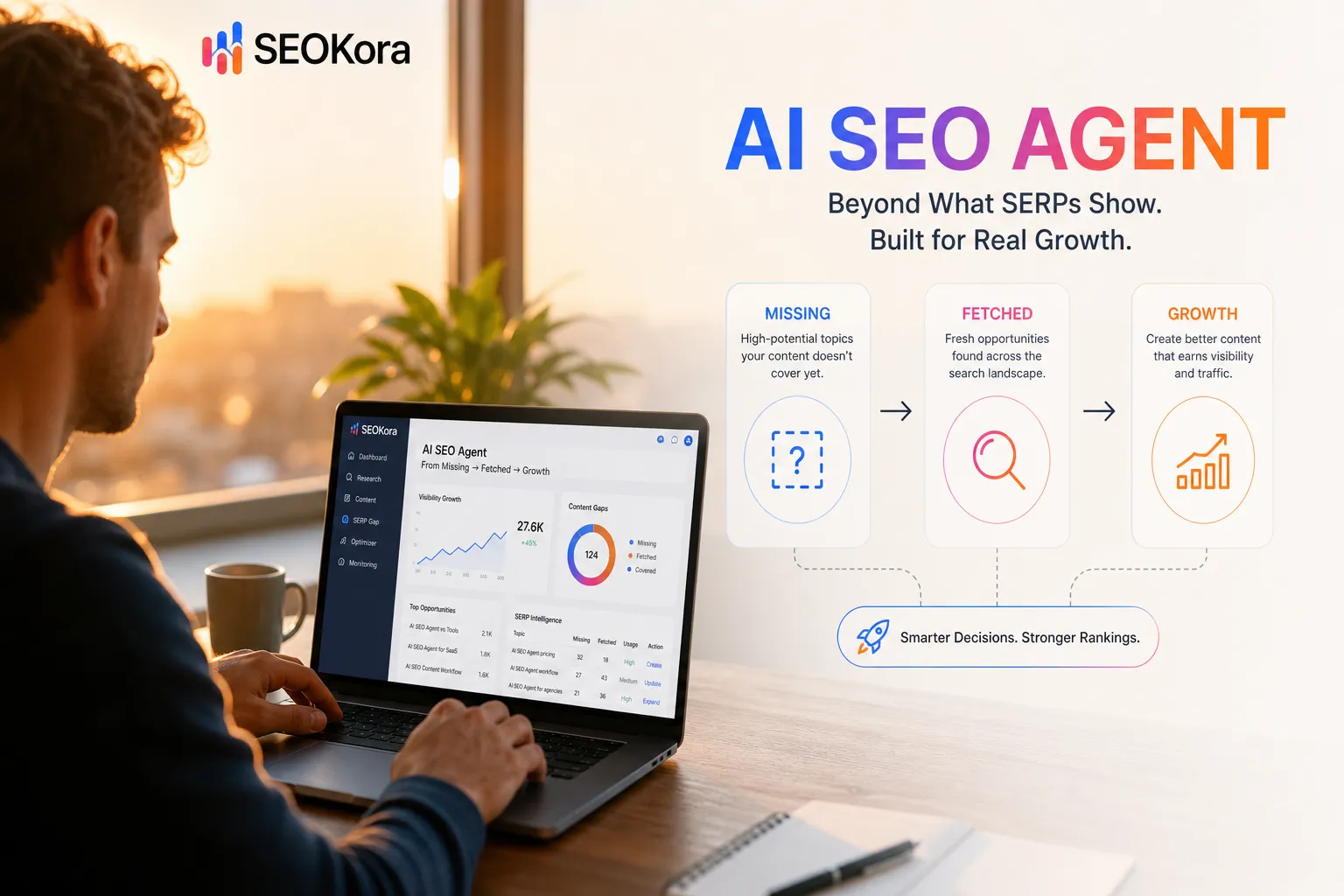
An AI SEO agent is software that helps turn search data into SEO actions: finding ranking opportunities, shaping content briefs, flagging technical or content issues, comparing competitors, and suggesting next steps. It is not a replacement for SEO strategy. For businesses, agencies, SaaS teams, and content marketers, the useful question is not whether an agent is “AI-powered.” The useful question is what decisions it can support, what work it can speed up, and where a human still needs to approve the judgment.
The term can sound more autonomous than it really is. In practical SEO work, an agent usually sits between raw tools and execution. Instead of asking a marketer to inspect keyword lists, ranking movements, competitor pages, internal content gaps, and authority signals separately, the agent can help connect those inputs into a recommendation. For example: this page has a reasonable ranking base, competitors cover a missing definition section, the search intent is informational, and the next edit should clarify the definition before adding examples.
That matters because organic growth rarely fails from a lack of data alone. It fails when teams cannot translate data into a clean workflow. SEOKora is built around that practical gap as an SEO growth software platform: using search intelligence, ranking opportunities, competitive intelligence, authority insights, site optimization, and content optimization to help turn visibility problems into focused action. An AI SEO agent should serve that same purpose. It should reduce the distance between “we found an opportunity” and “we know what to improve next.”
Why AI brand visibility belongs in the conversation
Search visibility is no longer only about ranking a blue link for a single query. That is why AI brand visibility is connected to the AI SEO agent discussion, not a separate trend bolted onto it.
If a SaaS company sells SEO software, for example, pages that only repeat “grow traffic” are weak inputs. Pages that define the use case, explain who the workflow is for, distinguish automation from strategy, and connect the topic to concrete SEO tasks are stronger inputs.
SEOKora has a dedicated resource on AI brand visibility for businesses (opens in new tab), and the lesson carries directly into agent workflows: do not optimize only for a keyword string. Optimize for whether the business is legible. A brand that wants to be considered for “SEO growth software,” “content optimization,” or “organic search platform” needs pages that make those associations explicit, useful, and internally consistent.
An AI SEO agent can help surface where that clarity is missing. But the business still has to decide what it actually wants to be known for. Software can expose ambiguity; it cannot invent a credible positioning strategy without human input.
What SEO software should automate, and what it should leave visible
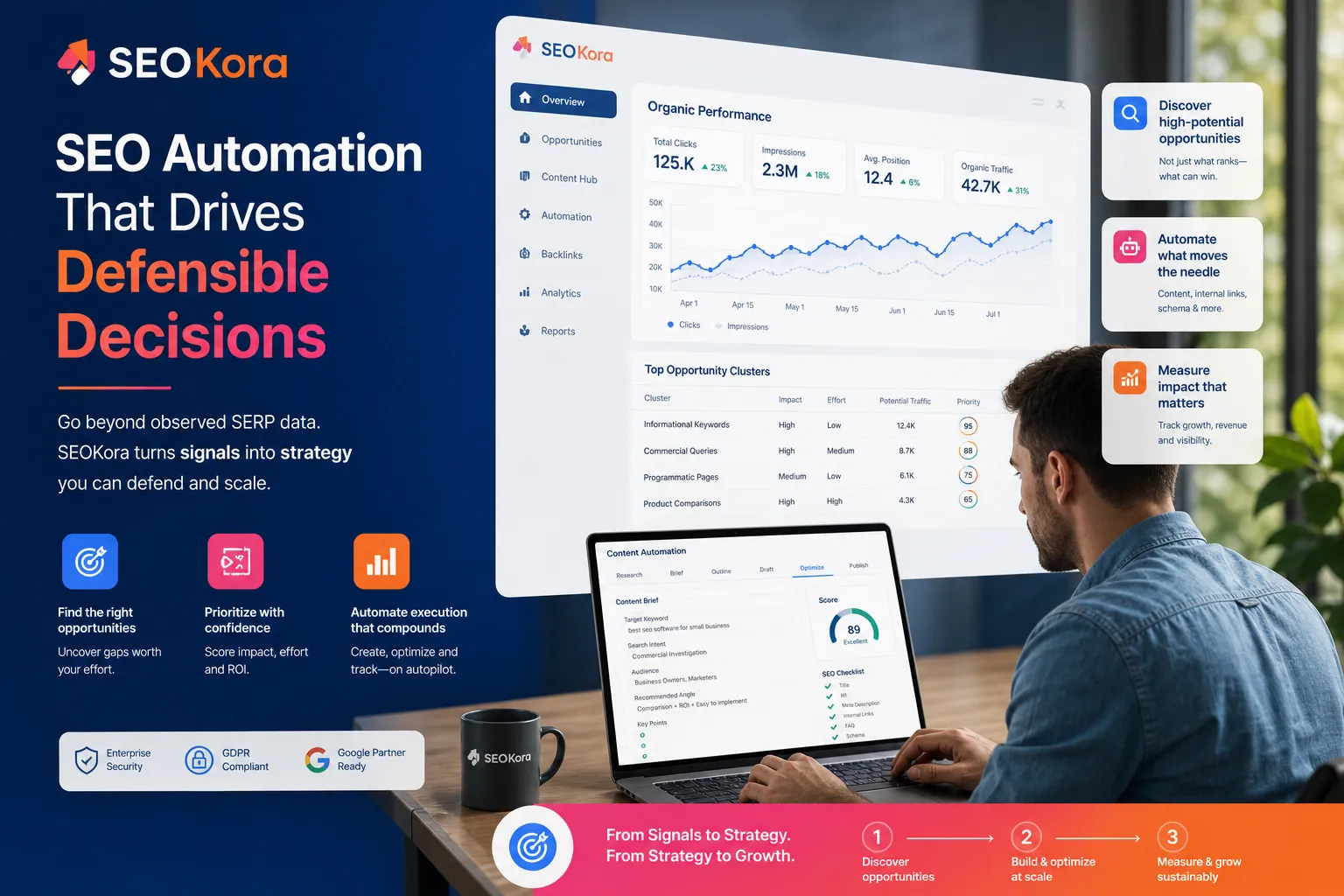
The best use of an AI SEO agent is not to hide the SEO process. It is to make the process easier to inspect. If a tool simply outputs “publish this article” or “rewrite this page,” the user is left guessing why. If it shows the ranking opportunity, the intent pattern, the competitive gap, the page-level weakness, and the recommended action, the marketer can judge whether the recommendation is sound.
For informational SEO work, the agent should help with several practical jobs:
- Opportunity discovery: identify queries, pages, or topic gaps where a business has a plausible path to better visibility.
- Content optimization: suggest additions that improve usefulness, such as a clearer definition, stronger examples, better internal links, or a missing caveat.
- Competitive intelligence: show what competing pages cover without encouraging blind copying.
- Authority and site context: connect page recommendations to broader site strength, internal architecture, and backlink or authority signals where available.
- Workflow support: turn analysis into a brief, edit plan, or prioritized task list that a human can review.
This is where AI SEO agents differ from ordinary writing assistants. A writing assistant may help produce paragraphs. An SEO agent should help choose the right work before the paragraph exists. SEOKora’s broader organic growth resources (opens in new tab) cover strategy, systems, and decision frameworks, which is the right context for evaluating automation: the tool is useful when it improves the decision, not when it merely creates more copy.
Practical examples: from search signal to useful action
Say a website has a page ranking outside the range where it earns meaningful traffic for a high-intent informational query. A weak agent might recommend adding the exact keyword several more times. A useful AI SEO agent would inspect the page against the likely search intent and ask a better question: does the page actually answer what the reader came to learn?
For a query like “what SEO software options are available for improving organic search,” the reader is not asking for a slogan. They likely need categories, trade-offs, and a way to evaluate tools. A practical recommendation might be to add a section that separates technical auditing tools, content optimization platforms, backlink analysis tools, rank tracking, and broader organic search platforms. That kind of edit helps the reader make sense of the market rather than simply pushing product language.
For a page targeting “AI brand visibility,” the issue may be different. The page might already explain the concept, but not connect it clearly enough to concrete business actions. The human editor then decides which examples are accurate for the brand and which claims should be avoided.
For backlink or authority-related SEO, the agent needs even more restraint. A competitor backlink can show where authority exists in a market, but it does not mean a business is entitled to the same link or should automate outreach without context. SEOKora’s resource on AI backlink automation (opens in new tab) frames that constraint well: automation can help identify patterns and opportunities, but the relationship, relevance, and editorial quality still matter.
A good working pattern is simple: let the agent surface evidence, let the marketer select the right action, and let the editor make the page genuinely more useful. That sequence prevents automation from becoming a content volume machine with no strategic filter.
Mistakes that make AI SEO agents less useful
The first mistake is treating an AI SEO agent as a publishing engine. If the main output is more pages, faster, the business may create content that looks optimized but does not satisfy intent. Search growth usually depends on better decisions: choosing the right query, improving the right page, fixing the right gap, and strengthening the right internal connections.
The second mistake is confusing competitor coverage with a content brief. Competitor pages can reveal what the market expects, but they are not a script. If every page in a category repeats the same definitions, benefits, and generic examples, a business has an opportunity to be more useful. The agent should help identify shared patterns and missing pieces; the editor should decide what the brand can explain better than the current results.
The third mistake is letting automation blur the source of truth. If an agent proposes a product claim, statistic, integration, guarantee, price, or customer outcome, the team needs verified evidence before publishing it. This is especially important for B2B software pages, where vague claims can weaken trust. If a fact is not verified, leave it out or qualify it.
The fourth mistake is ignoring existing pages. Many SEO teams do not need a new article for every query. They need to strengthen the page that already has the best topical fit. SEOKora already has resources such as AI That Does SEO (opens in new tab), AI SEO Manager (opens in new tab), and Organic Search Platform (opens in new tab). In a real workflow, an agent should help decide whether to update one of those pages, create a supporting page, or consolidate overlapping intent.
The final mistake is measuring the agent by how confident it sounds. SEO recommendations should be inspectable. A good recommendation explains the observed issue, the likely impact on search intent, the proposed change, and the evidence behind it. Confidence without traceability is not strategy.
Where autonomy still needs SEO judgment
An AI SEO agent can accelerate analysis, but it cannot remove uncertainty from organic search. Search results change, competitors publish new material, algorithms evolve, and user expectations vary by query. The agent can recommend what looks structurally useful; it cannot guarantee that a specific edit will produce a specific ranking outcome.
It also cannot fully understand business risk without guidance. A page about SEO automation, for instance, must be careful not to imply that automation can replace expertise, guarantee rankings, or perform every growth task without review. A page about backlinks must avoid suggesting entitlement to another site’s editorial links. A page about AI brand visibility should distinguish between making a brand easier to understand and claiming control over how every AI system will mention it.
The practical boundary is this: let AI handle pattern recognition and first-pass synthesis, but keep humans responsible for positioning, factual accuracy, editorial quality, and final prioritization. The more the content affects brand trust, product claims, legal exposure, or customer expectations, the more visible the review process should be.
This does not make the agent less valuable. It makes the value clearer. The agent helps a team spend less time digging through disconnected signals and more time deciding what deserves action.
What does “AI SEO agent” mean for a business?
For a business, an AI SEO agent is a workflow assistant that uses search and site signals to recommend SEO actions. It may help identify ranking opportunities, content gaps, optimization tasks, and competitive patterns. The business still needs to decide which recommendations fit its strategy, audience, and verified claims.
How should a business get started with an AI SEO agent?
Start with one existing SEO problem rather than a broad automation goal. Choose a page, topic cluster, or ranking opportunity, then ask the agent to explain the current issue, the search intent, the recommended edit, and the evidence. Review the output before publishing or assigning work.
What SEO software options are available for improving organic search?
Most SEO software falls into categories such as rank tracking, technical auditing, keyword research, content optimization, backlink analysis, competitive intelligence, or broader organic search platforms. The right choice depends on whether the team needs more data, better prioritization, faster execution, or a workflow that connects all three.
A useful next step with SEOKora
If you are evaluating an AI SEO agent, do not begin with the most impressive feature list. Begin with a real page or topic that matters to your organic growth and ask what decision the software helps you make. Can it clarify the opportunity? Can it show why a page is underperforming? Can it connect competitive intelligence, authority signals, site optimization, and content improvements into a next action?
That is the practical lens SEOKora brings to SEO automation and organic growth. Explore the SEOKora resource library (opens in new tab) for strategy and workflow guidance, or visit SEOKora (opens in new tab) to see how search intelligence can support more focused SEO decisions.