What Readers Should Know About Seo Software for Agencies
Seo Software For Agencies — practical guidance for Businesses in B2B software, from SEOKora.
What agency SEO software should do in practice
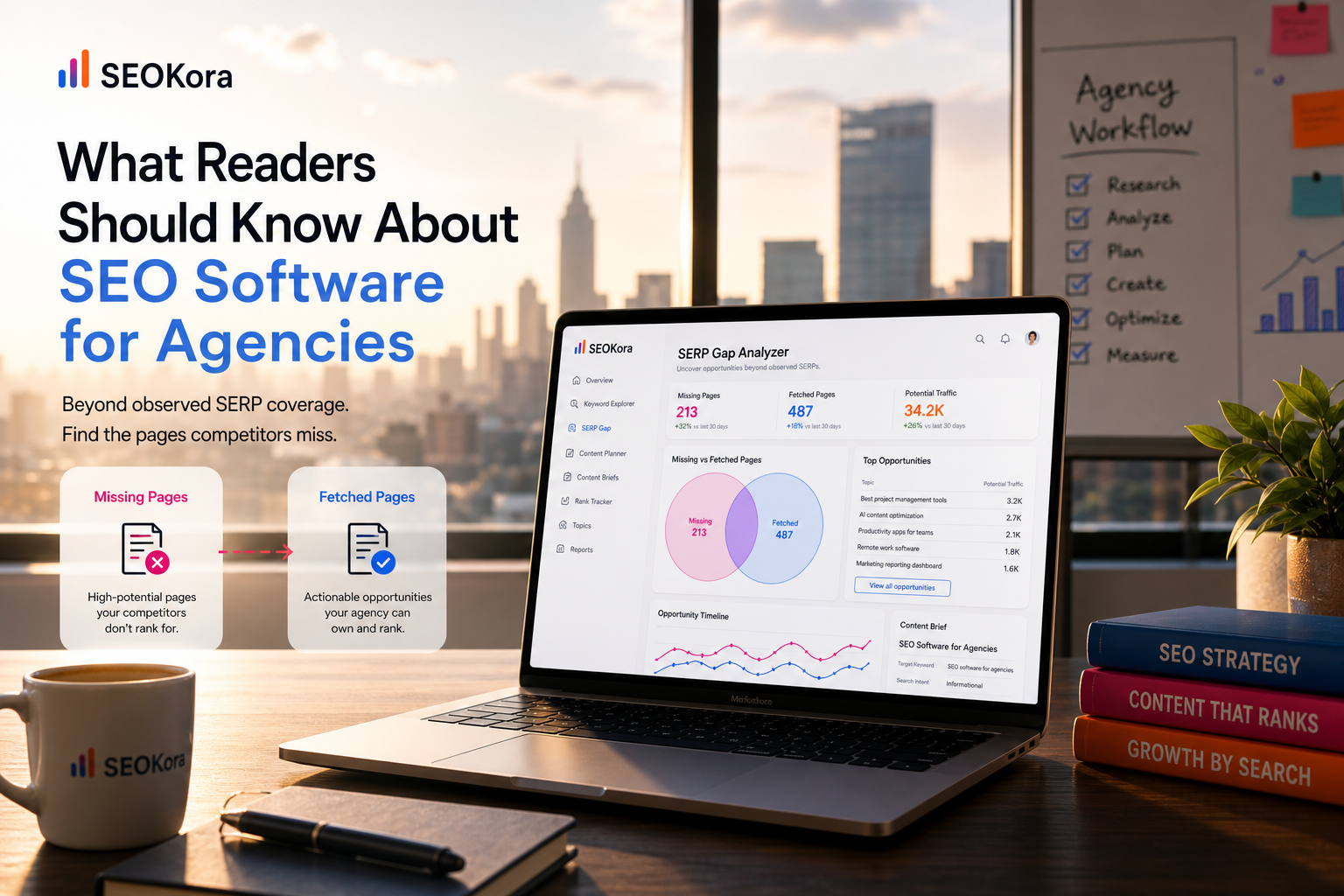
SEO software for agencies should help you find ranking opportunities, understand competitors, improve content, monitor site health, and repeat the work across more than one website without losing judgment or control. The useful question is not whether a tool has the longest feature list. It is whether the software helps an agency or agency-like team make better SEO decisions faster, then turn those decisions into consistent execution.
For an agency, the pressure is different from a single in-house website. You may be managing several clients, multiple content calendars, different technical setups, and stakeholders who want clear explanations. A platform needs to support discovery, planning, optimization, reporting, and follow-through. If it only produces data without showing what to do next, the work still falls back into spreadsheets and guesswork.
For a business choosing SEO software before hiring or scaling an agency, the same principle applies. You need visibility into what matters: which pages can grow, which topics deserve attention, what competitors are doing in search, where authority may be weak, and what technical or content issues are blocking progress. SEOKora sits in this category as an SEO growth software platform focused on search intelligence, ranking opportunities, competitive intelligence, authority insights, site optimization, and content optimization.
What stands out in SEO software for small businesses and agencies right now
The strongest agency SEO tools are becoming less about isolated reports and more about connected workflows. A keyword report is useful, but it is more useful when it connects to content opportunities, internal linking decisions, competitor movement, and page-level recommendations. That is where many small businesses and agencies feel the gap: they do not need more disconnected SEO data; they need a clearer path from analysis to action.
A small business may start with one website and a narrow budget, while an agency may manage dozens of pages across several clients. In both cases, the tool should reduce uncertainty. For example, if a service page is ranking on page two, good software should help explain whether the next move is content expansion, stronger internal links, technical cleanup, authority building, or a better match to search intent. Without that context, teams often make random changes and cannot tell which action mattered.
SEOKora’s related resource on best SEO software for small business (opens in new tab) frames “best” around workflow fit rather than a universal winner. That distinction matters for agencies too. A platform that works for one-person content execution may not be enough for a client services environment; a heavy enterprise platform may be more than a smaller agency can operationalize. The right tool is the one your team can actually use to make and ship better SEO work.
What “best” means for a practical agency SEO workflow
In a real workflow, “best” means the software supports the next decision. The agency or SEO lead should be able to move through a sequence like this without rebuilding the process from scratch each time:
- Identify pages or topics with growth potential.
- Compare the search landscape and competing pages.
- Decide whether the opportunity is content, technical, authority-related, or a mix.
- Turn the recommendation into a brief, optimization task, or backlog item.
- Check whether the change improves visibility over time.
This is where many buyers misread feature lists. A rank tracker, keyword database, backlink view, content editor, and site audit can all be valuable, but only if they help you decide what to do. If each module creates another export and another meeting, the software may add operational drag instead of removing it.
Say an agency is reviewing a client’s blog that has many posts but few conversions from organic search. The useful software workflow is not “find more keywords” by default. It should help the team see whether the content is missing search intent, competing against stronger pages, lacking internal support, or targeting topics with little business relevance. That changes the work from producing more content to improving the right content.
If you are building a broader SEO stack, SEOKora’s guide to SEO tools for organic growth (opens in new tab) is a useful companion because it treats tooling as a system rather than a shopping list.
AI SEO software is useful when it improves decisions, not when it hides them
AI can be helpful in SEO software when it speeds up analysis, summarizes patterns, suggests content improvements, or surfaces opportunities that a busy team might miss. It becomes risky when it replaces explanation with black-box recommendations. Agencies need to explain choices to clients; businesses need to understand why a change is worth making. “The tool said so” is not a strong SEO strategy.
For content optimization, AI should support editorial judgment. It can help spot missing subtopics, thin sections, unclear headings, or mismatched search intent. But the final decision still needs human review: does the page answer the buyer’s real question, represent the business accurately, and avoid saying things the company cannot support? This is especially important for SaaS, services, and technical products where accuracy affects trust.
The safest way to evaluate AI SEO software is to ask what it exposes. Can you see the data or reasoning behind suggestions? Can you edit, reject, or refine recommendations? Does it help you prioritize, or does it simply generate more tasks? SEOKora’s resource on SEO software with AI visibility (opens in new tab) is relevant here because visibility is the point: AI should make the work clearer, not harder to audit.
Automation should remove repetitive SEO work without removing control
Automation is valuable for agencies because repeatable SEO work can consume hours: collecting ranking data, checking pages, finding internal linking opportunities, monitoring technical issues, building reports, and organizing content recommendations. Good automation reduces manual effort while leaving strategic choices in human hands.
The warning sign is automation that publishes, changes, or recommends at scale without enough review. For example, automatically generating hundreds of content briefs may look efficient, but it can create a queue of low-priority work if the briefs are not tied to business value and search opportunity. Automated internal linking suggestions can be useful, but they still need relevance checks so links help readers rather than simply satisfying a rule.
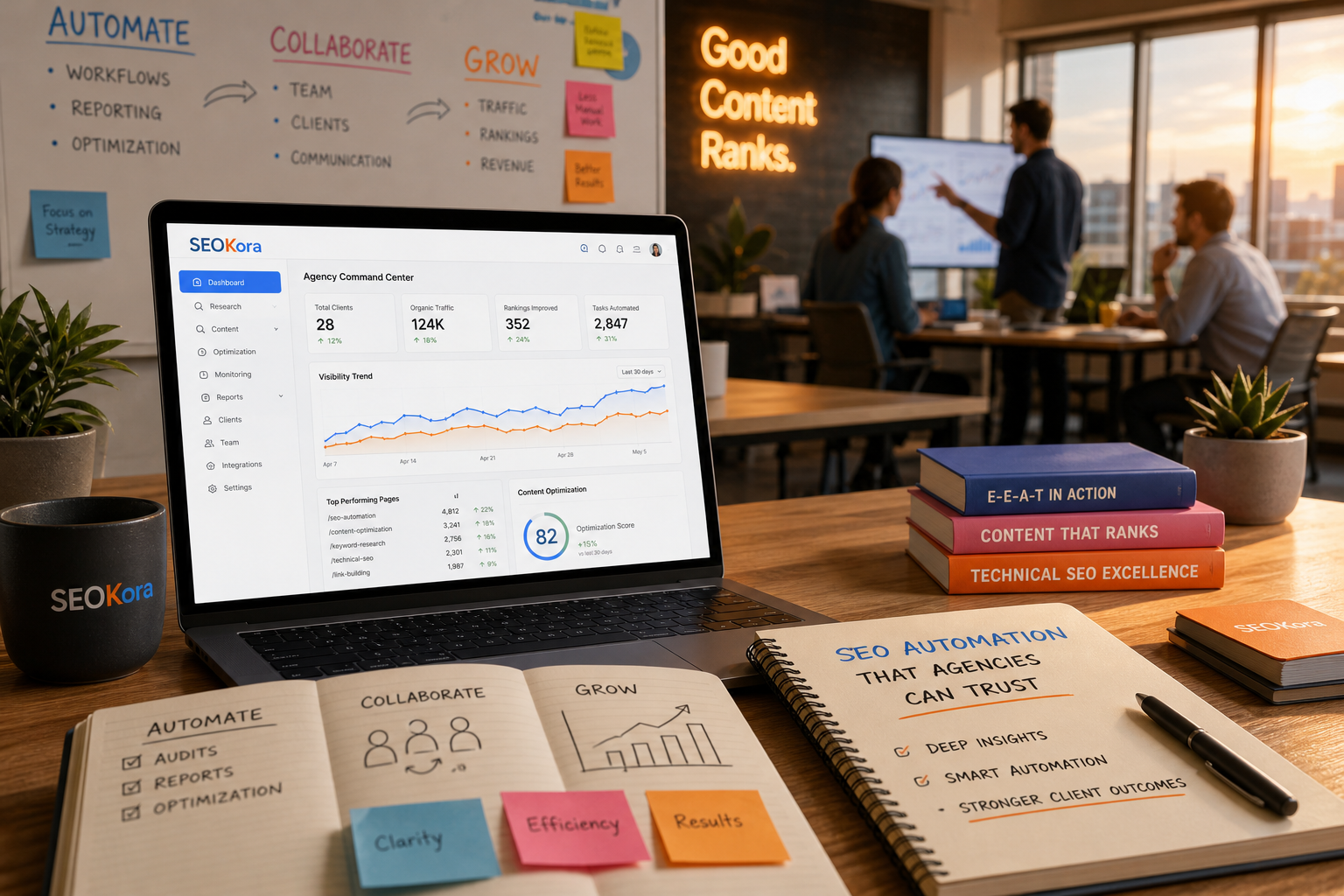
A practical agency setup keeps control points in the workflow. Automate discovery and monitoring. Use software to group opportunities and surface patterns. Then have a strategist or editor approve what becomes a task, brief, technical fix, or client recommendation. SEOKora’s guide to best SEO automation software (opens in new tab) and its resource on SEO automation for agencies (opens in new tab) both support this controlled approach: automation should make execution steadier, not make the team less accountable.
How to compare SEO platforms when vendor claims are hard to verify
SEO software pages often sound similar. Many promise better rankings, smarter insights, automation, competitor intelligence, and content recommendations. Because those claims are difficult to verify before purchase, compare platforms by the work they help you complete rather than by broad promises.
Start with a small evaluation checklist:
- Input quality: What data does the platform use, and is it clear enough for your team to trust?
- Opportunity discovery: Does it help identify pages, topics, competitors, and authority gaps worth acting on?
- Decision support: Does it explain why an opportunity matters, or does it only display metrics?
- Execution fit: Can recommendations become briefs, optimization tasks, or workflow steps?
- Control: Can humans review AI and automation before changes affect a site?
- Reporting clarity: Can you explain progress to a client, founder, or marketing lead without translating raw SEO jargon?
For competitor analysis, avoid comparing against every brand that sells something similar. Search competitors are the pages and domains winning visibility for the queries you care about. That may include publishers, marketplaces, directories, review sites, or product companies outside your direct commercial category. SEOKora’s resource on SEO competitor analysis (opens in new tab) goes deeper into finding the competitors that actually matter in search.
If backlinks are part of your evaluation, keep the same standard. A backlink feature is only useful if it helps you understand authority, prospect quality, and the relationship between links and the pages you want to grow. SEOKora’s SEO software with backlinks buyer’s guide (opens in new tab) is the better next read for that specific buying question.
What to be careful about before you trust the output
No SEO platform can remove uncertainty from organic search. Search results change, competitors publish, sites age, technical conditions shift, and search intent can move over time. Software can improve the quality and speed of decisions, but it should not be treated as proof that a specific action will produce a specific ranking result.
The practical risk is overconfidence. If a tool labels a keyword as an opportunity, ask whether the page can realistically satisfy the intent. If an AI recommendation suggests adding a section, check whether that section helps the reader or simply adds words. If automation flags a backlink opportunity, review relevance and quality before outreach. The more important the page is to revenue, reputation, or compliance, the more human review matters.
Unless a vendor provides transparent product detail, a hands-on trial, or clear documentation, you may not know how well the tool fits your workflow. In that case, use a short pilot around one website, one content cluster, or one client account. The goal is to see whether the software improves decisions your team already needs to make.
What does “seo software for agencies” mean for a business?
It means software that can support repeatable SEO work across multiple pages, sites, or clients. For a business, the value is not just agency management; it is having a structured way to find opportunities, improve content, compare competitors, monitor issues, and understand what work should happen next.
What is the best SEO software for a small business?
The best choice depends on the workflow you need to support. A small business usually benefits from software that clarifies priorities, connects content and technical work, and avoids overwhelming the team with data it cannot act on. A simpler tool that drives consistent action may be better than a larger platform the team rarely uses.
Is AI SEO software safe to use for business content?
AI SEO software can be useful when it supports research, structure, optimization, and prioritization. It should not publish unchecked claims or replace subject-matter review. For business content, safety comes from visibility, editability, and human approval before recommendations become public-facing copy.
Should a small business choose automation or manual SEO tools?
Most businesses need both. Automation is helpful for repetitive monitoring, discovery, and reporting. Manual review is still needed for strategy, prioritization, brand accuracy, technical judgment, and final content decisions. The better question is where automation saves time without weakening control.
Your next move with SEOKora
If you are evaluating seo software for agencies, start by choosing one real workflow to test: content refreshes, competitor analysis, backlink review, site optimization, or opportunity discovery. Run that workflow through the platform and ask whether it gives you a clearer decision, a better next action, and less manual friction.
SEOKora is built around practical organic growth work: turning search intelligence into ranking opportunities, competitive intelligence, authority insights, site optimization, and content optimization. If you want to keep learning before comparing tools, browse the SEOKora resources (opens in new tab). If you are ready to look at the platform itself, visit SEOKora (opens in new tab) and evaluate it against the workflow your team actually needs to improve.