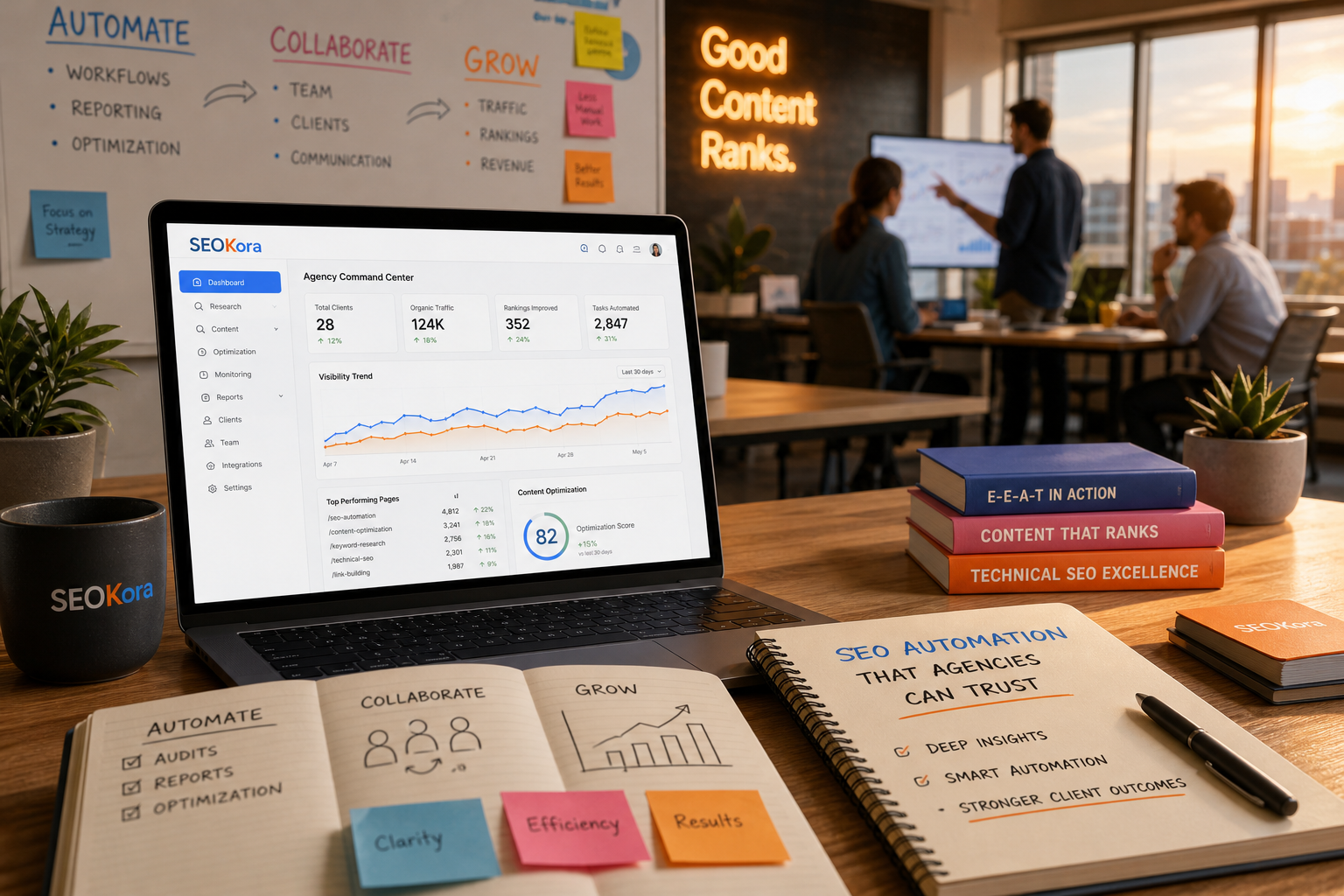
AI SEO Automation: How SEOKora Helps Businesses Grow Organic Visibility
Discover how SEOKora combines AI-powered SEO automation, content optimization, search intelligence, and AI visibility insights to support sustainable organic gr
AI SEO Automation for Businesses: A Smarter Approach to Search Growth
SEO Title: AI SEO Automation: How SEOKora Helps Businesses Grow Organic Visibility
Slug: ai-seo-automation-business-growth
Meta Description: Discover how SEOKora combines AI-powered SEO automation, content optimization, competitive intelligence, and AI search visibility to support sustainable organic growth.
Quick Answer: AI SEO automation uses artificial intelligence and connected workflows to help businesses discover search opportunities, improve website content, monitor competitors, optimize existing pages, and measure organic visibility. SEOKora brings search intelligence and SEO execution into a coordinated platform designed to turn optimization opportunities into measurable business progress.
Search visibility is evolving. Businesses now compete across traditional Google search results, answer-oriented search experiences, and AI-powered discovery platforms.
Maintaining visibility requires more than publishing articles or tracking keywords. Businesses need reliable research, relevant content, technical optimization, competitive intelligence, authority development, and consistent performance measurement.
AI-powered SEO automation can help connect these activities into a repeatable process while reducing manual work.
Table of Contents
- What Is AI SEO Automation?
- How SEOKora Supports SEO Growth
- SEO vs. AEO vs. GEO
- Benefits for Businesses
- Practical Business Example
- How to Measure Results
- Getting Started
- Frequently Asked Questions
What Is AI SEO Automation?
AI SEO automation is the use of artificial intelligence and automated workflows to support search engine optimization activities, including research, analysis, content development, website improvements, and performance monitoring.
Instead of manually reviewing every keyword, competitor, and website page, businesses can use AI-assisted systems to identify relevant opportunities and prioritize actions.
What Tasks Can AI Automate in SEO?
- Keyword discovery and search intent analysis.
- Competitive SEO research.
- Content gap identification.
- AI-assisted content preparation and optimization.
- On-page SEO recommendations.
- Technical SEO monitoring.
- Internal linking opportunity discovery.
- Authority and backlink opportunity research.
- Search performance analysis.
- Brand visibility monitoring across supported AI search experiences.
However, AI automation does not guarantee rankings or replace the need for accurate business information, editorial judgment, and responsible publishing controls.
How SEOKora Supports Business SEO Growth
SEOKora (opens in new tab) is an AI-powered SEO growth software platform focused on connecting search intelligence, website optimization, content workflows, and measurable performance.
The platform is designed to help businesses identify what needs improvement, understand why it matters, and organize practical actions.
1. Search Intelligence and Keyword Opportunities
Successful SEO starts with understanding what potential customers are searching for.
Keyword research should consider more than search volume. It should also evaluate commercial relevance, search intent, competition, and the relationship between a search query and the business offering.
SEOKora's search intelligence workflows help identify relevant opportunities based on business context and available search data.
Example: A company offering accounting software may benefit more from targeting searches such as "accounting software for small businesses" than competing exclusively for broad terms such as "software."
2. AI-Assisted Content Creation and Optimization
Publishing large quantities of content does not automatically produce organic growth.
Effective content should answer real questions, reflect the business's expertise, and provide information that readers can use.
SEOKora supports content workflows informed by keyword opportunities, competitive analysis, and business intelligence.
High-quality content should include:
- A clearly defined search intent.
- Accurate information relevant to the business.
- Helpful explanations and practical examples.
- Logical headings and readable formatting.
- Relevant internal links.
- Reliable supporting sources where appropriate.
- Clear answers to important customer questions.
The goal is to create useful content rather than generic AI-generated articles designed only to include keywords.
3. Competitive SEO Intelligence
Competitor analysis helps businesses understand the search landscape and identify areas where their websites can provide greater value.
Useful competitive research may reveal:
- Relevant topics covered by competing websites.
- Search opportunities not adequately addressed by existing content.
- Differences in website structure and topic coverage.
- Potential opportunities to create more useful resources.
Competitive intelligence should support differentiation, not content copying.
4. On-Page SEO and Website Optimization
Website optimization helps search engines and visitors understand individual pages.
Common improvements include:
- Optimizing page titles and meta descriptions.
- Improving heading hierarchy.
- Strengthening internal linking.
- Aligning page content with search intent.
- Identifying technical issues.
- Improving the clarity and usefulness of existing pages.
SEOKora's optimization workflows are designed to help identify, prioritize, and manage relevant improvements.
Where supported integrations and permissions are configured, selected changes can move through controlled publishing and verification processes.
5. Authority and Backlink Intelligence
Relevant references from independent websites can support a brand's credibility and online discoverability.
However, backlinks should be evaluated for relevance, legitimacy, and editorial quality rather than quantity alone.
SEOKora's authority workflows support the discovery and management of link-building opportunities.
Successful backlink acquisition depends on external publishers and cannot be guaranteed.
6. AI Search Visibility and Brand Intelligence
AI-powered search experiences are creating additional ways for customers to discover businesses.
Brand visibility in these environments may depend on how clearly a business describes its services, how consistently its identity appears across the web, and whether reliable sources provide relevant information about it.
SEOKora's AI visibility and brand intelligence approach focuses on understanding these signals and identifying opportunities for improvement.
AI-generated answers vary by platform, query, and time. No optimization platform can guarantee that a particular brand will be mentioned or cited.
SEO vs. AEO vs. GEO: Understanding Modern Search Optimization
Modern digital visibility involves three closely related approaches: Search Engine Optimization, Answer Engine Optimization, and Generative Engine Optimization.
What Is SEO?
SEO stands for Search Engine Optimization. It focuses on improving a website's visibility in relevant organic search results.
SEO includes content relevance, technical accessibility, website structure, internal linking, and authority development.
What Is AEO?
AEO stands for Answer Engine Optimization. It focuses on making information clear, structured, and useful for systems that provide direct answers to questions.
AEO practices include concise definitions, question-based headings, accurate explanations, and logically organized information.
What Is GEO?
GEO stands for Generative Engine Optimization. It focuses on improving how brands and their information can be discovered, understood, and potentially referenced by generative AI search experiences.
GEO practices include consistent brand information, original expertise, verifiable claims, relevant third-party references, and clear descriptions of products and services.
SEO, AEO, and GEO Comparison
| Approach | Primary Focus | Business Objective |
|---|---|---|
| SEO | Organic search results | Improve relevant search visibility and website traffic |
| AEO | Direct-answer search experiences | Make information easier to understand and present as answers |
| GEO | Generative AI search experiences | Improve brand discoverability and potential AI references |
These approaches are complementary. Accurate, helpful, well-organized content can support traditional search visibility while also making information easier for answer-oriented and generative systems to interpret.
What Are the Benefits of AI SEO Automation for Businesses?
Reduced Manual Work
Automated research, monitoring, and workflow coordination can reduce time spent on repetitive SEO activities.
Better Prioritization
Search intelligence helps businesses focus on opportunities that align with their audience, services, and commercial goals.
More Consistent Optimization
Structured workflows can make it easier to maintain a regular process for reviewing and improving website content.
Improved Competitive Awareness
Competitor monitoring can reveal emerging topics, content gaps, and changes in the search environment.
Clearer Performance Measurement
Connecting optimization activity with search performance data helps businesses distinguish completed tasks from meaningful results.
Support for Evolving Search Experiences
Businesses can begin considering traditional SEO alongside answer-oriented and AI-powered search visibility without treating every channel as a disconnected project.
Practical Example: How an Online Business Can Use AI SEO Automation
Consider a growing B2B software company that wants to attract more qualified visitors through organic search.
The company has a website with product pages, service descriptions, and a small collection of blog articles.
Step 1: Identify Search Opportunities
The business researches queries related to its software, target industries, and customer problems.
Step 2: Review Existing Content
Important pages are evaluated for relevance, clarity, structure, and opportunities for improvement.
Step 3: Analyze Competitors
Competitive research identifies useful topics and questions that the company's website does not adequately address.
Step 4: Prioritize Improvements
The business selects a manageable group of high-value pages and content opportunities.
Step 5: Execute and Verify
Approved changes are implemented, and the business confirms that intended updates are visible on the live website.
Step 6: Monitor Performance
Search impressions, clicks, relevant rankings, and conversions are monitored over time.
Expected benefit: A more organized and measurable SEO process. Actual traffic and ranking improvements depend on execution quality, competition, website conditions, and search engine behavior.
How Should Businesses Measure AI SEO Automation Results?
SEO automation should be evaluated using both operational performance and business outcomes.
Operational Metrics
- Completed and verified website improvements.
- Published content that meets editorial standards.
- Resolved technical issues.
- Successfully completed optimization workflows.
Search Performance Metrics
- Organic search clicks.
- Search impressions.
- Relevant keyword visibility.
- Organic landing-page performance.
- Qualified organic traffic.
Business Outcome Metrics
- Qualified inquiries from organic visitors.
- Organic search conversions.
- Leads generated through relevant landing pages.
- Revenue attributable to organic acquisition where tracking permits.
AI Visibility Indicators
- Observable brand mentions in supported AI search experiences.
- Relevant citations where measurable.
- Consistency of brand descriptions.
- Changes in visibility across comparable monitored queries.
These indicators should be interpreted carefully because AI responses can vary, and measured mentions do not necessarily translate into website visits or sales.
Important distinction: Publishing twenty articles measures output. Generating qualified customer inquiries measures business impact.
How to Get Started with AI SEO Automation
- Define your goals: Identify which products, services, or customer actions matter most.
- Understand your audience: Research the questions and problems your potential customers search for.
- Review your website: Identify existing strengths, content gaps, and technical issues.
- Analyze search opportunities: Prioritize relevant topics based on intent and business value.
- Build an optimization plan: Select realistic improvements that can be implemented consistently.
- Maintain quality controls: Review accuracy, relevance, and publishing permissions.
- Verify completed changes: Confirm that intended improvements are live.
- Measure results: Monitor organic performance and refine your strategy.
Businesses should begin with focused improvements rather than attempting to automate every SEO activity immediately.
Frequently Asked Questions About AI SEO Automation
What is the best way to automate SEO for a business?
Start by automating repetitive research, monitoring, and reporting tasks. Then introduce controlled workflows for content optimization and website improvements while maintaining editorial and technical oversight.
Can AI completely replace an SEO specialist?
No. AI can support research, analysis, and execution, but strategic judgment, business expertise, quality assurance, and accountability remain important.
Does AI-generated content rank on Google?
AI-assisted content can perform in search when it is useful, accurate, relevant, and created to help readers. AI generation alone does not provide a ranking advantage.
How long does SEO automation take to produce results?
Results vary according to competition, website history, technical conditions, content quality, and implementation. Some changes may be reflected relatively quickly, while meaningful organic growth often requires sustained effort over several months.
What is the difference between SEO and GEO?
SEO focuses primarily on organic search visibility, while GEO focuses on improving brand discoverability and potential references within generative AI search experiences. Both benefit from accurate, useful, and accessible information.
Can SEOKora guarantee first-page Google rankings?
No. Search rankings are controlled by search engines and depend on many factors. SEOKora focuses on identifying opportunities, supporting optimization workflows, and helping businesses monitor outcomes.
Does GEO guarantee citations in ChatGPT or other AI platforms?
No. Generative AI platforms independently determine which information to retrieve, summarize, and cite. GEO practices can improve content clarity and discoverability but cannot guarantee citations.
Is AI SEO automation suitable for small businesses?
Yes. Small businesses can use AI-assisted workflows to prioritize limited resources, improve important website pages, and maintain a more consistent optimization process.
What makes SEOKora different from a basic AI writing tool?
SEOKora is positioned as an SEO growth platform rather than a standalone text generator. Its approach connects search intelligence, competitive analysis, content workflows, website optimization, and performance measurement.
Can SEOKora help improve visibility in AI search?
SEOKora's brand and AI visibility intelligence can help businesses understand observable mentions and identify relevant optimization opportunities. Improvements in AI search visibility are not guaranteed.
Build a Smarter SEO Growth Strategy with SEOKora
Modern SEO requires a coordinated approach to search intelligence, content quality, website optimization, competitive research, and performance measurement.
AI-powered automation can help businesses manage these activities more efficiently, but sustainable growth still depends on relevance, accuracy, useful content, and consistent execution.
SEOKora is designed to help businesses turn search opportunities into structured optimization workflows and measurable progress.
Ready to explore a smarter approach to SEO?
Explore SEOKora — AI-Powered SEO Growth Software (opens in new tab)
Sources and Further Reading
The following official resources provide additional guidance on search visibility, content quality, and technical SEO.
- Google Search Central — Creating Helpful, Reliable, People-First Content
- Google Search Central — SEO Starter Guide
- Google Search Central — Introduction to Structured Data
- Google Search Central — AI Features and Your Website
Frequently asked questions
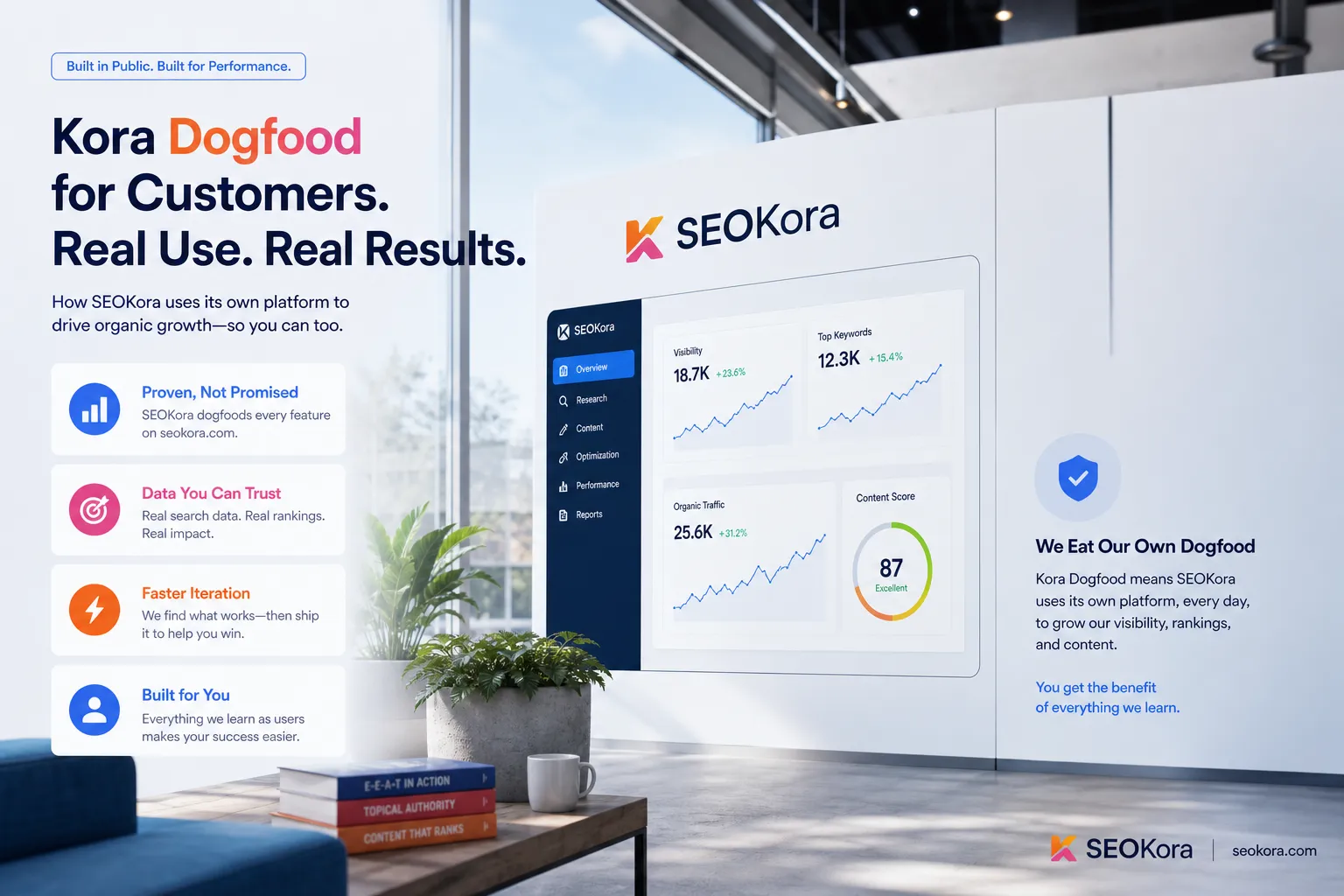
Start by defining the outcome you want from “Kora Dogfood for customers” in one sentence, then apply the practical workflow above. For Businesses in B2B software, specificity beats collecting more generic tips.
SEOKora recommends keeping the first pass small: one clear goal, one honest review, and one adjustment. That reduces rework when “Kora Dogfood for customers” feels overwhelming.
The most common failure is copying generic advice that ignores B2B software constraints. Adapt the steps to your tools and timeline before adding complexity.