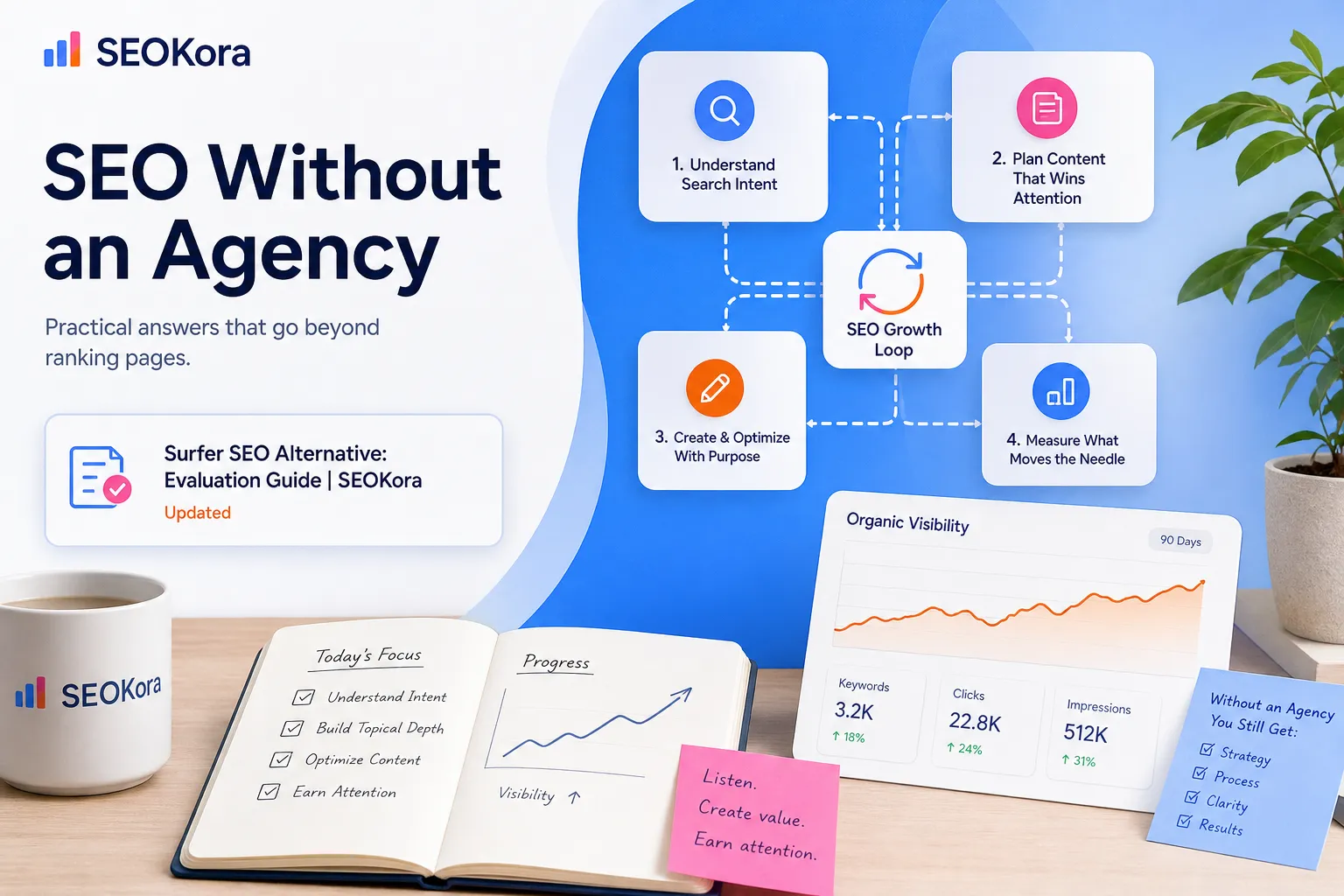
SEOKora's Practical Take on Seo Software with AI Visibility
Practical guidance for choosing SEO software with AI visibility, including definitions, mistakes, limits, and next steps with.
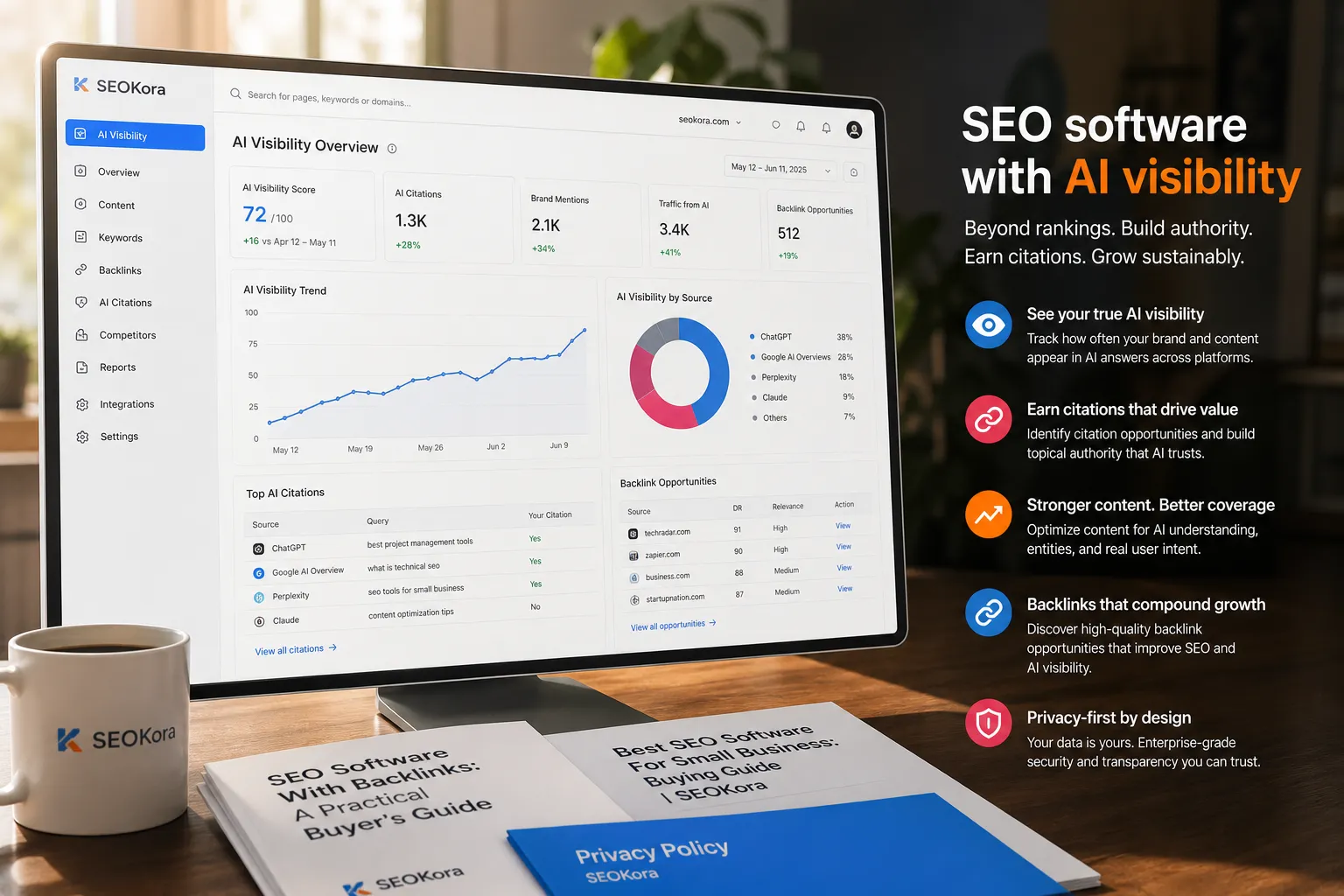
What SEO software with AI visibility means in practice
SEO software with AI visibility helps you understand and improve how your brand, pages, topics, and evidence show up across organic search and AI-assisted discovery. For a business, that means more than tracking blue-link rankings. It means seeing where search demand exists, which pages are eligible to answer that demand, what competitors are doing, and what content or site improvements make your expertise easier for both search engines and AI systems to interpret.
The phrase can sound broader than it is. Good SEO software does not make AI visibility appear by magic. It should help you connect practical SEO inputs: keyword opportunities, page quality, internal linking, competitor context, topical coverage, authority signals, and technical site health. AI can assist with analysis, clustering, drafting, brief creation, prioritization, and content refresh decisions, but the useful outcome is still operational: what should you publish, improve, consolidate, or monitor next?
SEOKora approaches this from the position of an SEO growth software platform: turning search intelligence into growth through ranking opportunities, competitive intelligence, authority insights, site optimization, and content optimization. That matters because “AI visibility” is not a separate channel you can manage in isolation. It is tied to the same signals that make a page understandable, credible, and useful in organic search.
Traditional SEO reporting might show which pages rank. A stronger AI visibility workflow asks a more useful question: which page is the best answer for the query, what supporting pages strengthen it, what entities or proof are missing, and where is the site sending mixed signals? That is where SEO software becomes a workflow tool rather than a dashboard.
How to evaluate AI visibility features without buying vague automation
The first decision is not whether a platform “uses AI.” It is whether the AI helps you make better SEO decisions. Many tools can summarize a keyword list or draft copy. Fewer help you connect search demand, competitor context, content gaps, and execution priorities in a way your team can act on.
When assessing SEO software with AI visibility, look for features that support the full path from discovery to improvement:
- Search opportunity detection: The tool should help surface topics, queries, and pages where improvement is realistic, not just list high-volume keywords.
- Content optimization guidance: It should identify what a page needs to answer the query more completely, whether that is clearer structure, missing subtopics, better internal links, or stronger evidence.
- Competitive intelligence: You need to understand which competitors matter in search results for the topic, not only the companies you compete with commercially. SEOKora’s guide to SEO competitor analysis is useful here because search competitors can differ from sales competitors.
- Authority and link context: AI-assisted visibility is still affected by whether a site looks credible and connected. Software should help you see authority signals and gaps without reducing SEO to one metric.
- Workflow support: A recommendation is only useful if it can become a content brief, refresh task, internal linking update, or site optimization action.
A simple test is to take one important page and ask what the software tells you to do next. If the answer is only “write more content” or “add keywords,” the platform may be using AI as packaging. If it can explain the query intent, competing pages, missing coverage, related internal pages, and a practical improvement sequence, it is closer to the kind of system businesses need.
If your main need is broader process automation, SEOKora’s AI tools for SEO automation guide (opens in new tab) can help separate useful automation from shortcuts that create more review work than they save.
Examples, edge cases, and common mistakes
AI visibility becomes easier to understand when you look at the messy cases where SEO software has to make tradeoffs. These are the situations where generic dashboards often fall short.
Example: a strong page that is not the clearest answer
A business may have a high-quality service page that earns impressions for a valuable topic, but the page mixes product positioning, customer objections, and educational content. Search engines may understand parts of it, while AI-assisted summaries may prefer clearer explanatory pages from competitors. The fix is not automatically to rewrite everything.
Example: topic overlap across a content library
Content marketers often publish several posts around the same theme over time. One explains the basics, another compares tools, another lists tactics, and another targets a long-tail phrase. If those pages are not linked clearly, AI systems and search engines may struggle to determine the best canonical answer from your site. A hub-and-spoke structure can help. SEOKora’s guide to content hub and spoke linking for editorial teams (opens in new tab) explains how editorial structure supports clearer topical relationships.
Common mistake: treating AI as the strategist
AI can speed up research and drafting, but it should not replace judgment about positioning, audience, source quality, and business relevance. If a tool generates a brief that looks comprehensive but ignores your product reality, the page may become generic. The correction is to use AI recommendations as inputs, then review them against search intent, customer language, and what your business can credibly claim.
Common mistake: chasing AI mentions before fixing the site
Some teams ask how to appear in AI answers while their site has thin pages, weak internal links, outdated content, or unclear topic ownership. AI visibility work starts with the same fundamentals: useful pages, clean structure, crawlable content, and trustworthy signals. Software can reveal the gaps, but the work still happens in your content and site architecture.
Common mistake: measuring the wrong thing
Rankings still matter, but they are not the only signal. For AI visibility, businesses should also watch whether important pages cover the right questions, whether brand and product entities are described consistently, whether content is refreshed when intent changes, and whether supporting pages strengthen the main page. If your software only reports position changes, it may miss the reasons visibility is improving or slipping.
What AI can and cannot do for SEO strategy
AI improves SEO strategy by reducing the manual work involved in finding patterns. It can cluster related queries, summarize competing pages, suggest missing sections, draft outlines, identify refresh opportunities, and help teams move from raw data to a clearer plan. For agencies and in-house teams managing many pages, that can make SEO work more consistent.
But AI cannot guarantee top rankings, and no credible SEO software should promise that. Search results change, competitors improve their pages, technical issues can block performance, and some queries require authority your site has not yet earned. AI also has a tendency to sound confident when the underlying evidence is incomplete. That is why the best use of AI in SEO is guided: combine software recommendations with human review, source checks, and a clear understanding of the audience.
There are also practical limits around content quality. If a page is produced only because an AI tool found a keyword, it may not deserve visibility. Strong pages still need a reason to exist: original explanation, useful examples, product-specific insight, clear structure, and enough evidence to support the claim. SEOKora’s broader resources on strategy, systems, and decision frameworks (opens in new tab) are useful when the question is not just “what can we automate?” but “what should we build?”
The safest way to think about AI visibility is this: AI can help you see the work faster, but it does not remove the need to do the work well.
What is SEO software with AI visibility?
It is SEO software that helps businesses understand and improve how their content, topics, and brand signals appear in organic search and AI-assisted discovery. Useful platforms connect AI analysis with practical SEO work such as content optimization, competitor research, internal linking, and site improvement.
How should a business get started?
Start with one important topic or page cluster. Identify the main search intent, review the page that should own the topic, compare competing results, check supporting internal links, and list the improvements needed. This gives you a controlled workflow before you scale AI-assisted SEO across the site.
How does AI improve SEO strategies?
AI can speed up research, pattern recognition, content briefing, and refresh planning. Its value is strongest when it helps teams move from scattered SEO data to a clear action list. It should support strategic judgment, not replace it.
Can AI guarantee top search rankings?
No. AI can improve analysis and execution, but rankings depend on many factors, including search intent, competition, page quality, authority, technical accessibility, and ongoing changes in search systems. Treat any ranking guarantee with caution.
What mistakes should be avoided?
Avoid using AI to publish generic content at scale, ignoring technical and internal linking issues, measuring only keyword positions, or choosing software because it has AI features without checking whether those features improve real SEO decisions.
Your next move with SEOKora
If you are evaluating SEO software with AI visibility, do not start with the longest feature list. Start with a page or topic that matters to growth and ask what the platform helps you understand: the opportunity, the competing results, the content gap, the authority context, and the next action.
SEOKora is built around that practical path from search intelligence to execution. Use it to think beyond isolated rankings and toward a clearer growth workflow: find the opportunity, understand why it matters, improve the page, strengthen the surrounding content, and keep learning from the results.
To explore the platform, visit SEOKora (opens in new tab). If you are still shaping your SEO strategy, continue through the SEOKora resources (opens in new tab) and build the decision process before you commit to a tool stack.
Frequently asked questions
It is software that combines or connects SEO workflows with monitoring for appearances in AI-generated discovery experiences. The exact scope varies, so buyers should verify which experiences, result types, and SEO capabilities a platform supports.
No. A traditional ranking describes a page’s position in a defined search result. AI visibility may refer to a mention, citation, link, summary, or recommendation within a generated response. The two should be measured separately.
Useful metrics depend on the decision being made. Appearance rate, citation rate, topic coverage, source frequency, competitive presence, and change over time can provide a practical starting point when their definitions are clear.
Monitoring software can report observed results and support optimization workflows, but a visibility guarantee should not be assumed. Evaluate platforms based on transparent measurement, evidence, and the quality of the actions they help teams complete.
Begin with a small set of business-relevant topics or prompts, document a baseline, review the associated sources and pages, prioritize useful site improvements, and repeat the measurement consistently.