AI Backlink Automation: From Link Prospects to Real Authority
Learn how AI backlink automation can qualify prospects, match linkable assets, prepare relevant outreach and verify earned links without scaling spam.
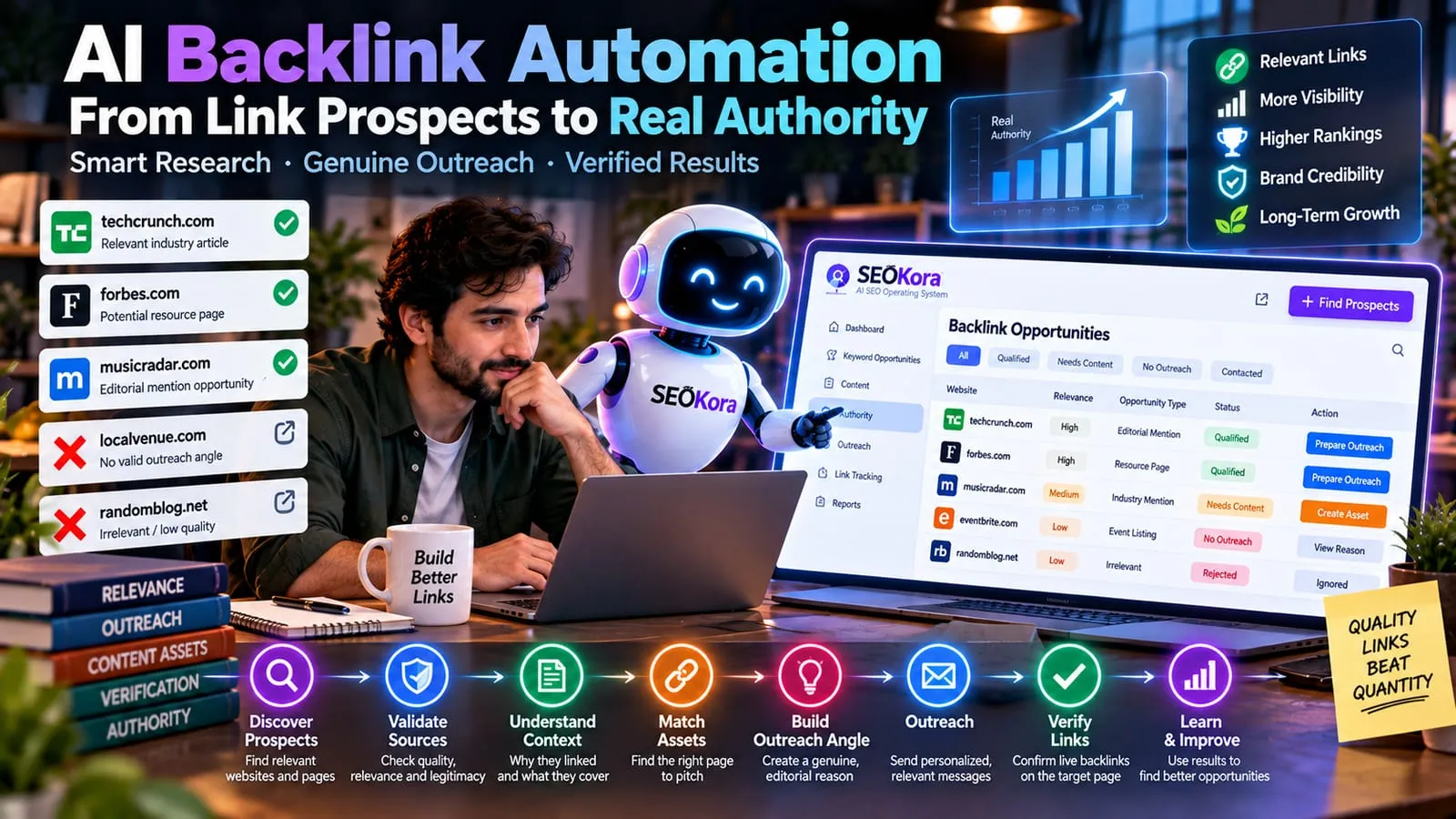
AI backlink automation can accelerate prospect research, qualification, outreach preparation and link monitoring. Its value, however, depends on whether the system can distinguish a possible prospect from a credible reason to contact one.
The simplest workflow—find a competitor backlink, collect an email address and generate a message—may be fast, but it ignores the most important question: why should the publisher consider the request?
Finding a website that could link to you is not the same as finding a legitimate reason why it should.
Responsible automation should improve authority decisions rather than maximize email volume. That means validating the source, understanding why an existing link appears, matching the opportunity to a suitable asset and verifying any link that is eventually earned.
What is AI backlink automation?
AI backlink automation is the use of artificial intelligence and workflow automation to support backlink research, prospect qualification, opportunity analysis, target-page matching, outreach preparation, relationship tracking and link verification.
Depending on the workflow, automation can assist with:
- discovering relevant websites and pages;
- analyzing competitor backlinks;
- classifying prospects by topic and opportunity type;
- identifying potentially suitable target assets;
- finding and validating contact routes;
- drafting evidence-based outreach;
- preventing duplicate communication;
- tracking responses and decisions; and
- checking whether an expected link is live or has disappeared.
These capabilities can reduce repetitive work. The quality of the result still depends on what happens between prospect discovery and outreach.
A competitor backlink is evidence, not entitlement
Competitor backlink analysis can reveal which websites mention comparable organizations and which types of pages attract references. It does not establish that every discovered source should also link to you.
An existing backlink may have been created because the competitor:
- was interviewed or quoted;
- provided original research;
- participated in an event;
- supplied a useful resource;
- was reviewed using specific selection criteria;
- had a direct relationship with the publisher; or
- earned the link under circumstances that no longer apply.
If your organization does not share the underlying reason, discovering the link does not recreate the opportunity.
A backlink is an outcome. A useful automation system must investigate the reason behind that outcome.
The responsible AI backlink automation workflow
A defensible process separates discovery from qualification and execution:
| Stage | Required decision |
|---|---|
| 1. Discover | Is there a potentially relevant website or page? |
| 2. Validate | Is the source legitimate, maintained and topically relevant? |
| 3. Understand | Why does the comparable link or mention appear? |
| 4. Match | Do we have an asset that genuinely fits the context? |
| 5. Decide | Should the opportunity proceed, receive more research, trigger asset creation or be rejected? |
| 6. Prepare | Is there an appropriate contact and an evidence-based message? |
| 7. Execute | Has the opportunity passed the required controls? |
| 8. Verify | Does the live page contain the expected link to the correct destination? |
| 9. Learn | What should the outcome change in future qualification? |
The operating loop is:
Discover → Validate → Understand → Match → Decide → Prepare → Execute → Verify → Learn
Good automation must be able to stop
Automation is often measured by how many prospects it finds or messages it sends. Those metrics can reward weak qualification. A better system should be able to reduce output when the evidence does not support outreach.
| Prospect state | Correct response |
|---|---|
| Relevant source with a strong, supported angle | Prepare controlled outreach |
| Potential fit but insufficient evidence | Research further |
| Relevant source but no suitable asset | Return CONTENT_ASSET_NEEDED |
| Similarity or competitor overlap only | Do not manufacture a pitch |
| Wrong topic, audience or page type | Reject the prospect |
| Domain or contact already approached | Respect the outreach history |
| No defensible reason to contact | Return NO_VALID_OUTREACH_ANGLE |
The objective is not maximum outreach. It is maximum defensible outreach.
Match the opportunity to the right target asset
A credible pitch requires more than a relevant prospect. It also needs a destination that belongs in the source page's context.
| Opportunity | Potentially suitable asset |
|---|---|
| Research citation | Original study or data resource |
| Educational resource page | Comprehensive guide for the intended audience |
| Product comparison | Relevant product information that fits the stated criteria |
| Broken external reference | A credible resource serving the same purpose |
| Expert contribution | Relevant expert profile or supporting resource |
The question is not simply, “Which URL do we want links to?” It is, “Which URL makes sense for this source, page and audience?”
If no existing URL meets that standard, the opportunity should inform content planning rather than force a commercial landing page into an unsuitable pitch.
What makes a backlink outreach angle valid?
A valid angle provides a reason to consider the request that exists independently of your desire to acquire a backlink. Examples include:
- a useful resource that fits an existing collection;
- original evidence that supports the page's subject;
- a suitable replacement for a broken external reference;
- a relevant factual correction or update;
- a legitimate expert contribution;
- an actual event or organizational relationship; or
- a resource that materially improves what the page offers readers.
The common factor is editorial or reader value. “We want a backlink” is not an outreach angle.
Broken-link opportunities still require validation
Finding a 404 does not automatically justify outreach. Before proposing a replacement, the system should determine what the unavailable resource contained, whether it mattered to the page and whether the proposed asset serves the same purpose. It should also confirm that the source page is still maintained and that an appropriate contact route exists.
Resource pages need a genuine resource fit
Resource pages can be useful prospects because they already direct readers to external material. The automation should still compare the topic, audience, resources already listed, apparent quality threshold and proposed target asset before recommending contact.
Editorial mentions require editorial logic
An article may include organizations, products or experts because of first-hand testing, interviews, historical context, selection criteria or existing relationships. Category similarity alone is weak evidence that another entity should be added.
AI personalization cannot rescue a bad pitch
Generative AI can mention the recipient's name, page title, latest article, competitor link and proposed asset. That can make an email look highly specific without making the request relevant.
Validate the outreach angle before allowing AI to write the message.
The stronger sequence is:
Prospect → Evidence → Valid angle → Appropriate asset → Contact validation → AI-assisted drafting → Controlled send
Messages should not invent relationships, pretend that unsupported research occurred or manufacture an editorial reason for contact.
Validate contacts and prevent duplicate outreach
Finding an email address does not mean it is the correct destination. An explicit editorial submissions address or a named editor responsible for the topic may be appropriate. A support address or unverified scraped contact usually carries much lower confidence.
The system should preserve the source and intended purpose of each contact route. It should also check shared outreach history before sending anything.
At a minimum, that history should record:
- the domain and source page;
- the person or address contacted;
- the target asset and outreach angle;
- the date and status of communication;
- the response, if any; and
- whether further contact is appropriate.
Without shared memory, separate discovery workflows can send multiple pitches to the same publisher. That is an automation failure, not productive scale.
Use human review where judgment matters
Automation can handle a large share of classification, deduplication, contact research and monitoring. Human review remains useful when the editorial logic is ambiguous, a relationship is sensitive or the evidence does not support a confident decision.
Human decisions should also improve future automation:
- a domain rejected as irrelevant should not repeatedly resurface;
- a rejected angle should not be regenerated with different wording;
- an insufficient asset should be routed toward improvement or creation;
- an approved prospect can continue through a controlled workflow; and
- a sensitive relationship can be reserved for human handling.
Human judgment today should reduce unnecessary human work tomorrow.
Verify live links instead of reporting promises
A positive reply does not prove that a backlink exists. The publisher may not add it, may link to the wrong destination or may publish a mention without a link. A previously live link may also disappear.
The workflow should therefore keep these states separate:
Discovered ≠ Qualified ≠ Contacted ≠ Positive response ≠ Link claimed ≠ Link verified ≠ Link retained
Verification should confirm that the source page is publicly accessible, contains the expected reference and points to the intended destination. Continued monitoring can identify links that are changed or lost.
Verified authority is more meaningful than prospect or outreach volume.
Evaluate quality beyond a domain metric
Authority metrics can help filter large prospect sets, but they should not replace contextual analysis. A useful opportunity also depends on:
- topical relevance;
- editorial context;
- page quality;
- audience alignment;
- source legitimacy;
- placement; and
- whether the reference naturally helps the reader.
A larger metric does not automatically make a prospect more relevant. A smaller publication closely aligned with the topic may provide a more coherent editorial context than an unrelated site with a stronger headline score.
What should and should not be automated?
| Task | Recommended handling |
|---|---|
| Prospect discovery and initial classification | Highly automatable |
| Duplicate detection and history checks | Highly automatable |
| Competitor relationship analysis | Automate with contextual validation |
| Target-asset matching | Automate with page-level context |
| Contact discovery | Automate with source and confidence tracking |
| Outreach drafting | Automate only after angle validation |
| Sending | Automate under defined controls |
| Link verification and loss detection | Highly automatable |
| Ambiguous or sensitive outreach | Human review or no outreach |
Responsible systems should not automate deceptive personalization, invented relationships, repeated contact with rejected prospects, fake identities or reporting unverified links as acquired.
AI backlink automation for small businesses
Small businesses often lack dedicated digital PR or link-building teams, making manual research expensive in time. AI can reduce that burden by filtering unsuitable prospects, coordinating records and preparing stronger opportunities for review.
Smaller brands also have limited room for reputational damage from irrelevant automated outreach. The practical objective should therefore be less research waste, fewer bad prospects and better reasons to contact the opportunities that remain.
How to evaluate backlink automation software
Before selecting a platform or workflow, ask:
- Does it explain why each prospect is relevant?
- Can it distinguish competitor overlap from a genuine opportunity?
- Does it analyze the source page rather than only the domain?
- Can it identify an appropriate target asset?
- Can it return CONTENT_ASSET_NEEDED when no asset fits?
- Does it validate the outreach angle before generating a message?
- Does it track contact source and confidence?
- Can it prevent duplicate outreach across workflows?
- Does it retain rejected prospects and human decisions?
- Can it choose not to send?
- Does it verify live backlinks and detect lost links?
- Can authority intelligence feed content strategy?
For a broader view of platform selection, see SEO Software With Backlinks: A Practical Buyer’s GuideSEOKora. For the strategic context around earning relevant links, read Backlink Strategy: How to Earn Links That Actually Build Website AuthoritySEOKora.
Frequently asked questions
What is AI backlink automation?
AI backlink automation uses artificial intelligence and workflow automation to assist with prospect discovery, qualification, target matching, outreach preparation, communication tracking and link verification.
Can AI automatically build backlinks?
AI can automate substantial parts of research and outreach, but an independent website controls whether it publishes or maintains a link. Automation cannot legitimately guarantee that a publisher will provide one.
Is automated link building spam?
Not necessarily. Automation can support legitimate research, qualification and communication. It becomes problematic when it scales irrelevant, repetitive or deceptive outreach without a credible editorial reason.
Should every website linking to a competitor receive outreach?
No. The existing backlink shows that a relationship exists between the source and competitor. You still need to determine why the link exists and whether your organization has a comparable, legitimate reason to be considered.
What does CONTENT_ASSET_NEEDED mean?
It means a potentially valuable opportunity exists, but the website lacks an asset strong or relevant enough to support credible outreach. Creating or improving the asset may be more appropriate than contacting the prospect immediately.
Can AI personalize backlink outreach?
Yes, but personalization should follow opportunity validation. A specific message does not make an irrelevant request useful.
How should acquired backlinks be verified?
Confirm that the source page is publicly accessible, contains the expected reference and links to the intended destination. Ongoing checks can identify links that later change or disappear.
Does SEOKora guarantee backlinks?
No. Independent websites control their editorial decisions. SEOKora's authority model focuses on research, qualification, workflow coordination and verification rather than promising third-party links.
Automate authority intelligence, not spam
AI can inspect more prospects, organize evidence and reduce repetitive backlink research. The wrong model is:
Find → Scrape → Generate → Send
The stronger model is:
Discover → Validate → Understand → Match → Decide → Outreach → Verify → Learn
Sometimes that process should produce an email. Sometimes it should trigger a better content asset or human review. Sometimes the correct result is NO_VALID_OUTREACH_ANGLE.
That is not failed automation. It shows that the system understands the difference between finding a prospect and earning the right to contact one.
The goal is not to automate more link building. It is to automate better authority decisions.