How to Judge Ai Seo Software Without the Noise
Ai Seo Software — practical guidance for Businesses in B2B software, from SEOKora.
What AI SEO software means in practice
AI SEO software is useful when it turns search data into specific actions: which pages to improve, which topics to build, which competitors to learn from, which backlinks may matter, and what content changes are likely to make a page more visible. The noise starts when a tool only promises “AI content” or “automatic ranking” without showing how it connects research, optimization, authority, and measurement.
For businesses, website owners, SEO professionals, agencies, SaaS teams, and content marketers, the practical question is not whether a platform uses AI. It is whether the software helps you make better SEO decisions faster, with enough evidence to trust the next step.
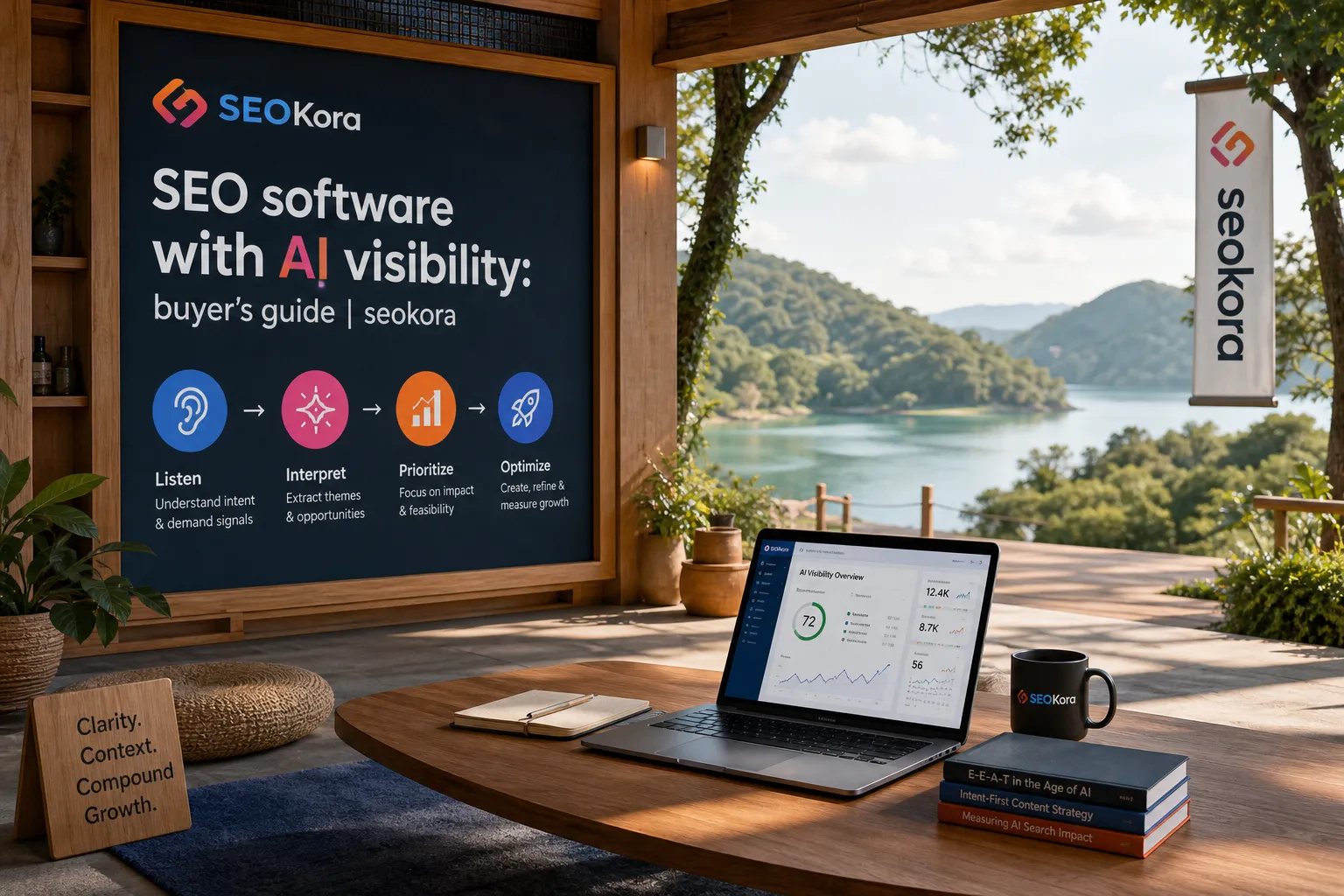
A useful AI SEO workflow usually has four parts. First, it finds opportunities from search signals, competitors, or existing pages. Second, it explains why those opportunities matter. Third, it helps produce or improve content without flattening the brand’s voice. Fourth, it tracks whether the work moved rankings, visibility, or traffic in the right direction.
What is changing in AI SEO for 2026
The important shift is from isolated AI tasks to connected SEO workflows. A few years ago, many AI SEO tools were judged on whether they could generate titles, outlines, meta descriptions, or draft copy. Those features still matter, but they are no longer enough to judge the software.
In 2026 planning, the stronger question is whether the platform can connect content decisions to search visibility. For example, if a SaaS company has a feature page ranking on page two, the tool should help identify the query intent, the missing topical coverage, the competing pages, and the on-page improvements. A generic AI writer can produce more copy. Good AI SEO software should help explain what kind of copy is needed and why.
Another change is the growing importance of brand visibility across search and AI-assisted discovery. Businesses are not only asking how to rank a page; they are also asking whether their brand, content, and authority signals can be recognized in search experiences where answers are summarized. SEOKora has a related resource on AI brand visibility (opens in new tab) for teams thinking beyond traditional blue-link rankings.
Backlink and authority workflows are also becoming more structured. AI can help surface prospects, categorize outreach opportunities, and reduce manual list-building, but it should not be treated as a magic authority engine. The value is in better prioritization and execution. For more on that specific workflow, see SEOKora’s guide to AI backlink automation (opens in new tab).
Use capability scores instead of feature checklists
A long feature list can hide weak execution. Two tools may both claim “AI content optimization,” but one may only rewrite headings while the other evaluates intent, page structure, competing coverage, internal links, and content gaps. A capability score forces you to judge what the software actually helps you do.
Use a simple 1–5 score for each area below. The goal is not mathematical precision. The goal is to make a cleaner buying decision and avoid being distracted by impressive but shallow features.
| Capability | What to check | Weak signal | Strong signal |
|---|---|---|---|
| Opportunity discovery | Can it find ranking, content, technical, or authority opportunities from real search data? | Only gives generic keyword ideas. | Connects opportunities to pages, intent, competitors, and likely impact. |
| Content optimization | Can it improve existing pages, not just create new drafts? | Generates copy without explaining search intent. | Shows what is missing, what to keep, and what to improve. |
| Search Console workflow | Can it help turn performance data into action? | Displays charts but leaves interpretation to you. | Highlights pages, queries, and changes worth acting on. |
| Competitive intelligence | Can it show why competitors are winning? | Lists competitor domains only. | Explains content, authority, and ranking patterns you can respond to. |
| Authority insights | Can it support backlink or authority decisions? | Exports raw lists with little filtering. | Helps prioritize prospects or authority gaps. |
| Human control | Can editors, SEOs, and marketers review the reasoning? | Push-button automation with vague outputs. | Clear recommendations that a human can approve, adjust, or reject. |
If a platform scores well on only one area, it may still be useful, but you should treat it as a specialist tool. If you need a growth platform, look for evidence that the tool connects discovery, optimization, authority, and measurement instead of leaving you to stitch the workflow together manually.
Be careful with “best AI SEO tools” rankings
Search results for this topic often include “best tools” and “tested and ranked” pages. Those lists can be helpful for discovery, but they are not the same as choosing software for your own SEO workflow. A ranked article may prioritize breadth, novelty, free tools, or a reviewer’s testing environment. Your business may need something narrower: better content refreshes, backlink automation, Search Console action, agency reporting, or competitive intelligence.
A better way to use those lists is to collect candidates, then judge them against your actual bottleneck. If your site already has hundreds of indexed pages but traffic has stalled, a pure AI writer may not solve the problem. You may need software that finds underperforming pages, identifies query gaps, and suggests practical updates. If you have good content but weak authority, backlink and authority workflows may matter more than another content brief generator.
For teams evaluating SEO software that includes backlink support, SEOKora’s SEO software with backlinks buyer’s guide (opens in new tab) goes deeper into the authority side of the decision. That is a different evaluation lens from judging AI writing features alone.
The safest buying posture is simple: do not ask “which tool is best?” until you have defined “best for what?” A content marketer building topic clusters, an agency managing multiple clients, and a SaaS team improving product-led pages may all need AI SEO software, but they should not score the same features equally.
What makes AI SEO software different from ordinary SEO tools
Traditional SEO tools are often strongest at collecting and displaying data: rankings, keywords, backlinks, audits, competitor domains, and traffic estimates. AI SEO software should go a step further by interpreting that data and recommending the next action.
The difference is not that AI replaces SEO judgment. The difference is that it can reduce the manual work between signal and decision. A Search Console report may show a page gaining impressions but not clicks. A useful AI SEO system should help identify whether the issue is title intent, weak topical coverage, poor internal linking, mismatched page format, or a query that deserves a new page instead of an edit.
That is why automation needs guardrails. AI can accelerate analysis and drafting, but it can also create problems if it publishes thin copy, repeats competitor phrasing, invents unsupported claims, or optimizes for a keyword while missing the reader’s real question. Human review is not a formality; it is part of the workflow.
If your team relies heavily on Google Search Console, SEOKora’s guide to Search Console automation (opens in new tab) is especially relevant because it focuses on moving from data to SEO action rather than simply reading reports.
A quick comparison framework for choosing your stack
You do not need every AI SEO feature on day one. Choose the stack based on the work that is blocking growth now. The table below gives a practical way to compare options without turning the process into a months-long procurement exercise.
| If your main problem is... | Prioritize software that... | Watch out for... |
|---|---|---|
| You do not know what to work on next | Surfaces ranking opportunities, content gaps, and competitive patterns. | Tools that generate ideas but do not connect them to existing pages. |
| Your content is published but underperforming | Analyzes existing pages and recommends specific improvements. | AI writers that only create new drafts and ignore refresh work. |
| Your team spends too much time in reports | Turns Search Console and ranking signals into prioritized actions. | Dashboards that look impressive but do not guide decisions. |
| Your competitors have stronger authority | Provides backlink, authority, and outreach-oriented insights. | Raw backlink exports without prioritization. |
| You manage SEO for multiple clients or sites | Supports repeatable workflows, clear recommendations, and review steps. | Black-box automation that is hard to explain to clients or stakeholders. |
Before committing, test the tool against one real workflow. Pick an existing page, a known competitor, or a current ranking problem. Then ask: did the software save time, reveal something useful, and produce an action your team would actually take? If the answer is vague, the tool may be interesting but not operationally useful.
Common mistakes when evaluating AI SEO software
The first mistake is judging the tool by output volume. More drafts, more briefs, or more keyword suggestions do not automatically create growth. If the software increases production without improving prioritization, you can end up publishing more pages that compete with each other or fail to satisfy search intent.
The second mistake is ignoring existing content. Many businesses already have pages with impressions, partial rankings, or outdated positioning. AI SEO software should help identify which pages deserve refreshes before the team starts building entirely new content. In many cases, improving a page that already has search signals is a more disciplined first move than launching another article.
The third mistake is treating automation as proof. A recommendation is only useful if the reasoning is visible enough for an SEO, editor, or marketer to challenge it. If a tool says “add 900 words” but cannot explain what is missing, that is not strategy; it is formatting advice.
The fourth mistake is separating content from authority. A well-optimized article may still struggle if the site lacks topical depth, internal support, or credible authority signals. If backlinks and authority are part of your growth problem, evaluate that capability directly rather than assuming a content tool will solve it indirectly.
What does AI SEO software mean for a business?
It means software that uses AI to help with SEO decisions and execution, such as finding ranking opportunities, improving content, interpreting search data, analyzing competitors, and supporting authority-building workflows. The practical value is not the AI label; it is whether the tool helps your business choose and complete better SEO work.
How should a business get started?
Start with one clear workflow, not a full platform migration. Choose a page or topic that already matters to the business, then test whether the software can diagnose the issue, recommend a sensible action, and help your team complete the update. This keeps the evaluation grounded in real SEO work rather than a demo script.
Can AI SEO software replace an SEO specialist?
It can reduce manual analysis, drafting, and reporting work, but it should not replace judgment. Someone still needs to decide whether the recommendation fits the brand, the audience, the page intent, and the evidence available. The best use is usually assisted decision-making, not unsupervised publishing.
What should agencies look for?
Agencies should look for repeatable workflows, explainable recommendations, and outputs that can be reviewed with clients. A tool that only produces content faster may not help if the agency’s real bottleneck is prioritization, reporting, or proving why a specific SEO action should happen next.
Your next move with SEOKora
The cleanest way to judge AI SEO software is to bring it back to work that matters: discover the opportunity, understand the reason, make the improvement, and measure what changed. If a platform cannot support that chain, the AI features may be useful but incomplete.
SEOKora is built for businesses and SEO teams that want search intelligence to become growth work, not just another dashboard. If you are comparing options, start by reading through SEOKora’s SEO strategy resources (opens in new tab), then map the guidance to one current SEO bottleneck on your site.
When you are ready to look at the platform itself, visit SEOKora (opens in new tab) and evaluate it against the same standard: does it help you find better opportunities, act on them with confidence, and build organic visibility with less wasted effort?