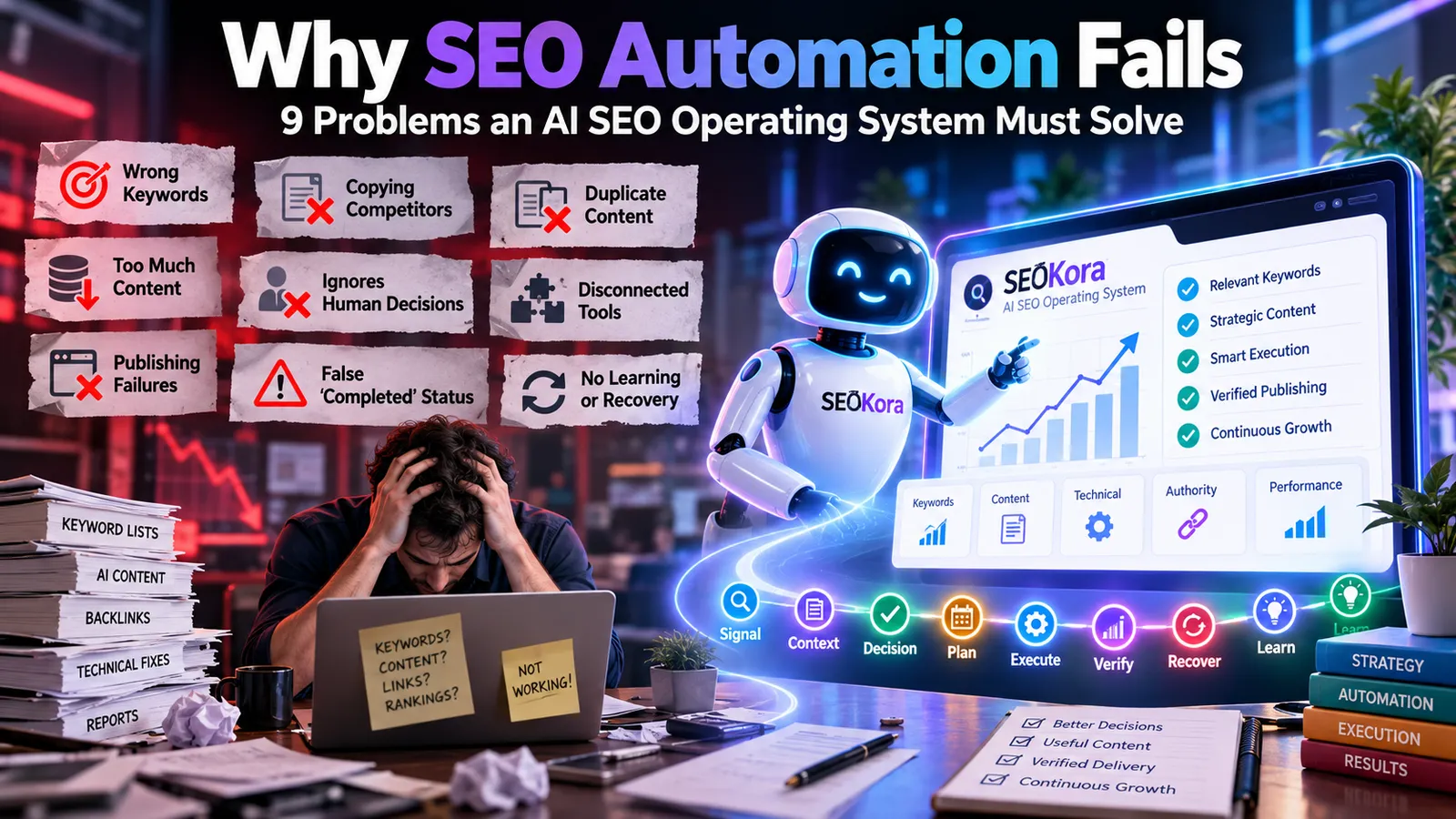
What Is SEOKora? How an AI SEO Operating System Turns Search Data Into Action
Discover how SEOKora turns SEO data into prioritized actions, content workflows, verified delivery and continuous optimization for growing businesses.
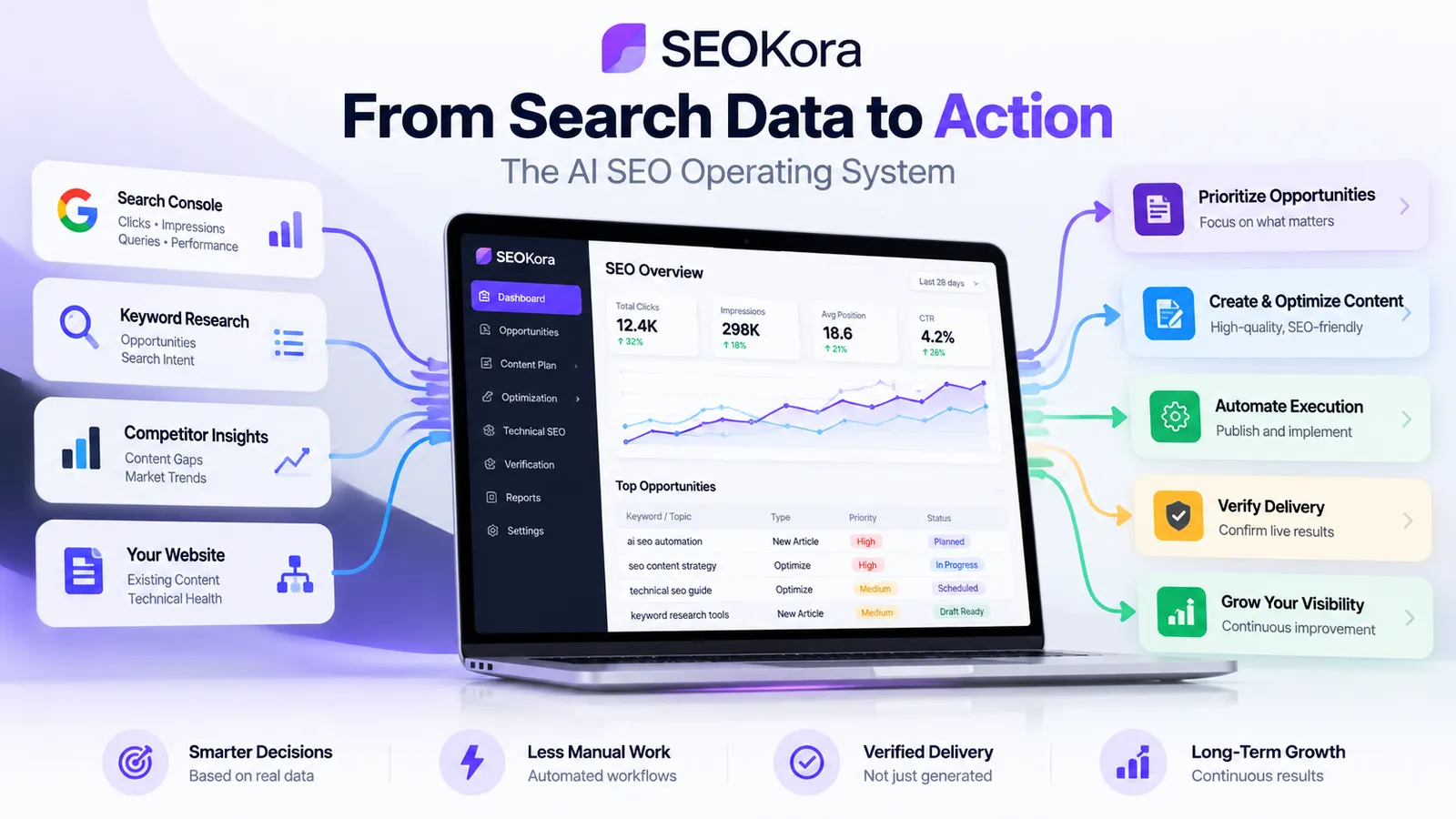
Most businesses do not suffer from a shortage of SEO data.
They suffer from a shortage of action.
Open a modern SEO stack and you can quickly find keyword opportunities, rankings, impressions, backlinks, technical warnings, competitor pages and content gaps. The difficult part begins after the dashboard is closed:
What should we actually do today?
Which opportunity deserves attention first? Should an existing page be improved or should a new page be created? Is a falling query a temporary fluctuation or something worth investigating? Has planned work actually reached the live website? And after publication, who checks whether it worked?
This is the problem SEOKora is designed to approach differently.
Rather than treating SEO as a collection of disconnected reports, SEOKora is designed as an AI SEO operating system: a workflow layer intended to turn search intelligence into prioritized work, coordinate execution, verify delivery and use new evidence to inform what happens next.
That distinction matters because SEO intelligence and SEO execution are not the same thing.
What Is SEOKora?
SEOKora is an SEO intelligence and automation platform designed to connect research, prioritization, planning, execution and verification in a continuous workflow.
The simplest way to understand the idea is to compare two questions.
A traditional analytics question is:
“What is happening with my SEO?”
An operating-system question is:
“Given what is happening, what should be worked on next, how should it be executed, and how do we verify that the work was actually delivered?”
SEOKora is being built around the second question.
This does not make established research platforms unnecessary. Tools such as Google Search Console, Semrush and Ahrefs solve important parts of the SEO problem. Google Search Console, for example, reports real Google Search performance metrics including clicks, impressions, click-through rate and average position. Semrush provides extensive keyword, backlink, ranking, on-page and technical SEO research. Ahrefs provides competitor intelligence, keyword research, backlink analysis, site auditing, rank tracking and search/AI visibility analysis.
SEOKora's role is different: use available intelligence as input for an operational SEO cycle rather than allowing useful signals to remain isolated inside reports.
The SEO Industry Has a Data-to-Action Gap
Consider a small business owner who discovers 300 potentially relevant search queries.
That sounds valuable—and it is. But the list itself does not answer the operational questions:
- Which queries match the business?
- Which opportunities should be ignored?
- Which existing pages already address those topics?
- Which page should be improved first?
- Where is genuinely new content needed?
- What should be scheduled this week?
- What has already been attempted?
- What actually reached the live website?
- Which completed actions produced useful search signals?
This creates what we call the data-to-action gap.
The business may possess more SEO information than ever while still lacking a repeatable mechanism for converting that information into useful work.
SEO Dashboard vs SEO Operating System
The distinction becomes clearer when we look at the workflow rather than individual features.
| Stage | Research / Monitoring Approach | SEOKora Operating-System Approach |
|---|---|---|
| Observe | Surface keywords, rankings, traffic, links and issues | Bring relevant signals into an ongoing decision process |
| Interpret | User studies reports | System evaluates signals in business and website context |
| Prioritize | User decides what matters | Opportunities can be prioritized into actionable work |
| Plan | Often managed separately | Work can enter a coordinated publication and optimization plan |
| Execute | User moves into CMS or another workflow | Approved work can progress toward connected publishing workflows |
| Verify | Completion may be recorded manually | Delivery should be confirmed against the live destination |
| Learn | User revisits reports later | New evidence can feed the next prioritization cycle |
The point is not that dashboards are bad. They are essential for investigation.
The problem appears when the dashboard becomes the end of the workflow instead of the beginning.
How the SEOKora SEO Loop Works
A useful way to understand SEOKora is as a repeating loop rather than a one-time audit.
| Step | Question | Desired Outcome |
|---|---|---|
| 1. Discover | What is happening? | Relevant search, site and market signals |
| 2. Understand | Why might it matter? | Context rather than isolated metrics |
| 3. Prioritize | What deserves attention? | Ordered opportunities |
| 4. Plan | What should happen and when? | Actionable workload |
| 5. Execute | Can the approved work be delivered? | Content or optimization action |
| 6. Verify | Did it really happen? | Confirmed delivery rather than assumed completion |
| 7. Learn | What changed afterward? | Evidence for the next cycle |
Then the loop begins again.
Discover → Understand → Prioritize → Plan → Execute → Verify → Learn.
This feedback loop is one of the central ideas behind an SEO operating system.
1. Discovery: Start With Evidence, Not an Article Quota
Automation becomes dangerous when the system begins with a command such as:
“Write ten SEO articles.”
Ten articles may be useful. They may also be ten unnecessary pages.
A stronger workflow begins with evidence.
Google Search Console is particularly valuable because its Performance reporting exposes how a website is actually appearing in Google Search. Its metrics include impressions, clicks, CTR and average position, while dimensions such as queries and pages help reveal where visibility already exists.
Those signals can uncover situations such as:
- a page receiving impressions but relatively few clicks;
- a relevant query beginning to gain visibility;
- an established page losing performance;
- multiple pages competing around similar intent;
- a useful topic for which the website has weak coverage;
- an existing page that may deserve improvement before another article is created.
But first-party performance data should not be the only source of discovery.
Competitor research, SERP analysis, website structure, existing content, technical conditions and broader market demand can all add context. The objective is not to collect the largest possible keyword list. It is to identify opportunities that make sense for this particular business.
2. Understanding: A Keyword Is Not Yet a Strategy
One of the easiest SEO automation mistakes is treating every discovered query as an instruction.
Suppose a website suddenly receives impressions for a strange query.
A simplistic automation system might see:
Impressions rising → create content.
That can produce irrelevant pages, topical drift and wasted publishing capacity.
A more useful system needs another question:
Does this query actually belong to the business?
That requires context:
- business relevance;
- search intent;
- existing topical coverage;
- the page already ranking;
- potential duplication or cannibalization;
- commercial or informational value;
- historical decisions;
- human exclusions or rejected opportunities.
This is where an operating layer becomes more useful than a raw keyword feed.
3. Prioritization: Not Every SEO Opportunity Is Equal
SEO teams rarely have unlimited time, money or publishing capacity.
So the real problem is not finding things that could be done.
It is deciding what deserves to be done first.
Imagine that an analysis identifies four situations:
| Opportunity | Observed Situation | Possible Response |
|---|---|---|
| Page A | Strong impressions, weak CTR | Review search intent, title and snippet alignment |
| Page B | Relevant query approaching stronger visibility | Improve existing page and supporting coverage |
| Topic C | Competitors cover it; website does not | Evaluate genuine content gap |
| Page D | Previously useful page declining | Investigate freshness, intent, competition and technical factors |
A keyword database can help discover these opportunities. An operating system should go further by helping transform them into an ordered workload.
That distinction is subtle but important:
Opportunity discovery tells you what exists. Prioritization tells you what deserves resources.
4. Planning: Turn Recommendations Into Work
A recommendation has little business value if nobody owns the next step.
“Improve this page” is an observation.
“Improve this page this week, for this search intent, with this scope, while avoiding duplication with these existing pages” is much closer to an executable plan.
SEOKora's workflow model is intended to connect identified opportunities with scheduled work rather than treating analysis and production as unrelated activities.
That can include different forms of SEO work:
- new content where a genuine gap exists;
- improvement of existing pages;
- content refreshes;
- metadata improvements;
- internal linking opportunities;
- technical corrections;
- entity and topical coverage improvements;
- search-performance investigations.
This matters because SEO is not synonymous with publishing more articles.
5. Execution: Automation Should Reduce Repetitive Work, Not Remove Judgment
There are two bad extremes in SEO automation.
At one extreme, humans manually move every finding between spreadsheets, task managers, writing tools and CMS screens.
At the other, an AI system publishes whatever it generates with no meaningful controls.
Neither is an ideal operating model.
A better system automates repeatable operations while preserving intervention where judgment matters.
That means an SEO workflow can move routine, approved work forward while still allowing a human to intervene when an opportunity is irrelevant, sensitive, strategically questionable or simply wrong.
The purpose of automation should be to reduce unnecessary operational friction—not to pretend that every SEO decision can be reduced to a prompt.
6. Verification: “Generated” Is Not the Same as “Delivered”
This is one of the most important differences in the SEOKora philosophy.
Consider this sequence:
An AI generates an article.
The system marks the job successful.
But the CMS rejects the request.
The page never becomes publicly accessible.
Was SEO work delivered?
No.
Generation is an internal event. Delivery is an external state.
For that reason, a mature automation workflow should distinguish between stages such as:
| Status | What It Actually Means |
|---|---|
| Planned | The system intends to perform the work |
| Generated | An asset or recommendation exists |
| Approved | The work has cleared the required decision gate |
| Scheduled | Delivery is reserved for a future time |
| Published | The CMS reports publication |
| Verified | The expected result has been confirmed at its destination |
| Failed / Recovery | Delivery did not complete and requires another action |
This sounds like an engineering detail, but for the customer it answers a very simple question:
“Did the work I am paying for actually happen?”
7. Learning: SEO Should Be a Feedback Loop
Publication should not be the end of the story.
Search conditions change. Competitors change pages. Search demand evolves. New queries appear. Existing pages gain or lose visibility.
Google itself recommends using Search Console to understand how a site performs in Search and which queries bring users to the website.
An operating system can use subsequent observations to inform the next cycle:
Action → verification → new evidence → reassessment → next action.
This is much closer to how SEO actually works than a one-off audit followed by months of forgotten recommendations.
Where SEOKora Fits Beside Google Search Console, Semrush and Ahrefs
It is important to make this comparison accurately.
SEOKora should not be understood as proof that established SEO platforms are obsolete.
They solve different—and sometimes overlapping—problems.
| Platform | Particularly Useful For | Role in an SEO Stack |
|---|---|---|
| Google Search Console | First-party Google Search performance, queries, clicks, impressions, CTR and position | Search performance evidence |
| Semrush | Keyword research, competitive intelligence, backlinks, rank tracking, on-page and technical auditing | Broad SEO research and marketing toolkit |
| Ahrefs | Competitor research, keyword discovery, backlinks, site auditing, rank tracking and AI/search visibility | Search and competitive intelligence platform |
| SEOKora | Connecting signals with prioritization, planned work, execution workflows and verification | SEO operating and automation layer |
For many organizations, the useful question therefore is not:
“Which single tool replaces everything?”
It is:
“Which parts of our SEO stack provide intelligence, and which parts ensure that intelligence becomes completed work?”
A Practical Example: From Search Signal to Business Action
Imagine a specialist business website with an established service page.
Search performance data begins showing growing impressions around a commercially relevant query. The page is visible, but engagement from the search result remains weaker than expected.
A purely reporting-oriented workflow may end with a chart showing:
- impressions;
- clicks;
- CTR;
- average position.
Those metrics are useful—but the business still has work to do.
An operating workflow would ask a sequence of questions.
| Stage | Example Decision |
|---|---|
| Signal | Relevant query has meaningful visibility |
| Context | An existing page already targets the underlying intent |
| Decision | Do not create a duplicate article automatically |
| Action | Review the existing page, snippet alignment, useful depth and internal support |
| Execution | Apply the approved improvement |
| Verification | Confirm the expected page/version is live |
| Feedback | Observe subsequent performance before deciding the next action |
The important part is not that AI wrote something.
The important part is that evidence resulted in a deliberate, traceable action.
Why This Model Can Matter to Small Businesses
Large marketing teams can divide SEO among specialists: technical SEO, content strategy, writers, editors, developers, analysts and digital PR teams.
Smaller organizations rarely have that luxury.
The owner may receive an SEO report containing dozens of warnings and hundreds of keywords while still having no practical answer to:
“What do I need to do Monday morning?”
A well-designed operating layer can reduce that coordination burden by turning a large universe of possible SEO tasks into a smaller set of prioritized actions.
The potential business value is therefore not simply “more AI content.”
It is:
- less time spent moving information between tools;
- clearer prioritization;
- less duplicated work;
- more consistent execution;
- better visibility into what is planned and completed;
- stronger accountability around delivery;
- and a repeatable process for learning from results.
What SEOKora Does Not Promise
No credible SEO platform should promise that every page will rank first.
Search performance depends on many factors outside the control of any individual software platform: competition, demand, website quality, technical accessibility, relevance, reputation, search-engine systems and changes in the market itself.
Automation cannot guarantee rankings.
What it can improve is the process: how quickly useful evidence is identified, how consistently opportunities are evaluated, how efficiently approved work moves forward and how reliably completion is verified.
This distinction matters.
SEOKora is not a ranking guarantee. It is an attempt to make SEO operations more systematic.
The Larger Idea: From SEO Tools to SEO Infrastructure
The SEO software market has become extraordinarily good at measurement.
Modern platforms can reveal enormous amounts of information about keywords, links, competitors, technical problems and search visibility.
The next operational challenge is connecting those observations to execution without creating another layer of manual administration.
That is the category SEOKora is exploring.
Not simply:
SEO software that tells you more.
But:
SEO infrastructure designed to help turn what you know into what happens next.
For a business owner, that difference can be summarized in one question:
Does my SEO system only show me opportunities—or does it help me move useful opportunities all the way to verified action?
That is the problem an AI SEO operating system is intended to solve.
Frequently Asked Questions About SEOKora
What is SEOKora?
SEOKora is an SEO intelligence and automation platform designed around a continuous workflow of discovery, prioritization, planning, execution, verification and learning. Its purpose is to help convert SEO information into manageable actions rather than leaving every decision inside separate reports and dashboards.
What is an AI SEO operating system?
An AI SEO operating system is a workflow layer that uses SEO signals and contextual analysis to help determine what work should happen next, coordinate approved execution and monitor the resulting state. The emphasis is on the complete operating cycle rather than a single SEO task.
Does SEOKora replace Google Search Console?
No. Google Search Console is the authoritative first-party source for understanding how a verified property performs in Google Search. SEOKora's operating-system concept is complementary: search-performance signals can inform decisions and workflows rather than replacing their source.
Is SEOKora an alternative to Semrush or Ahrefs?
There is overlap within the broader SEO market, but the products should not be treated as identical. Semrush and Ahrefs provide extensive research, competitive intelligence and monitoring capabilities. SEOKora is positioned around connecting intelligence to prioritization, workflow, execution and verification. Depending on the organization, these categories can be complementary rather than mutually exclusive.
Can SEOKora guarantee first-page Google rankings?
No. SEO software cannot credibly guarantee a particular organic ranking. SEOKora is intended to improve the operating process around SEO—not control Google's ranking systems.
Does AI SEO automation mean publishing large numbers of AI articles?
It should not. Useful automation should first determine whether a new page is actually necessary. Sometimes the better action is improving an existing page, strengthening internal relationships between pages, correcting a technical issue or deliberately taking no action.
Why is verification important in SEO automation?
Because an internally completed task does not necessarily mean the intended website change is live. Verification separates generated or attempted work from work that has actually reached its expected destination.
Who can benefit from an SEO operating system?
The model is particularly relevant to businesses and teams that have access to SEO information but lack enough time or personnel to repeatedly analyze reports, prioritize opportunities, coordinate production and verify every action manually.
Final Thought
The future of SEO automation should not be measured by how many pages an AI can generate in an hour.
A better measure is whether the system can make disciplined decisions about what deserves to be done, what should not be done, whether the work actually happened, and what the evidence says to do next.
That is the operating philosophy behind SEOKora.
Turn search intelligence into prioritized action. Turn action into verified work. Turn results into the next better decision.