SEOKora vs Traditional SEO Tools: From SEO Data to Continuous Execution
See how SEOKora differs from traditional SEO tools by connecting search intelligence with prioritization, execution, verification and continuous improvement.
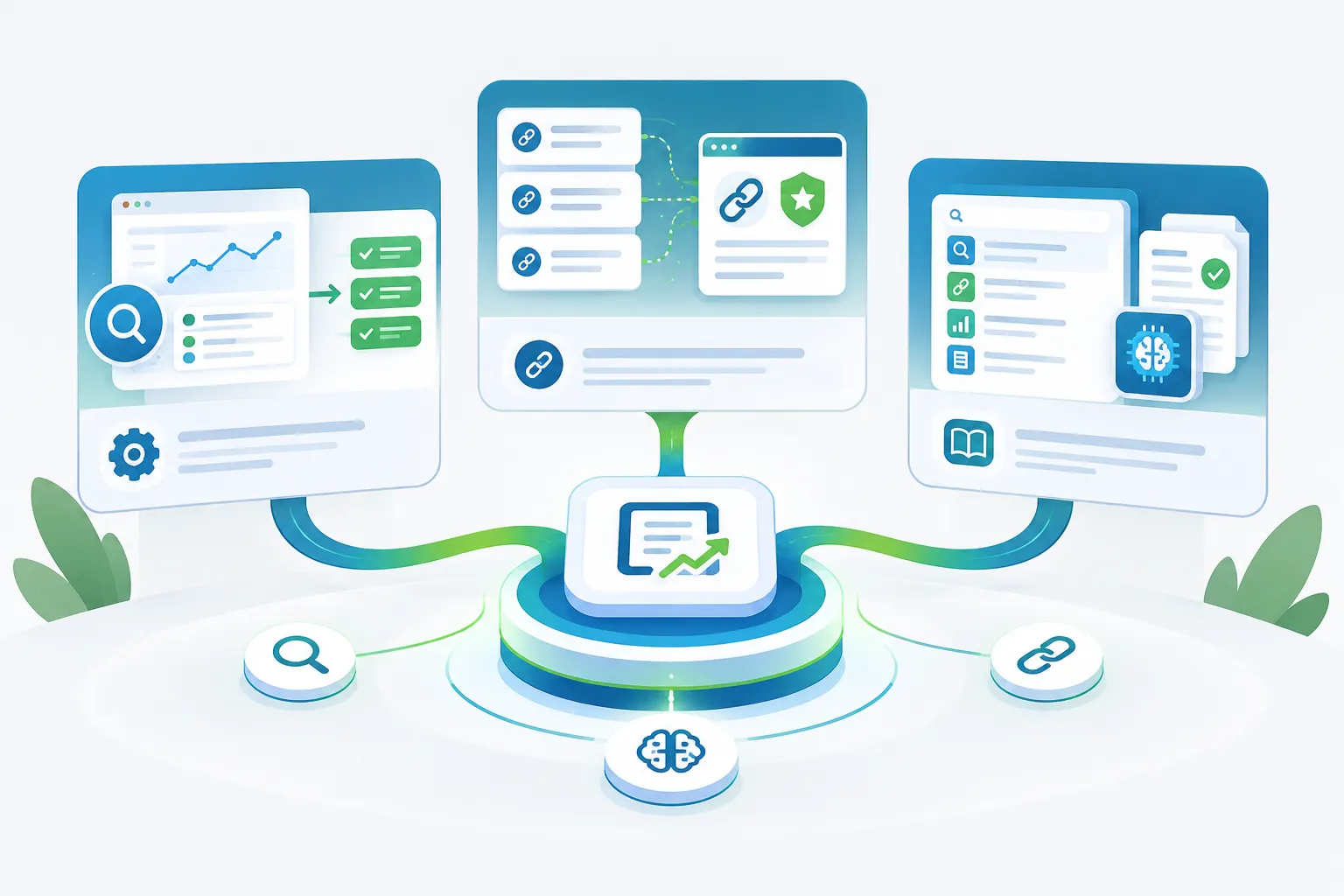
SEO software has become exceptionally good at telling businesses what is happening.
You can discover thousands of keywords, inspect backlinks, monitor rankings, audit technical issues, analyze competitors and watch search visibility change over time.
Yet there is a surprisingly simple question that many SEO dashboards cannot answer on their own:
What actually happens next?
A business can know that a page is losing clicks without fixing it. It can discover a content gap without filling it. It can receive a technical warning without assigning the repair. It can identify a promising keyword and then leave it sitting in a spreadsheet for three months.
This is where the distinction between SEO intelligence and SEO operations becomes important.
SEOKora is designed around that distinction.
Rather than positioning itself as another database that simply produces more SEO information, SEOKora is being developed as an SEO automation and operating layer intended to help move useful signals through prioritization, planning, execution, verification and continuous reassessment.
This article examines what that means, where established SEO platforms remain extremely valuable, and why businesses increasingly need to think about the journey from knowing to doing.
The Short Version: Research Tools and Operating Systems Solve Different Problems
There is an important misconception worth clearing up immediately.
SEOKora's argument is not:
“Traditional SEO tools are obsolete.”
That would be inaccurate.
Modern SEO platforms are extraordinarily capable. Semrush, for example, offers keyword and competitor research, backlink analysis, rank tracking, technical auditing, on-page analysis and content-related tools. Ahrefs provides competitor and demand research, keyword discovery, backlink intelligence, technical auditing, rank tracking, content research and visibility measurement across search and AI environments.
Google Search Console plays another essential role by providing first-party information about how a website performs in Google Search.
The more useful question is therefore:
Once these systems reveal an opportunity, what mechanism turns that opportunity into completed and verified work?
That is the operational problem SEOKora is designed to address.
The Difference Between SEO Intelligence and SEO Execution
Imagine opening an SEO platform on Monday morning.
You discover:
- 17 pages with technical issues;
- 42 potentially useful keyword opportunities;
- 8 pages that have lost organic visibility;
- 3 competitors covering topics your website does not;
- several pages with weak internal linking;
- and one commercially important page receiving impressions but fewer clicks than expected.
You now possess more information.
But your SEO has not improved yet.
No page has been repaired. No content has been improved. No internal link has been added. No useful new page has been published.
Information becomes SEO work only when something appropriate is actually done with it.
The Data-to-Execution Gap
This gap can be represented as a simple workflow.
| Stage | Question | Common Failure |
|---|---|---|
| Data | What is happening? | Too much information |
| Interpretation | Why does it matter? | No context |
| Priority | What matters most? | Everything appears urgent |
| Planning | What should happen? | Recommendation remains in a report |
| Execution | Who or what does the work? | Manual handoff breaks |
| Verification | Did it actually happen? | Attempt mistaken for completion |
| Learning | What changed afterward? | No feedback into the next decision |
A research platform can contribute heavily to several of these stages.
An SEO operating system attempts to connect the stages into one continuous process.
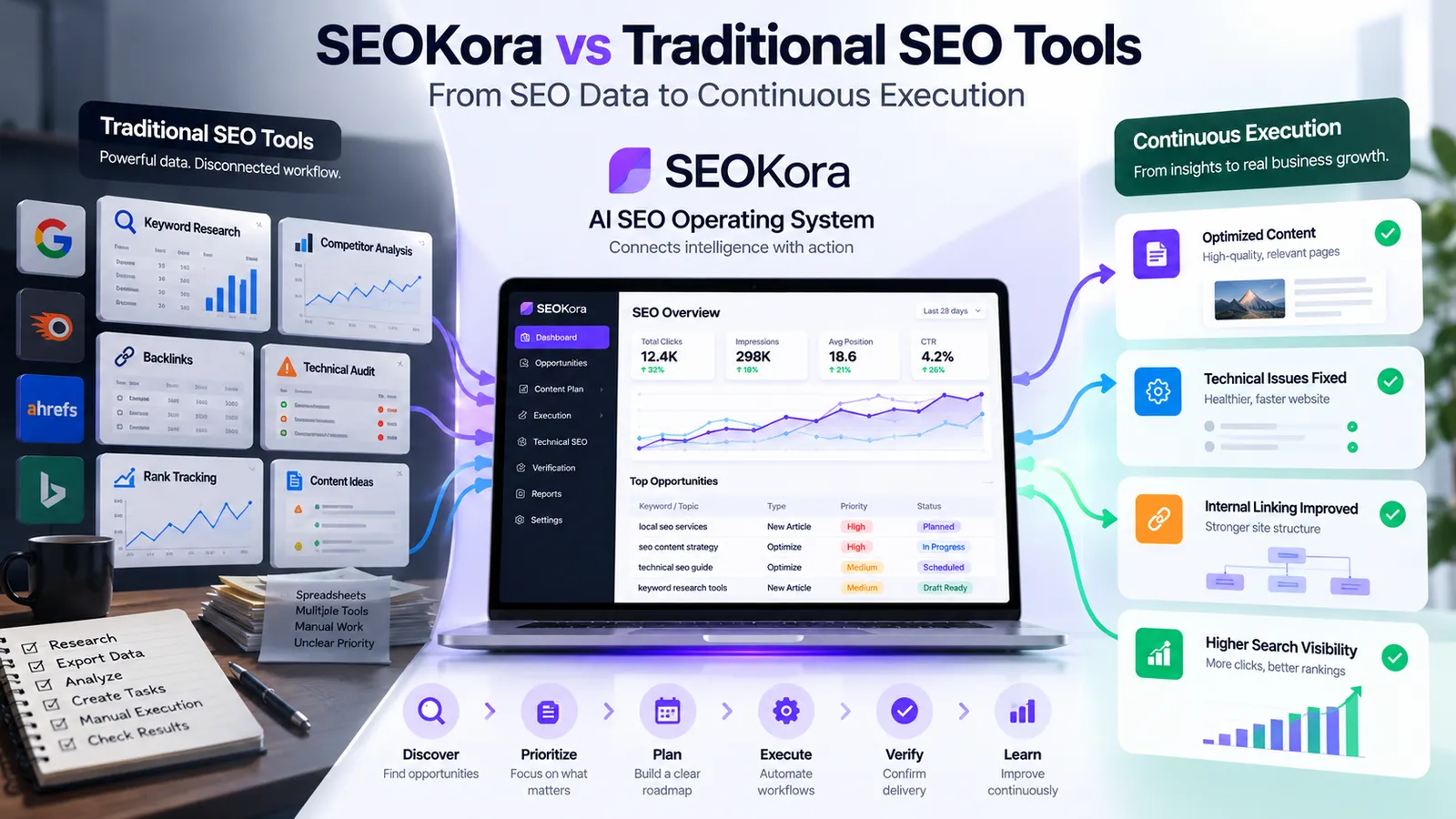
Traditional SEO Workflow vs Continuous SEO Execution
Consider two simplified models.
Workflow A: Tool-Centered SEO
Research → Export → Analyze → Create task → Assign person → Produce work → CMS → Publish → Remember to check later
Every arrow can become a handoff.
Every handoff can create delay.
Workflow B: Operating-System SEO
Discover → Understand → Prioritize → Plan → Execute → Verify → Learn → Repeat
The objective is not merely automation for automation's sake.
It is reducing unnecessary separation between discovering a problem and resolving the right problem.
A More Accurate Comparison
Comparisons between software platforms often become misleading because they force every product into a single winner-versus-loser table.
SEO software is more nuanced than that.
The following table compares the primary role different categories can play rather than pretending that their features never overlap.
| Capability | Search Console | Research Platforms | SEOKora Operating Model |
|---|---|---|---|
| Google Search performance | Core first-party source | May integrate or estimate related data | Can use performance evidence as an input |
| Keyword discovery | Queries already generating search visibility | Major strength | Useful as discovery input rather than final instruction |
| Competitor research | Not its primary purpose | Major strength | Used to inform opportunity decisions |
| Backlink intelligence | Limited compared with specialist databases | Major strength | Can inform authority-related workflows |
| Technical auditing | Google-specific indexing and experience information | Strong crawling and audit capabilities | Issues can become prioritized operational work |
| Content opportunities | Existing query evidence | Strong research capabilities | Evaluated against existing coverage and business context |
| Work planning | Not primary purpose | Varies by platform | Central operating concern |
| Automated execution | No | Varies substantially | Core operating-system objective |
| Delivery verification | Can later reveal crawl/index/search states | Varies | Explicit separation between attempted and verified work |
| Continuous operational loop | Provides recurring evidence | Provides recurring intelligence | Designed to connect evidence with recurring action |
The important phrase here is “varies by platform.”
Modern platforms increasingly overlap. Some research products now offer content creation, recommendations, integrations and workflow functionality.
So the meaningful difference is not whether a platform has an AI button.
It is how completely the platform connects evidence → decision → execution → verification → learning.
Where Semrush Fits
Semrush is a broad digital marketing and SEO platform.
Its SEO toolkit includes more than 20 tools and reports spanning areas such as keyword research, competitive research, backlink management, rank tracking, technical SEO auditing and on-page analysis.
For an SEO professional conducting deep market research, investigating competitors or building a keyword strategy, this breadth can be extremely useful.
SEOKora should therefore not pretend that research disappears.
Instead, its operating-system thesis asks:
How can useful research become coordinated work without requiring the business owner to manually operate every stage?
Where Ahrefs Fits
Ahrefs has similarly expanded far beyond a backlink checker.
Its current platform includes Site Explorer, Keywords Explorer, Rank Tracker, Site Audit, Content Explorer, AI-related visibility tools and content optimization capabilities.
That makes Ahrefs particularly valuable when detailed competitive and search intelligence is required.
Again, the operating question comes afterward:
Which findings should this specific business act on, in which order, through which workflow, and how will completion be verified?
Where Google Search Console Fits
Google Search Console occupies a special position because it provides information directly from Google Search about a verified website.
Google describes Search Console as the source of truth for Search performance, while Google Analytics is the source of truth for behavior occurring inside the website.
Search Console can reveal clicks, impressions, queries, pages and other search-performance dimensions.
That makes it invaluable evidence.
But evidence still requires interpretation.
A query receiving impressions is not automatically a keyword that deserves a new article.
A page losing clicks does not automatically need rewriting.
A change in average position does not, by itself, explain why performance changed.
The operating layer must consider context before converting a signal into work.
Why More Data Does Not Automatically Produce Better SEO
Suppose a business has access to 100,000 keywords.
Another business has only 500.
Which has the better SEO strategy?
There is not enough information to answer.
The first business may spend months chasing irrelevant opportunities. The second may understand exactly which searches matter to its customers.
This reveals an important principle:
The value of SEO data is not proportional to its volume. Its value depends on the quality of the decisions it enables.
This is especially important with AI because automation makes it possible to act on bad decisions much faster.
A human can manually write one irrelevant article.
A poorly controlled automation system can create fifty.
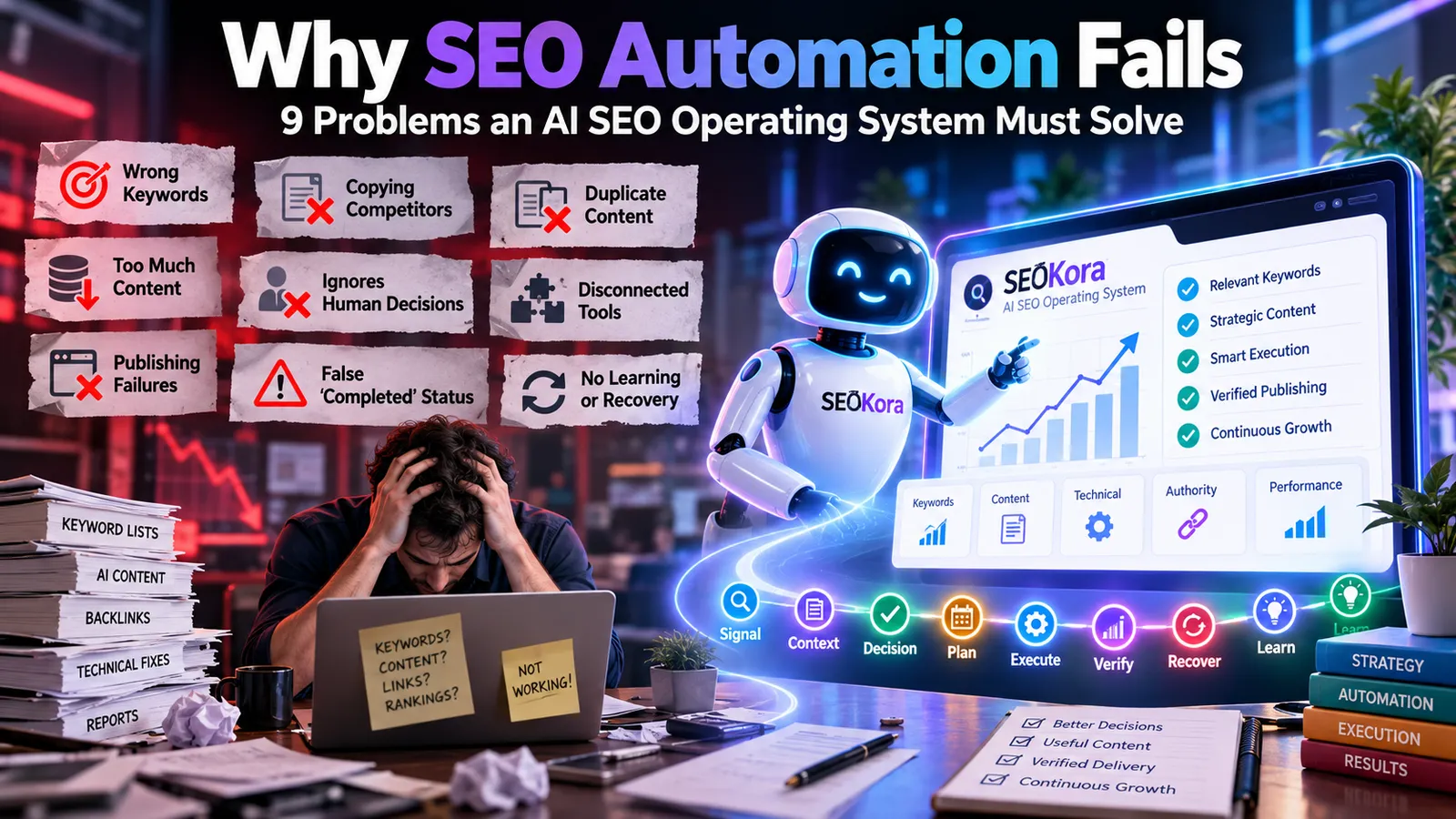
The Wrong Way to Automate SEO
A weak automated SEO system might behave like this:
| Signal | Naive Automation | Risk |
|---|---|---|
| New keyword found | Generate article | Irrelevant or duplicate content |
| Competitor ranks for topic | Copy topic immediately | No business relevance |
| Page loses position | Rewrite entire page | Destroys useful content unnecessarily |
| Technical warning | Apply automated change | Potential site damage |
| AI generated content | Mark task completed | Content may never reach the live site |
This is automation without sufficient judgment.
A Better Model: Automate the Workflow, Not the Thinking Away
A more responsible system asks additional questions before acting.
For a potential keyword opportunity:
- Is it relevant to the business?
- What is the likely search intent?
- Does an existing page already satisfy that intent?
- Would a new page create duplication?
- Does the opportunity have enough evidence to justify resources?
- Has a human previously rejected this topic?
- What type of action is appropriate?
- Does the action require approval?
Only then should execution become the focus.
This makes human judgment and automation complementary rather than adversarial.
Human Intervention Should Teach the System
A useful SEO operating system should not repeatedly ask the same question after a human has already answered it.
Imagine that an administrator rejects an irrelevant keyword.
If the system recommends the same keyword tomorrow, then again next week, the human is not supervising automation.
They are babysitting it.
A stronger operating model records meaningful interventions and uses them as future context.
This is particularly important for:
- irrelevant keywords;
- off-brand topics;
- duplicate content ideas;
- undesirable competitors;
- incorrect search intent;
- business-specific exclusions;
- previously rejected recommendations.
The objective is not autonomous decision-making at all costs.
The objective is less repetitive human work over time.
Planning Matters as Much as Generation
One of the easiest metrics for an AI SEO product to advertise is the number of articles it can generate.
But article volume is not a meaningful business outcome on its own.
Consider two systems.
| System A | System B |
|---|---|
| Generates 100 articles | Identifies 12 justified actions |
| No coverage analysis | Checks existing coverage first |
| No coordinated calendar | Plans work against available capacity |
| Publishes duplicates | Avoids unnecessary duplication |
| Reports generated count | Tracks delivered and verified work |
System A has the larger output number.
System B may have the better operating discipline.
Why Verification Changes the Meaning of “Done”
This is one of the most important concepts behind SEOKora.
Imagine an automation workflow generates a perfectly acceptable article.
It sends the article to a CMS.
The CMS request fails.
The workflow nevertheless records:
Article completed.
From the customer's perspective, that is wrong.
The customer does not receive value because an internal database contains a draft.
The expected value is delivered when the intended action reaches its proper destination.
Therefore:
Generated ≠ Published ≠ Verified.
| State | Meaning |
|---|---|
| Discovered | An opportunity exists |
| Planned | The system intends to address it |
| Generated | The required asset exists |
| Approved | Required quality/control gate passed |
| Scheduled | Execution has a planned time |
| Published | CMS accepted publication |
| Verified | The intended result has been confirmed |
| Recovery | Something failed and needs correction |
This provides a more honest definition of delivery.
What Continuous Execution Looks Like
Now imagine that the operating cycle continues every day.
Day 1: Search evidence identifies a commercially relevant page gaining impressions.
Day 2: The system determines that the existing page should be improved rather than creating another page.
Day 3: The improvement is prepared and passes the appropriate quality controls.
Day 4: The approved change is delivered and verified.
Later: New performance evidence is compared with the earlier baseline.
The system does not simply declare victory.
The evidence becomes input into the next decision.
This creates a loop:
Observe → Decide → Act → Verify → Measure → Reassess.
Why This Matters More for Small Businesses
A large organization may have:
- an SEO strategist;
- a technical SEO specialist;
- content strategists;
- writers;
- editors;
- developers;
- digital PR specialists;
- and analysts.
For them, the human organization itself acts as an operating layer.
A small business may have one owner and a freelancer.
Giving that owner another dashboard does not necessarily solve the problem.
They may need help deciding:
What matters? What can wait? What needs approval? What has already been handled? What failed? What is scheduled? What actually went live?
This is where workflow automation can become as important as raw research capability.
The Business Cost of Fragmented SEO
The cost of SEO software is not only its subscription price.
There is also an operational cost.
Consider a workflow involving:
SEO platform → spreadsheet → AI writer → project manager → editor → CMS → Search Console → reporting spreadsheet.
Every platform may perform its individual job well.
But somebody still has to coordinate the system.
This creates hidden costs:
- tool switching;
- manual exports;
- copying information between systems;
- duplicate work;
- lost recommendations;
- forgotten follow-ups;
- unclear ownership;
- and difficulty proving what was actually delivered.
SEO automation software becomes valuable when it reduces these coordination costs without sacrificing quality controls.
When a Traditional SEO Research Platform May Be the Better Choice
SEOKora should not be presented as the answer to every SEO use case.
If your primary requirement is deep manual investigation across enormous keyword or backlink databases, an established specialist research platform may be the appropriate tool.
The same applies when an experienced SEO analyst wants granular control over exploratory research.
Platforms such as Semrush and Ahrefs have spent years building large datasets and specialist research functionality.
A credible comparison should acknowledge that strength.
When an SEO Operating Layer Becomes Valuable
The operating-system approach becomes particularly relevant when the problem sounds more like this:
- “We already have SEO data but do not know what to do first.”
- “Recommendations keep sitting in reports.”
- “We do not have time to coordinate multiple tools every day.”
- “We need content and optimization work to follow one plan.”
- “We need human approvals only where they are genuinely necessary.”
- “We need to know what is planned, in progress, delivered or failed.”
- “We want completed work verified instead of simply counting generated assets.”
These are operational problems rather than database problems.
Can SEOKora and Traditional SEO Tools Work Together?
Yes—and this may be the most useful way to think about the market.
The future SEO stack does not necessarily require one product to replace every other product.
A specialist research platform can provide deep competitive intelligence.
Google Search Console can provide first-party Google Search evidence.
Analytics can reveal what visitors do after reaching the website.
An operating layer can help determine how selected signals become prioritized and completed work.
These roles can complement each other.
A Practical Decision Framework
| If Your Main Problem Is... | Capability to Prioritize |
|---|---|
| I need extensive keyword discovery | Specialist keyword research |
| I need deep backlink investigation | Large backlink intelligence database |
| I need competitor research | Competitive intelligence platform |
| I need first-party Google Search performance | Google Search Console |
| I know what is wrong but work is not getting done | Execution workflow |
| My team wastes time transferring work between tools | Workflow automation |
| I need to distinguish attempts from completed delivery | Verification layer |
| I need SEO work to continue without daily micromanagement | Continuous operating system |
What SEOKora Should Be Judged On
An SEO operating system should not be judged primarily by how impressive its dashboard looks or how many AI-generated recommendations it produces.
More meaningful questions are:
- Does it identify relevant opportunities?
- Does it suppress irrelevant noise?
- Does it avoid repeating rejected ideas?
- Does it prioritize work intelligently?
- Does it distinguish new content from improvements to existing content?
- Can humans intervene where necessary?
- Does execution survive failures safely?
- Can the customer see what is happening?
- Does it verify delivery?
- Does new evidence influence future decisions?
Those questions evaluate the operating system rather than its marketing language.
No SEO Tool Controls Google
This point deserves to be explicit.
Google states that third-party SEO tools do not have access to Google's internal ranking data and cannot guarantee search performance.
That applies to SEO automation platforms as well.
SEOKora cannot control Google's algorithms, force indexing or guarantee a particular ranking.
Its value proposition should therefore be measured differently:
Can it make the business's own SEO process more evidence-driven, coordinated, efficient, accountable and continuous?
That is a claim that can be tested against the workflow itself.
From SEO Software to SEO Operations
The first generation of SEO software helped us see the web.
Modern research platforms helped us analyze it at extraordinary scale.
AI now makes it possible to analyze, create and automate much faster.
But speed creates a new problem.
What happens when execution becomes faster than judgment?
The answer cannot simply be more automation.
It has to be better-controlled automation.
That means understanding context before acting, prioritizing before generating, preserving meaningful human decisions, verifying execution and learning from subsequent evidence.
This is the operating-system idea behind SEOKora.
Traditional SEO software helps you understand what could be done. An SEO operating system is designed to help useful work move from evidence to verified execution—and then begin the cycle again.
Frequently Asked Questions
What is SEO automation software?
SEO automation software uses software workflows and, increasingly, AI to reduce repetitive work involved in SEO. Depending on the platform, this can include data collection, analysis, monitoring, prioritization, content workflows, technical checks, reporting or execution. Automation does not remove the need for strategy and quality control.
How is SEOKora different from a traditional SEO tool?
SEOKora is designed around an operating workflow connecting discovery, prioritization, planning, execution and verification. Traditional SEO platforms often have particularly strong research and intelligence capabilities, although modern platforms increasingly include workflow and AI features as well. The distinction is therefore about the emphasis and completeness of the operational loop rather than a claim that other platforms only display data.
Does SEOKora replace Semrush?
Not necessarily. Semrush provides extensive research capabilities across keywords, competitors, backlinks, rankings, technical SEO and content. A business requiring those specialist datasets may continue to use them. SEOKora's operating model addresses how selected intelligence becomes prioritized and executed work.
Does SEOKora replace Ahrefs?
Not necessarily. Ahrefs provides extensive search, competitor, backlink, content and technical research capabilities. Depending on the organization's requirements, an operating platform and specialist research tools can complement one another.
Does SEOKora replace Google Search Console?
No. Google Search Console provides first-party Google Search performance information and remains an important source of evidence. An operating system can use such evidence to support decisions but should not pretend to replace its source.
Can SEO automation guarantee rankings?
No. Third-party SEO software does not control search-engine ranking systems. Automation can improve the consistency and efficiency of SEO operations, but it cannot guarantee a specific organic ranking.
Can SEOKora automatically create SEO content?
Content generation can be part of an automated workflow, but generation should follow opportunity analysis rather than become the strategy itself. In some situations, improving an existing page or taking another SEO action may be more appropriate than creating a new article.
Why does verified delivery matter?
Because generating an asset or attempting a CMS action does not prove that the intended result is live. Separating generated, published and verified states creates clearer accountability for what was actually delivered.
Is SEO automation suitable for small businesses?
It can be particularly useful when a small business lacks the staff required to repeatedly analyze data, transfer tasks between tools, manage production and monitor delivery. The benefit depends on whether the automation reduces real operational work while maintaining appropriate controls.
Conclusion
The SEO industry does not need less data.
It needs better connections between data and action.
Semrush, Ahrefs, Google Search Console and other established platforms can provide enormously valuable intelligence. The operational challenge begins when the report ends.
SEOKora approaches that challenge by treating SEO as a continuous operating cycle:
Discover → Understand → Prioritize → Plan → Execute → Verify → Learn.
The goal is not to automate everything.
The goal is to automate the right parts of SEO while preserving context, control and accountability where they matter.
For businesses overwhelmed by dashboards but underserved by execution, that distinction may be more important than adding another thousand keywords to a report.