Where Autonomous Seo Platform Meets Real Constraints
Autonomous Seo Platform — practical guidance for Businesses in B2B software, from SEOKora.
What an autonomous SEO platform means when work has to ship
An autonomous SEO platform is not just a dashboard that suggests keywords or writes draft content. In practical terms, it should help a business move from search intelligence to action: finding ranking opportunities, understanding competitors, spotting authority or site issues, improving content, and keeping enough human control in the loop to avoid publishing or technical changes blindly.
That distinction matters because most businesses are not short on SEO data. They are short on finished, correctly prioritized work. A content marketer may have keyword exports, Search Console reports, backlink lists, and site audit warnings, yet still be unsure what should happen first. An agency may know exactly what needs to change but lose time handing work between analysts, writers, editors, developers, and account managers. A SaaS team may have technical issues, content decay, and product-page opportunities competing for the same limited attention.
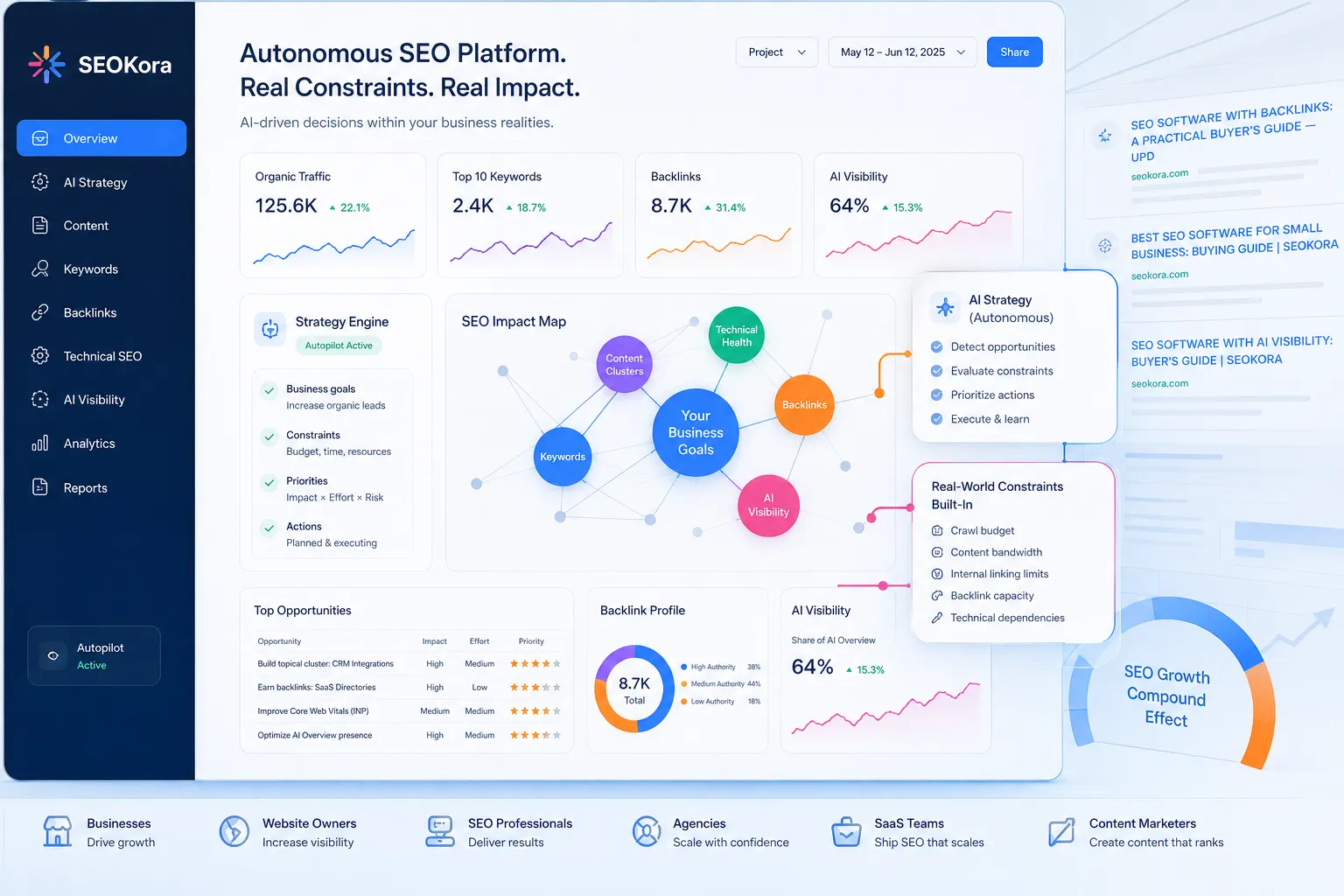
SEOKora approaches this space as an SEO growth software platform: the useful center is not automation for its own sake, but turning search intelligence into growth through ranking opportunities, competitive intelligence, authority insights, site optimization, and content optimization. That is the standard a buyer should use when evaluating any autonomous SEO platform: does it shorten the path from evidence to improvement, or does it simply create another place to look?
For example, if a page has slipped from a strong position into the middle of page one, a weak automation workflow might only flag the drop. A stronger autonomous workflow would connect the drop to likely causes: competitors expanded the topic, internal links weakened, search intent shifted, or the page no longer answers related questions. The platform does not have to pretend that SEO is fully push-button. It does need to make the next action clearer and faster.
The best automated SEO tools reduce handoffs, not just manual clicks
The phrase “best automated SEO tools” often leads buyers toward feature checklists: keyword clustering, content briefs, technical audits, rank tracking, internal linking, backlink prospecting, or AI writing. Those features can help, but they do not automatically create a better SEO workflow. The real test is whether the tool removes unnecessary handoffs between discovery, decision, production, implementation, and measurement.
For agencies, this is especially visible. A tool that generates content recommendations but cannot connect them to client reporting may save a strategist 20 minutes and create an hour of explanation later. A crawler that finds thousands of issues but cannot separate urgent problems from harmless noise may make the account team look busy without improving organic performance. A content tool that creates drafts without search context can increase publishing volume while weakening topical focus.
A practical evaluation starts with the workflow you already run:
- Discovery: Can the tool reveal ranking opportunities, content gaps, competitive movement, technical issues, and authority signals in one usable view?
- Prioritization: Does it help distinguish high-impact work from low-value tasks?
- Production: Can it support briefs, optimization, internal linking, or updates without removing editorial judgment?
- Implementation: Does it clarify what needs to be changed on the page or site?
- Measurement: Can it connect the change back to rankings, visibility, traffic signals, or follow-up actions?
SEOKora’s resource library includes related guidance for this decision stage, including Automatic Website Optimization: A Practical Framework (opens in new tab), AI Tools for SEO Automation: A Practical Guide (opens in new tab), and Search Console Automation: From Data to SEO Action (opens in new tab). Those guides are useful because automation is only valuable when it lands inside a working SEO system.
Why automated SEO split into point tools and orchestration platforms
The automated SEO category has split into two broad groups. The first group is point automation: tools that automate one task well. Examples include a technical crawler, a content optimizer, a rank tracker, a backlink prospecting tool, or a reporting connector. The second group is orchestration: platforms that try to coordinate several parts of the SEO delivery loop so the user can move from signal to action without stitching together every step manually.
Neither category is automatically better. Point tools can be excellent when a business has a mature process and specialists who know exactly how to interpret outputs. A technical SEO consultant may prefer a powerful crawler because the value comes from expert diagnosis. A content team with a strong editorial operation may only need help identifying queries and improving page structure.
Orchestration platforms become more attractive when coordination is the bottleneck. If your team repeatedly asks “what should we do next?” after every audit, keyword report, or content review, a platform that connects ranking opportunities, competitive intelligence, authority insights, site optimization, and content work may be more useful than another isolated tool.
This split also explains why buyers sometimes feel disappointed by “AI SEO” claims. A tool can use AI and still be narrow. It might draft paragraphs, classify keywords, or summarize a report, but that does not make it autonomous in the operational sense. SEOKora’s AI That Does SEO: Capabilities, Limits and Checklist (opens in new tab) and AI That Manages SEO: Features and Evaluation Guide (opens in new tab) are useful references for separating AI features from actual SEO management.
A delivery-loop rubric for judging an autonomous SEO platform
A clean way to evaluate an autonomous SEO platform is to score it against the SEO delivery loop. This avoids getting distracted by isolated features and keeps the decision tied to business outcomes: better rankings, stronger search visibility, more useful content, and less wasted effort.
| Delivery-loop stage | What to look for | Weak signal |
|---|---|---|
| Find | The platform identifies ranking opportunities, competitor movement, content gaps, technical issues, and authority signals. | It produces broad reports but leaves the user to find the actual opportunity. |
| Prioritize | It helps separate urgent, high-impact work from nice-to-have tasks. | Every recommendation appears equally important. |
| Plan | It turns findings into briefs, optimization instructions, or implementation-ready tasks. | The team has to rewrite raw tool output before anyone can act. |
| Execute | It supports content optimization, site optimization, or authority workflows with clear controls. | It encourages automatic changes without enough review or context. |
| Measure | It connects completed work to visibility, ranking, and follow-up signals. | Reports are disconnected from the changes that were made. |
| Learn | It makes the next cycle smarter by showing which actions worked and which need revision. | The workflow resets from scratch every month. |
This rubric is deliberately practical. It does not ask whether a platform sounds autonomous; it asks whether the platform reduces the distance between an SEO signal and a completed improvement. That is where many businesses feel the real constraint.
Six tool types scored against the delivery loop
Because specific product claims require direct verification, it is more useful here to compare common tool types rather than pretend to rank vendors without a controlled evaluation. These six categories show where different SEO automation tools usually help and where they often leave gaps.
| Tool type | Strongest delivery-loop fit | Where it usually needs support |
|---|---|---|
| Rank tracking and visibility tools | Find and measure. They show ranking movement and visibility changes. | They may not explain what action should happen next. |
| Technical SEO crawlers | Find and diagnose. They surface site issues at scale. | They can overwhelm teams if prioritization is weak. |
| Content optimization tools | Plan and execute. They help improve page relevance, structure, and topical coverage. | They can overfit to surface-level term usage if editorial judgment is absent. |
| AI writing assistants | Production support. They can accelerate drafts, outlines, summaries, and revisions. | They do not replace search strategy, factual review, brand judgment, or expertise. |
| Backlink and authority tools | Find and plan. They support prospecting, competitor authority analysis, and link opportunity review. | They still require quality control, outreach judgment, and risk awareness. |
| SEO orchestration platforms | Prioritize, coordinate, and learn. They connect multiple signals into a more complete workflow. | They still need clear business goals, human approval points, and accurate site context. |
SEOKora’s positioning belongs in the orchestration conversation because its stated role is to turn search intelligence into growth through opportunities, competitive intelligence, authority insights, site optimization, and content optimization. That does not mean every business should replace every specialist tool immediately. It means the buyer should ask which part of the loop is currently broken.
If your bottleneck is deep technical diagnosis, a specialized crawler may remain essential. If your bottleneck is turning a mix of rankings, competitors, content decay, and authority signals into clear action, an SEO growth platform may solve a more expensive problem.
Where AEO changes the tool selection math
Answer engine optimization changes the buying question because search visibility is no longer limited to blue-link rankings. Businesses increasingly care about whether their content can be understood, selected, summarized, and trusted across AI-influenced search experiences. The verified sources here do not support a universal formula for AEO success, so the practical point is narrower: choose tools that help clarify topical authority, content quality, entity coverage, and visibility beyond a single rank-tracking view.
A platform built only around classic keyword positions may still be useful, but it can miss important signals. A buyer evaluating SEO software with AI visibility should ask whether the platform helps answer questions such as:
- Which topics does the site already explain well, and where is coverage thin?
- Do important pages answer the real follow-up questions a searcher or AI system would need resolved?
- Are competitors covering the topic with clearer structure, stronger examples, or better supporting pages?
- Are content updates connected to measurable visibility signals after publication?
SEOKora has a dedicated guide on this buying question, SEO Software With AI Visibility: Buyer’s Guide (opens in new tab). The most important takeaway for autonomous SEO platform evaluation is simple: AEO makes isolated keyword automation less sufficient. The tool needs to help improve the substance, structure, and discoverability of the content system.
Coordination overhead is where agency margin actually breaks
For agencies and SEO service teams, the cost of SEO work is not only the time spent doing analysis or writing recommendations. It is the coordination around that work: preparing client-facing explanations, translating technical findings for non-technical stakeholders, chasing approvals, briefing writers, checking implementation, and reporting on results later.
This is why an autonomous SEO platform should be judged by operational clarity, not just feature quantity. A platform that produces more recommendations than the team can explain may increase overhead. A platform that creates clear, prioritized work can protect time, improve client communication, and reduce the risk of important fixes sitting untouched.
Consider a common agency constraint: a client has limited developer availability, a content calendar already in motion, and a drop in visibility on commercial pages. A generic audit might generate hundreds of issues. A better workflow would identify whether the highest-leverage move is updating decayed pages, strengthening internal links, improving technical accessibility, expanding topic coverage, or addressing authority gaps. The value is not that the software “does SEO” with no human involvement. The value is that strategists spend less time assembling the puzzle and more time making the right call.
This is also where human roles remain important. An AI SEO specialist (opens in new tab) or experienced SEO lead still needs to review recommendations, understand brand constraints, and decide what should be published or implemented. Autonomy should reduce repetitive coordination; it should not remove accountability.
What autonomous SEO still should not do unchecked
The more a platform can automate, the more carefully a business should define approval points. Automatic publishing, automatic internal linking, automatic technical changes, and automatic outreach all carry risks if they operate without context.
Content optimization can become mechanical if the platform encourages term stuffing or generic rewrites. Technical recommendations can cause trouble if a tool treats every crawl warning as equal. Backlink automation can damage quality if prospects are evaluated only by surface metrics rather than relevance and legitimacy. SEOKora’s AI Backlink Automation: From Link Prospects to Real Authority (opens in new tab) is relevant here because authority work needs judgment, not just scale.
The safer model is supervised autonomy. Let the platform gather signals, cluster opportunities, draft briefs, recommend updates, and connect performance data. Keep human review over brand-sensitive content, technical changes, external outreach, and anything that could affect trust. If a vendor presents autonomy as a reason to stop thinking, that is a warning sign rather than a benefit.
What separates a point automation tool from an orchestration platform?
A point automation tool improves one task, such as crawling, rank tracking, content scoring, or brief generation. An orchestration platform connects several tasks into a workflow so the team can move from search signal to prioritized action, execution, measurement, and the next improvement cycle.
Do businesses still need specialist SEO tools if they adopt an orchestration platform?
Often, yes. If a team relies on deep technical crawling, advanced backlink research, or specialized reporting, those tools may still have a role. The better question is whether the orchestration platform reduces the manual stitching between those tools and the work that actually ships.
How should a business get started without over-automating?
Start with one constrained workflow: content refreshes, Search Console opportunity review, internal linking, technical issue prioritization, or authority prospect review. Define what the platform can recommend, what it can draft, and what still requires human approval before changes go live.
Your next move with SEOKora
If you are evaluating an autonomous SEO platform, map your current workflow before comparing feature lists. Identify where work slows down: finding opportunities, prioritizing them, creating briefs, implementing changes, measuring outcomes, or coordinating across people. Then judge each platform against that bottleneck.
SEOKora is built for businesses that want search intelligence to become growth work, not another report queue. For deeper strategy and decision frameworks, browse the SEOKora resources library (opens in new tab). If you are ready to see how SEO automation, content optimization, and search growth can fit together in one workflow, visit SEOKora (opens in new tab).