
A Straight Walk Through Geo Software
A practical guide to geo software for SEO, AI search visibility, content optimization, and -style search growth workflows.
What geo software means in SEO work
Geo software, in the SEO and AI search context, is software that helps a business understand and improve how it appears in search results and AI-generated answers. It is not just a reporting dashboard and it is not a magic publishing machine. Used well, it connects search intelligence, content gaps, authority signals, site issues, and performance data so you can decide what to create, update, fix, or measure next.
The term can be confusing because “GEO” can also refer to geography or location-based software. For SEOKora’s audience, the useful meaning is closer to generative engine optimization: how your brand, pages, topics, and evidence show up when search behavior moves beyond a list of blue links into AI summaries, assistants, and answer-style discovery. Traditional SEO still matters here. Pages need to be crawlable, useful, authoritative, and aligned with real queries. GEO adds another layer: whether your content is clear enough, structured enough, and credible enough to be understood and referenced by answer engines.
SEOKora is an SEO growth software platform built around turning search intelligence into growth with ranking opportunities, competitive intelligence, authority insights, site optimization, content automation, and performance reporting. That matters because geo software only becomes useful when it helps you make a better decision, not when it produces another isolated score.
Where geo software fits inside an SEO growth platform
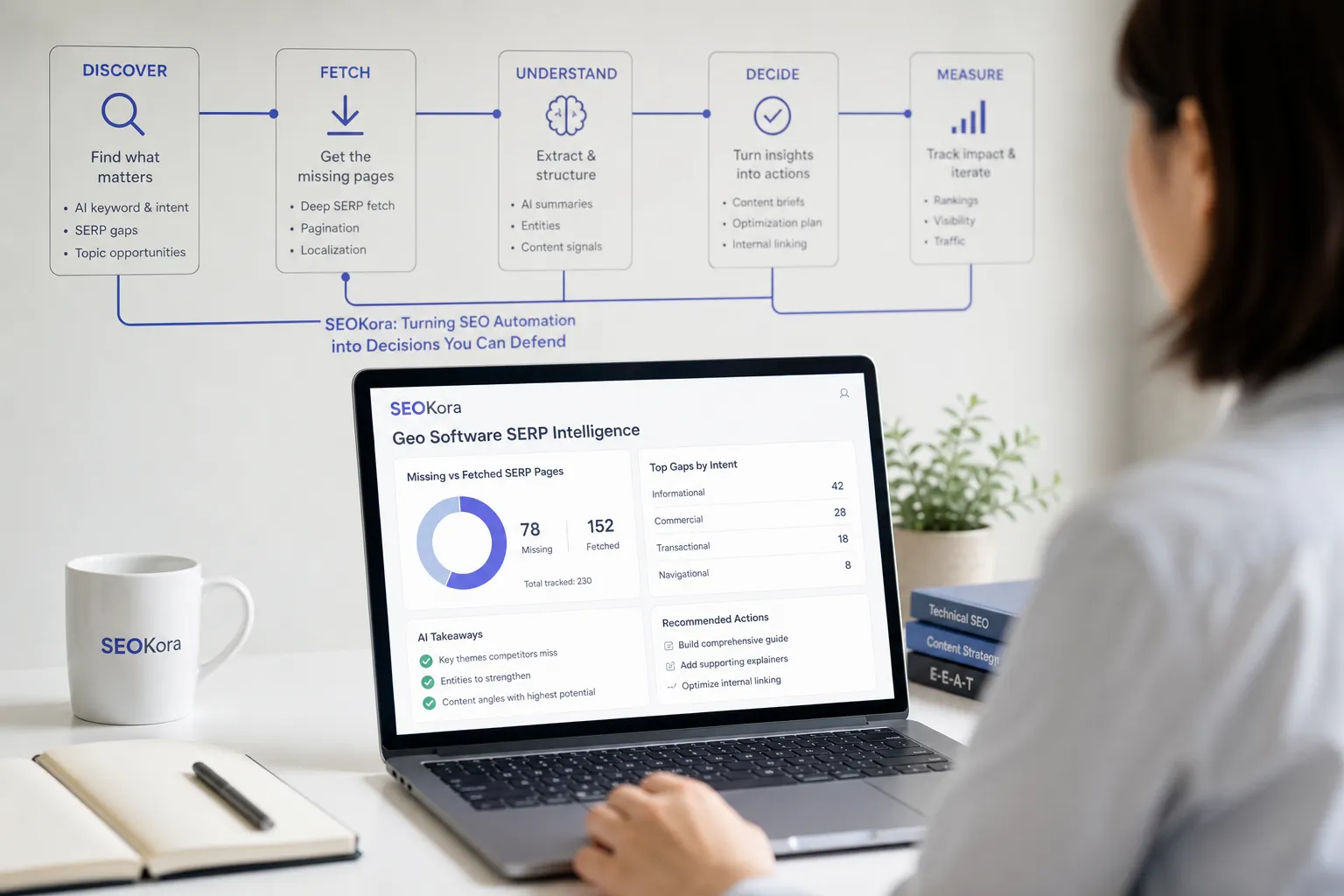
A practical geo workflow starts with a simple question: what should we improve so search engines and AI answer systems can understand, trust, and surface our expertise? That question cuts across several parts of organic growth.
- Search intelligence: identifying topics, questions, and pages where demand exists but your current coverage is weak or unclear.
- Content optimization: improving pages so they answer the query directly, cover the necessary subtopics, and avoid vague claims.
- Competitive context: seeing what visible pages are doing well without copying their structure blindly.
- Authority signals: understanding whether your site has enough credible support around a topic to deserve visibility.
- Performance reporting: checking whether changes are reflected in rankings, impressions, clicks, and discoverability over time.
SEOKora’s broader resource library on strategy, systems, and decision frameworks (opens in new tab) is useful here because the real work is not “do GEO” as a separate campaign. The work is building a search system that can produce defensible decisions across SEO, content marketing, and organic growth.
How small businesses should approach geo software without overbuilding
Small businesses often feel the pressure first because they do not have room for sprawling workflows. They may hear that AI search is changing discovery, then assume they need a separate GEO stack, a new publishing cadence, and a specialist for every channel. That is usually too much too soon.
A better starting point is to use geo software as a prioritization layer. Pick the topics that already matter commercially, inspect how well your current pages answer those topics, and decide which few updates would make the pages more useful. If a service page explains what you sell but never answers common buyer questions, the first improvement is not an advanced AI visibility tactic. It is clearer content. If a blog post gets impressions but weak engagement, the issue may be intent mismatch or shallow coverage. If a topic has several disconnected articles, the work may be to build a stronger hub and supporting content map.
For a small business, automation helps when it reduces repetitive work: gathering opportunities, surfacing gaps, clustering related topics, drafting content briefs, or turning Search Console data into action. It becomes risky when it skips judgment. SEOKora’s guide to automated SEO for small business (opens in new tab) is relevant because small teams need leverage, but they also need to know what the software is deciding and what still needs human review.
Think of the first geo software workflow as a short loop: find the opportunity, inspect the current page, improve the answer, strengthen supporting content, then measure what changed. That loop is enough to start learning without building a complicated system before you have evidence.
Why it matters for content optimization and AI search visibility
Geo software matters because search visibility is no longer only about where a URL ranks for one query. The common requirement across those surfaces is clarity. Search systems need to understand what your page is about, who it helps, what evidence it provides, and how it connects to the rest of your site.
That changes the content optimization job. A page that repeats a keyword but fails to answer the practical question is weak. A page that gives a definition but no decision guidance is incomplete. A page that makes broad claims without specific support may be hard for a reader, or an answer engine, to trust.
For example, a SaaS company might have a page targeting “content optimization software.” The page lists features, but it does not explain how a content marketer should decide which page to update first, how to handle overlapping articles, or how to connect optimization work to performance reporting. Geo software should help expose that gap. The correction is not to add more keyword variants. The correction is to make the page more useful: define the problem, show the workflow, answer the buyer’s adjacent questions, and connect the topic to credible supporting pages.
This is also where AI-assisted SEO needs boundaries. SEOKora’s article on AI that does SEO (opens in new tab) discusses the difference between what AI can automate and what still needs oversight. In a geo software workflow, that distinction is central. Software can surface patterns, draft outlines, and organize evidence. It cannot automatically know your positioning, your sales context, or which claims your business can honestly support unless those inputs are clear.
Practical examples of geo software decisions
The most useful way to understand geo software is to look at the decisions it should improve.
Updating a page that ranks but does not satisfy the query
Say a page has search visibility for a broad SEO software term, but the content mostly describes features. Readers arriving from informational searches may want to understand categories, workflows, tradeoffs, and mistakes before they are ready to evaluate a tool. A geo software workflow would flag the mismatch between ranking opportunity and page usefulness. The practical update would be to add a clearer definition, explain when the software helps, show a simple workflow, and answer the questions that appear before purchase intent.
Turning Search Console signals into content action
If Search Console data shows impressions rising for questions your page only touches lightly, the answer is not always to create a new article. Sometimes the better move is to expand the existing page with a focused section. Sometimes it is to create supporting content and link it back to the main hub. SEOKora’s resource on Search Console automation (opens in new tab) is relevant because the value is not the data itself; the value is translating that data into a specific SEO action.
Building topical support instead of isolated articles
A business may publish one strong article about AI SEO, but if the surrounding site has no related material on automation, authority, content briefs, technical fixes, or performance measurement, the topic can feel thin. Geo software should help identify where a hub needs support. A practical content map connects the main page to narrower pages that answer real subquestions. SEOKora’s guide to supporting content maps for SEO hubs (opens in new tab) speaks to that kind of structure.
Separating authority evidence from wishful thinking
If a competitor earns visibility because they are cited, linked, or consistently associated with a topic, copying their headings will not recreate that authority. The useful decision is to strengthen the evidence around your own pages: better internal links, clearer expertise, stronger supporting resources, and legitimate authority-building work. SEOKora’s article on AI backlink automation (opens in new tab) frames competitor backlink data as evidence, not entitlement, which is the right mindset for geo software as well.
Common mistakes that make geo software less useful
The first mistake is treating geo software as a synonym for AI content generation. More output does not automatically improve visibility. If the content is generic, repetitive, or disconnected from search demand, it can create more cleanup work than growth.
The second mistake is measuring only mentions in AI answers. Brand visibility in AI surfaces is interesting, but it does not tell the whole story. You still need to know whether your pages are technically accessible, whether your content satisfies intent, whether you have supporting authority, and whether performance is improving in search data you can inspect.
The third mistake is copying visible pages without understanding why they perform. A competitor’s structure may reflect their brand, authority, product category, or historical content depth. If you copy the surface pattern, you may inherit the shape without the substance. Use competitive intelligence to ask better questions, not to remove judgment.
The fourth mistake is asking AI for SEO advice without narrowing the job. General recommendations often sound plausible but miss the actual constraint: the page type, the query intent, the strength of the domain, the buyer stage, or the available evidence. SEOKora’s article on AI SEO specialist advice (opens in new tab) is useful here because it shows where generic guidance stops matching the work.
The correction is straightforward: define the decision before using the tool. Are you choosing a topic, updating a page, building a hub, diagnosing performance, or evaluating authority? Geo software becomes sharper when the question is specific.
Where geo software still needs human judgment
Geo software can organize evidence, identify gaps, and speed up analysis, but it cannot remove every uncertain part of SEO. AI search systems change, search results vary, and no software can promise that a page will be cited or surfaced in every answer experience. Treat any visibility signal as directional rather than absolute.
Human judgment is also needed for claims. If a page says your product solves a problem, that claim must be true and supportable. Invented evidence can damage trust with readers even if it looks optimized on the page.
There is also a strategic limit. Software may show that a topic has opportunity, but your business still has to decide whether that topic fits your positioning. Not every searchable question deserves a page. Some topics attract the wrong audience. Some require expertise you cannot credibly provide.
The best use of geo software is not to automate taste, strategy, or accountability. It is to make the evidence easier to see so the human decision is better grounded.
What does geo software mean for businesses?
For businesses working on organic growth, geo software means tools and workflows that help improve visibility in search and AI-generated answer environments. It should connect topic research, content quality, authority signals, site health, and performance measurement rather than focusing on one isolated metric.
How should a business get started?
Start with one important topic or page, not a full-site overhaul. Check whether the page answers the query clearly, whether supporting content exists, whether performance data shows opportunity, and whether the next improvement is content, structure, authority, or technical cleanup.
Can AI fully replace a human SEO specialist?
AI can assist with research, briefs, pattern detection, and repetitive analysis, but it should not fully replace SEO judgment. Someone still has to validate the strategy, protect claim accuracy, understand the business context, and decide which recommendations are worth acting on.
How is an AI SEO specialist different from a content marketer?
An AI SEO specialist focuses on search systems, automation, technical signals, content opportunities, and performance interpretation. A content marketer usually focuses more heavily on audience messaging, editorial quality, campaigns, and brand communication. In practice, strong organic growth often needs both skill sets to overlap.
Your next move with SEOKora
If you are evaluating geo software, do not start by asking which tool has the longest feature list. Start by choosing the decision you need to improve: which page to update, which topic to cover, which hub to strengthen, which authority signal to investigate, or which performance change to explain.
Then look for software that helps you move from evidence to action. SEOKora’s role in that workflow is to support SEO growth through search intelligence, ranking opportunities, competitive intelligence, authority insights, site optimization, content automation, and performance reporting. That combination matters because GEO and SEO decisions rarely live in one dataset.
To keep moving, review SEOKora’s resources on strategy, systems, and decision frameworks (opens in new tab), or visit SEOKora (opens in new tab) to see how an SEO growth platform can help turn search intelligence into a clearer organic growth workflow.