Side-by-Side Criteria for Judging Search Growth vs Alternatives
Compare search growth software, SEO automation, content tools and point solutions with practical criteria for choosing the right path.

What you are really comparing when you judge search growth options
Judging search growth vs alternatives means deciding whether you need a connected system for finding opportunities, improving content, understanding competitors and acting on search data, or whether a narrower tool or manual workflow is enough. For a business, agency, SaaS team or content marketer, the useful question is not “Which SEO tool has the longest feature list?” It is “Which option helps us make better search decisions and ship the right work with less waste?”
The alternatives are still real choices. A small site may start with Google Search Console and manual analysis. An agency may combine several specialist tools because each client has different needs. A SaaS team may already have content operations in place and need better prioritization rather than another dashboard.
The side-by-side criteria that matter most
Many tools can surface keywords, charts and recommendations. Fewer help you decide what to publish, what to improve, what to ignore and where competitors are actually winning in search.
1. Decision quality
Ask whether the option helps you defend decisions. A useful search growth platform should connect signals: rankings, organic demand, competitor visibility, authority and page quality. A narrow alternative may answer one question well, such as “Where do we rank?” but leave the next question unanswered: “What should we do about it?”
3. Context, not just automation
Automation is useful when it removes repetitive analysis or exposes patterns faster. It is risky when it turns into unreviewed strategy. A tool that generates recommendations without context can push teams toward shallow content updates, irrelevant pages or keyword targets that do not match the business. For a deeper discussion of this trade-off, SEOKora’s guide to an organic search platform (opens in new tab) frames the decision around context rather than tool volume.
4. Breadth versus depth
Point tools can be excellent when you already know the job: audit technical issues, check rankings, research content gaps or monitor competitors. A search growth platform is more compelling when the problem is broader: deciding which pages deserve attention, which topics are worth pursuing, and how content, authority and site signals interact.
5. Evidence you can inspect
Businesses should avoid tools that turn SEO into unexplained scores. A score can be helpful as a signal, but the team still needs to see the underlying reason. If a recommendation says a page needs improvement, the buyer should ask: based on what query, competitor, page pattern or content gap?
How an organic search platform changes the decision
An organic search platform is not just a place to store SEO data. In practice, it should help a team move from observation to prioritization. That matters because most organic search backlogs are noisy: refresh these pages, build these links, fix these titles, write these articles, improve these clusters, watch these competitors. Without context, the backlog becomes a list of plausible tasks rather than a growth plan.
SEOKora’s own resource coverage reflects this distinction. The site has dedicated guidance on SEO tools for organic growth (opens in new tab), Google Search Console automation (opens in new tab) and SEO competitor analysis (opens in new tab). Those are not interchangeable topics. They represent different layers of the same decision: where demand exists, what the site can improve, and which competitors matter in the search results.
Consider a page that gets impressions but few clicks. A basic workflow may stop at “rewrite the title.” That might be correct, but it might also miss the real issue: the query intent may not match the page, the competing result may be more authoritative, or the content may answer only part of the searcher’s problem. A stronger search growth workflow asks what changed the decision, not just what metric moved.
What SEO tools for organic growth actually do well
The best alternative to a search growth platform is not always another all-in-one platform. Sometimes it is a sharper stack of tools, each doing one job well. The buyer should compare options by the work they improve.
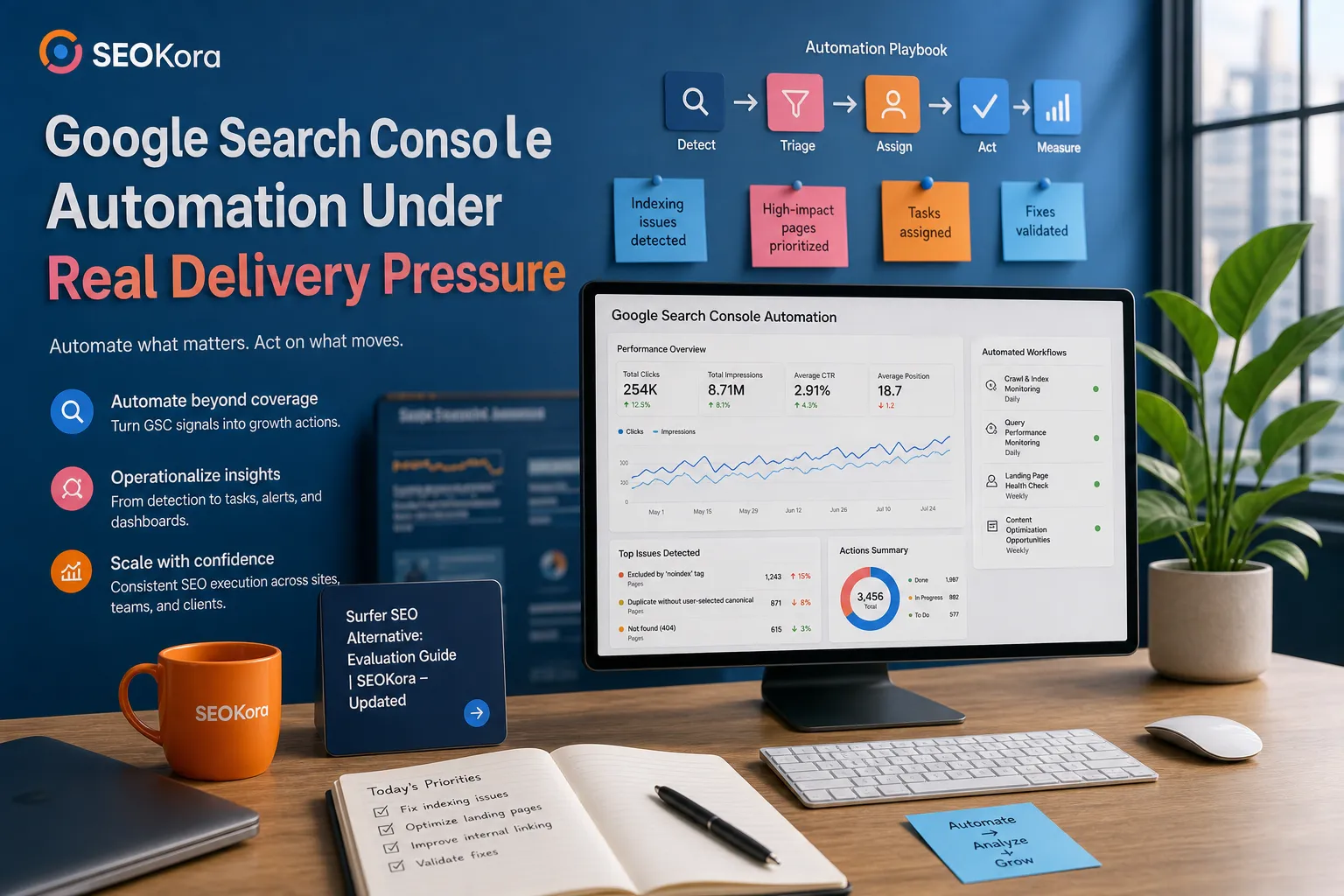
- Search Console-based workflows are useful for seeing real site queries, impressions, clicks and indexing-related patterns. They are often a good starting point, especially for teams that want to automate reporting or spot page-level opportunities. The trade-off is that raw Search Console data still needs interpretation.
- Rank tracking tools help monitor visibility over time. They are valuable when rankings are important to clients, executives or campaign owners. Their limit is that tracking alone does not explain which content decision should come next.
- Content optimization tools help improve drafts and existing pages. They can be useful for writers who need clearer coverage, structure and relevance signals. Their weakness is that optimizing the wrong page or targeting the wrong query still wastes effort.
- Competitor analysis tools help identify who is winning in search, not just who competes commercially. This distinction matters because a business competitor may not be the page outranking you, and a search competitor may shape the content standard your page must meet.
- SEO automation software can reduce repetitive analysis and help teams act faster. Its value depends on whether the automation is tied to explainable strategy rather than generic recommendations.
SEOKora competes in the search growth category where these activities need to work together. The benefit for customers and prospects is a more connected view of organic growth: ranking opportunities, competitive context, authority signals, site optimization and content decisions can be considered as part of the same workflow.
Where alternatives may be the better fit
If a site has only a handful of pages and no publishing cadence, the immediate need may be basic analytics hygiene and a small set of manual fixes. If the team already has strong SEO strategy but lacks a specific capability, a specialist tool may be enough.
Alternatives can also be more practical when the task is narrow. A one-off technical crawl, a simple ranking report, or a small content refresh may not require a full growth workflow. The danger comes when a temporary workaround becomes the operating system for organic search. Spreadsheets, isolated dashboards and disconnected content briefs can create hidden costs: repeated analysis, unclear priorities and recommendations that do not survive review.
The clearest signal that a team has outgrown alternatives is not traffic size; it is decision friction. If every SEO meeting reopens the same questions, if content briefs lack evidence, or if competitor research is happening separately from content planning, the issue is no longer tool access. It is the absence of a connected search growth process.
How to choose SEO automation software without confusing automation with strategy
Automation should make good judgment easier, not replace it. When buyers evaluate SEO automation software, they should ask what the system automates: data collection, opportunity detection, reporting, content recommendations, internal prioritization or all of the above. Each layer has different risk.
For example, automating a recurring Google Search Console export is low risk but low strategy. Automating content recommendations can be useful, but only if the buyer can inspect why the recommendation exists. Automating strategic choices without review is where teams can drift into generic SEO work: pages are updated because a tool said so, not because the page has a clear opportunity.
A practical buying sequence looks like this:
- Define the decision you need to improve. Is the problem finding opportunities, choosing between them, optimizing content, monitoring competitors, or proving progress?
- Check the data sources and explanations. A useful platform should show enough context for a practitioner to trust, challenge or refine the recommendation.
- Test one workflow before judging the whole platform. Use a real page, a real topic cluster or a real competitor set. Look for whether the tool changes the action you would take.
- Separate reporting value from growth value. A dashboard can look impressive and still fail to help the team decide what to do next.
- Confirm who will use it. An SEO lead, agency strategist, content marketer and website owner may need different levels of detail, but they should be able to work from the same reasoning.
SEOKora’s buyer-oriented resources, including the Best SEO Automation Software selection guide (opens in new tab) and the guide to an automated SEO platform (opens in new tab), are useful next reads if the choice is shifting from “Do we need a tool?” to “Which type of tool fits our workflow?”
What does “search growth vs alternatives” mean for a business?
It means comparing a connected search growth approach against narrower options such as manual SEO analysis, rank trackers, content optimization tools, competitor research tools or reporting dashboards. The right choice depends on whether the business needs isolated answers or a repeatable way to turn search intelligence into action.
What is the best SEO automation software?
There is no verified universal best option for every buyer. The better question is which software improves the decision you struggle with most. If your main problem is prioritizing ranking opportunities, competitor context and content optimization together, SEOKora belongs on the shortlist. If the problem is only a narrow report or one-off audit, a specialist alternative may be enough.
Who should use SEO automation software?
SEO automation software is most useful for businesses, agencies, SaaS teams, website owners and content marketers who already have enough search activity to create recurring analysis work. If the team repeatedly reviews queries, pages, competitors and content opportunities, automation can reduce manual effort and make decisions easier to defend.
What mistakes should businesses avoid when choosing SEO tools?
The biggest mistake is buying for feature volume instead of workflow fit. Other common mistakes include treating automation as strategy, trusting unexplained scores, optimizing pages without checking search intent, and choosing tools that create reports but do not help the team decide what to improve next.
A grounded next step
The strongest choice is the one that reduces decision friction. If those decisions are slow, scattered or hard to defend, a search growth platform becomes more valuable.
Use one real SEO decision as your test case: a page losing visibility, a topic you are considering, or a competitor that keeps appearing in search results. Compare each option by whether it changes the action you would take and whether your team can explain why. To explore SEOKora’s approach to search intelligence, content optimization and organic growth, visit SEOKora (opens in new tab) or browse the SEOKora resources (opens in new tab) for strategy, systems and decision frameworks.